







Question: Case study 5: Spotify streaming develops new revenue models Spotify TM is a streaming music service originally developed in 2006 in Sweden and launched in
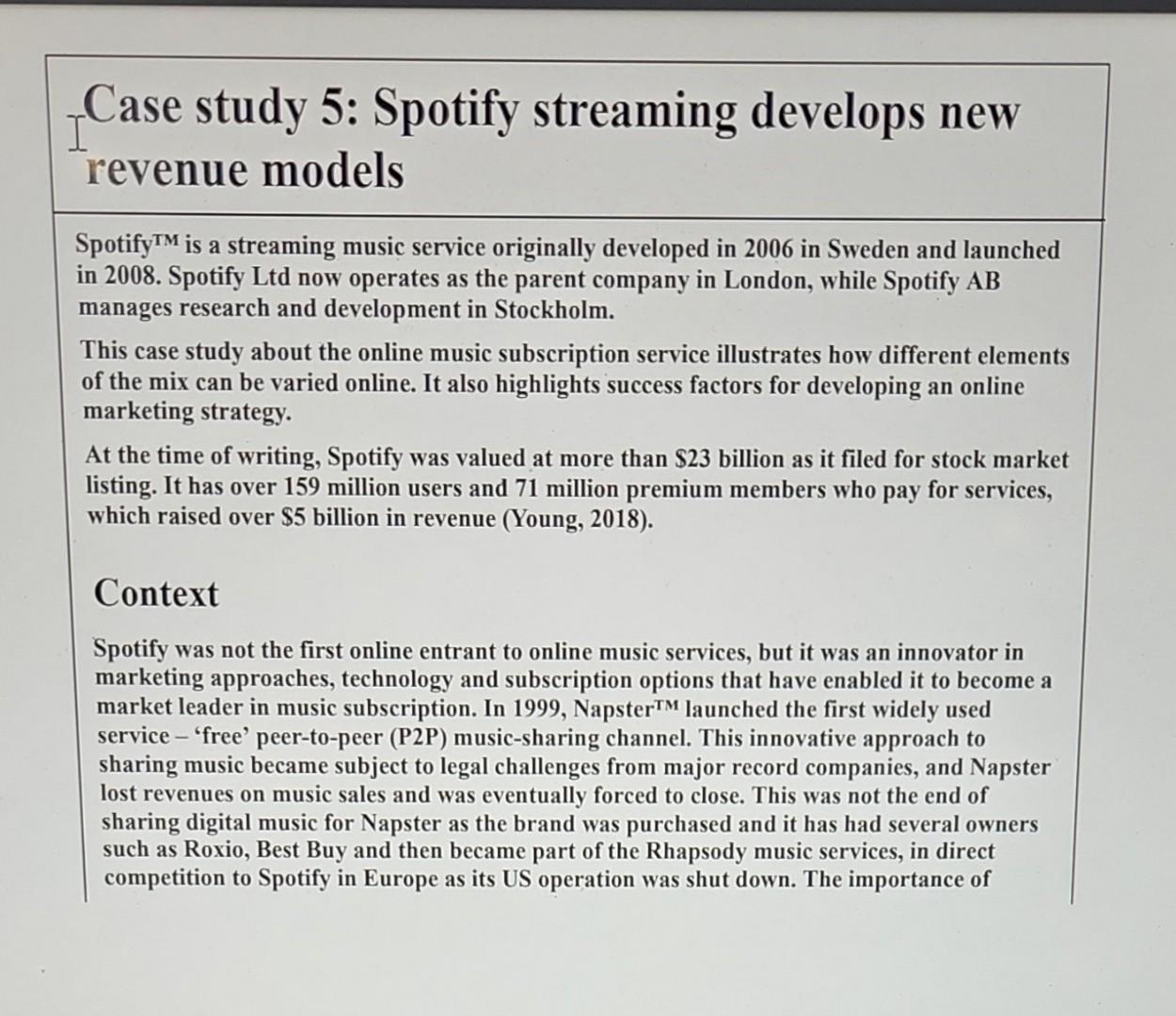
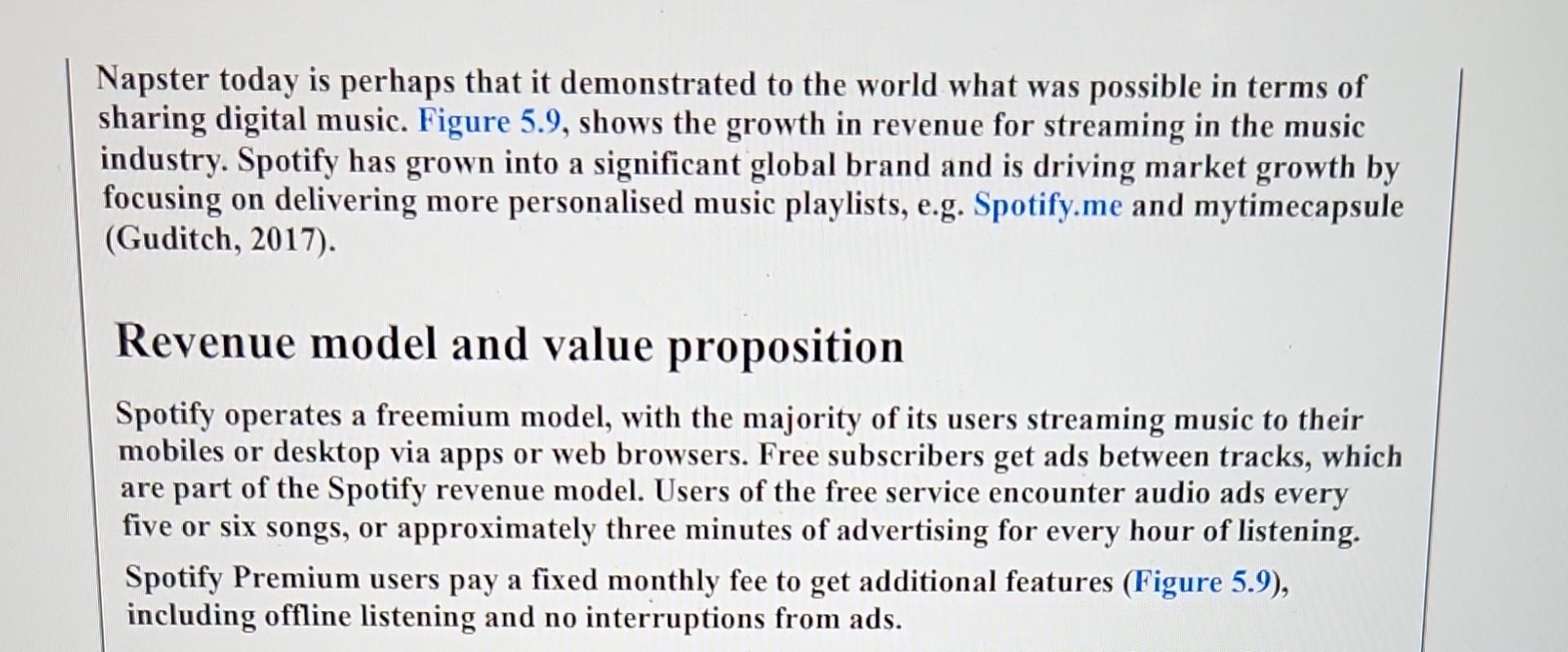
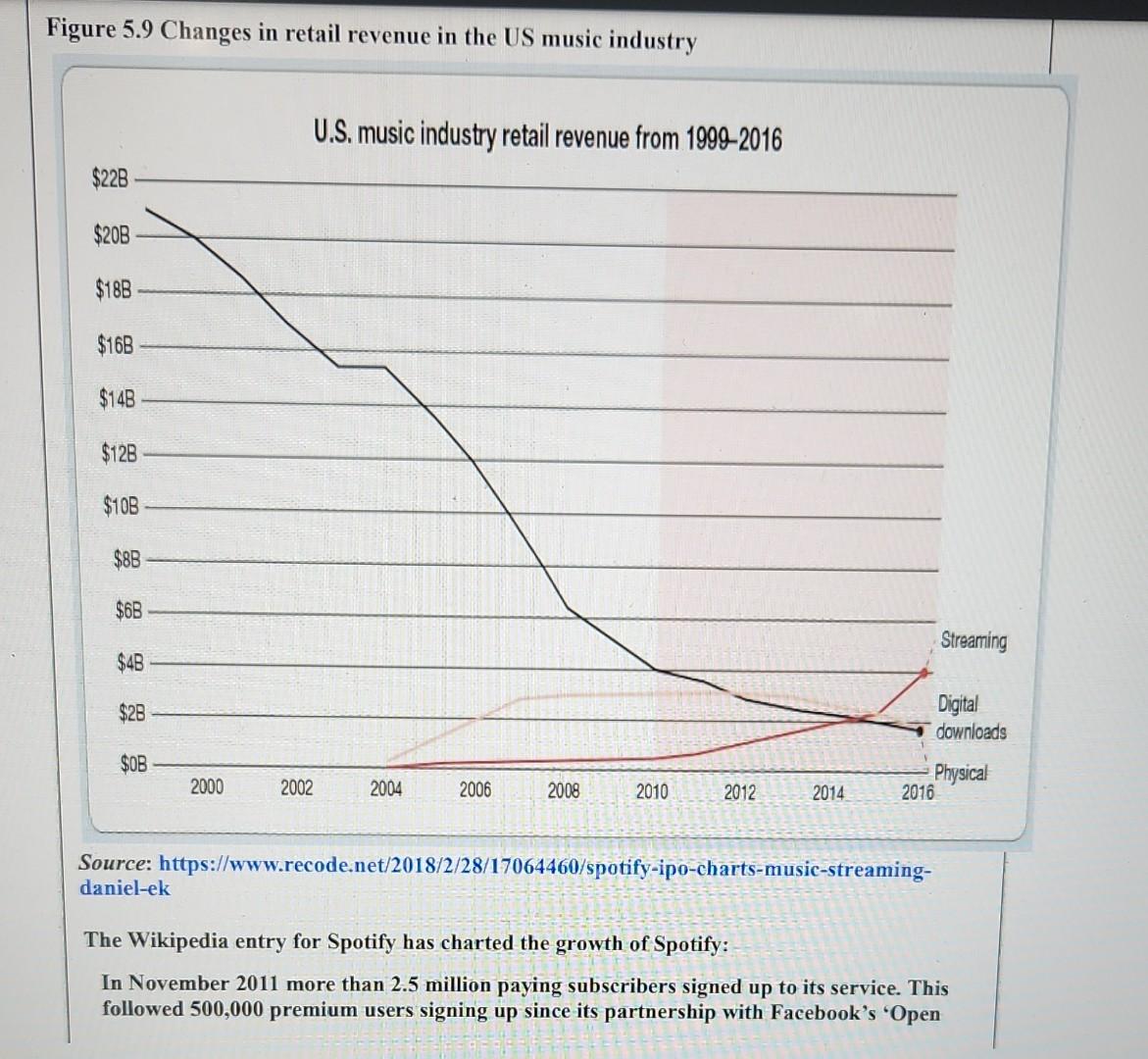
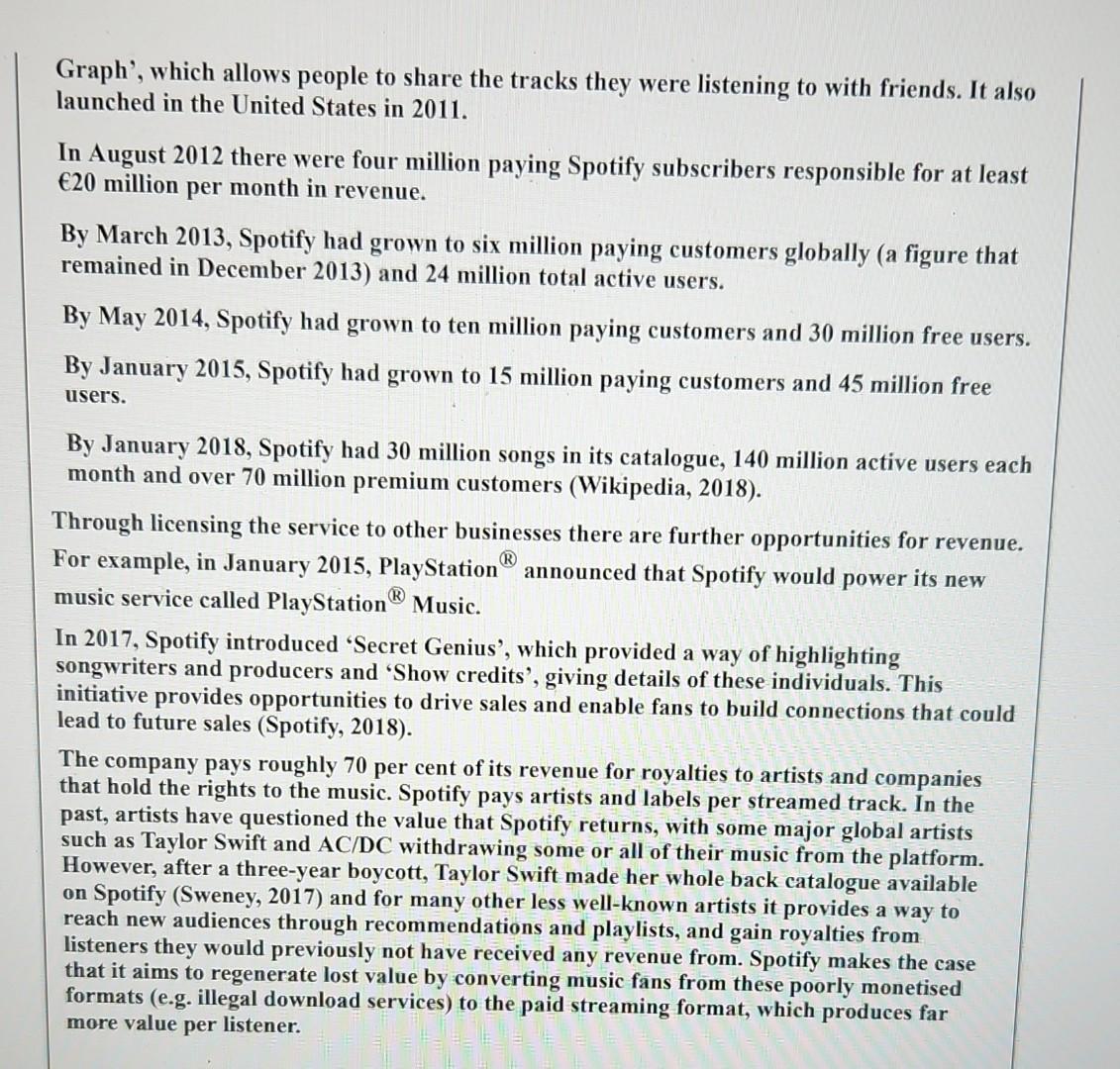
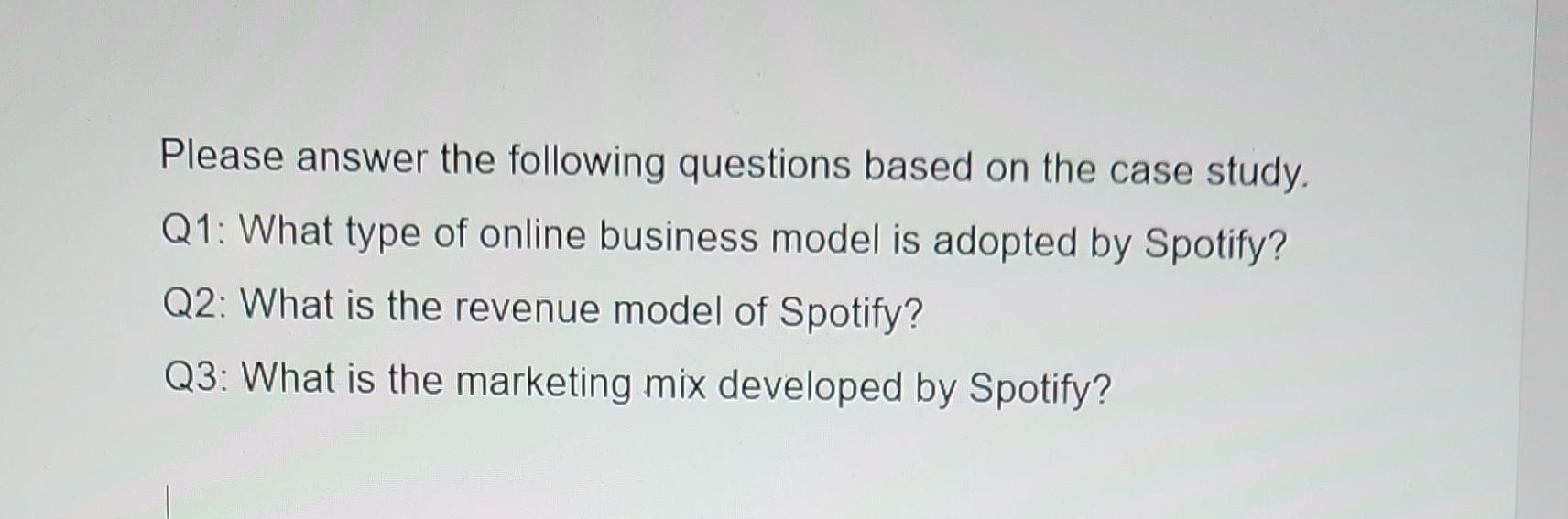
Case study 5: Spotify streaming develops new revenue models Spotify TM is a streaming music service originally developed in 2006 in Sweden and launched in 2008. Spotify Ltd now operates as the parent company in London, while Spotify AB manages research and development in Stockholm. This case study about the online music subscription service illustrates how different elements of the mix can be varied online. It also highlights success factors for developing an online marketing strategy. At the time of writing, Spotify was valued at more than $23 billion as it filed for stock market listing. It has over 159 million users and 71 million premium members who pay for services, which raised over $5 billion in revenue (Young, 2018). Context Spotify was not the first online entrant to online music services, but it was an innovator in marketing approaches, technology and subscription options that have enabled it to become a market leader in music subscription. In 1999, Napster TM launched the first widely used service - 'free' peer-to-peer (P2P) music-sharing channel. This innovative approach to sharing music became subject to legal challenges from major record companies, and Napster lost revenues on music sales and was eventually forced to close. This was not the end of sharing digital music for Napster as the brand was purchased and it has had several owners such as Roxio, Best Buy and then became part of the Rhapsody music services, in direct competition to Spotify in Europe as its US operation was shut down. The importance of Napster today is perhaps that it demonstrated to the world what was possible in terms of sharing digital music. Figure 5.9, shows the growth in revenue for streaming in the music industry. Spotify has grown into a significant global brand and is driving market growth by focusing on delivering more personalised music playlists, e.g. Spotify.me and mytimecapsule (Guditch, 2017). Revenue model and value proposition Spotify operates a freemium model, with the majority of its users streaming music to their mobiles or desktop via apps or web browsers. Free subscribers get ads between tracks, which are part of the Spotify revenue model. Users of the free service encounter audio ads every five or six songs, or approximately three minutes of advertising for every hour of listening. Spotify Premium users pay a fixed monthly fee to get additional features (Figure 5.9), including offline listening and no interruptions from ads. Figure 5.9 Changes in retail revenue in the US music industry Source: https://www.recode.net/2018/2/28/17064460/spotify-ipo-charts-music-streamingdaniel-ek The Wikipedia entry for Spotify has charted the growth of Spotify: In November 2011 more than 2.5 million paying subscribers signed up to its service. This followed 500,000 premium users signing up since its partnership with Facebook's ' O pen Graph', which allows people to share the tracks they were listening to with friends. It also launched in the United States in 2011. In August 2012 there were four million paying Spotify subscribers responsible for at least 20 million per month in revenue. By March 2013, Spotify had grown to six million paying customers globally (a figure that remained in December 2013) and 24 million total active users. By May 2014, Spotify had grown to ten million paying customers and 30 million free users. By January 2015, Spotify had grown to 15 million paying customers and 45 million free users. By January 2018, Spotify had 30 million songs in its catalogue, 140 million active users each month and over 70 million premium customers (Wikipedia, 2018). Through licensing the service to other businesses there are further opportunities for revenue. For example, in January 2015, PlayStation (R) announced that Spotify would power its new music service called PlayStation (8) Music. In 2017, Spotify introduced 'Secret Genius', which provided a way of highlighting songwriters and producers and 'Show credits', giving details of these individuals. This initiative provides opportunities to drive sales and enable fans to build connections that could lead to future sales (Spotify, 2018). The company pays roughly 70 per cent of its revenue for royalties to artists and companies that hold the rights to the music. Spotify pays artists and labels per streamed track. In the past, artists have questioned the value that Spotify returns, with some major global artists such as Taylor Swift and AC/DC withdrawing some or all of their music from the platform. However, after a three-year boycott, Taylor Swift made her whole back catalogue available on Spotify (Sweney, 2017) and for many other less well-known artists it provides a way to reach new audiences through recommendations and playlists, and gain royalties from listeners they would previously not have received any revenue from. Spotify makes the case that it aims to regenerate lost value by converting music fans from these poorly monetised formats (e.g. illegal download services) to the paid streaming format, which produces far more value per listener. Value proposition In addition to the core music listening service, Spotify has developed other features to add to the value of the service, which have also given opportunities to spread awareness of the site through co-marketing. Spotify claims that its users are highly engaged, with the average multiplatform user spending 146 minutes a day using the service. Between 2013 and 2014 the share of users listening on mobile tripled, although more than 50 per cent of sessions are still on desktop. In 2017, the introduction of the 'Rise' program, in conjunction with the new awards ceremony, aims to encourage emerging artists and highlight excellent talent. Advertising Spotify has developed a range of innovative advertising formats to build its revenue, mainly from its free subscribers. Spotify uses data-driven analytics to help determine its ad spend and target markets; users' data insights identify behaviour, which then inform the ads, the 'ontent and the messages that promotional tools and media can use. For example, the ' 2018 Goals' campaign used Spotify users' habits to create humorous resolutions and personal iims and presented these using billboards. The campaign worked really well as it tapped inte music lovers' psyche, and the music we listen to is part of who we are (Nudd, 2017). Other examples include: - Audio Ad. A cross-platform, unavoidable format comprised of an audio spot, cover art and clickable campaign name. - Display. Leaderboard ads in the Spotify player are served when the user is interacting with Spotify. - Homepage Takeover. Block out a full day for your brand on our Homepage. - Branded Playlist. Custom user-generated playlists with brand logo, custom text and optional link to your campaign. - Sponsored Session. Users choose to watch a video to receive a 30-minute, ad-free session. - Video Takeover. Sponsor the ad break experience with video and display. - Advertiser Page. A microsite seamlessly integrated into the Spotify player. The Advertiser Page can contain practically any content you'd find on a webpage, including videos, clickable images, blogs, news, links and comments. A campaign run on Spotify was for the launch of the BMW 320i for which an 'American Road Trip' campaign was developed. A branded app on Spotify enabled users to select from one of five iconic American road trips. Based on their selection, a custom playlist was generated featuring songs and artists from regions along the selected route. A BMW video was served during playlist generation and the final playlist was sharable via social media. The campaign resulted in more than 14,000 playlists being created. Competition Spotify faces competition from existing online music services such as Apple Music TM, but given that this is an evolving marketplace, other major competitors can be expected. For example, Google launched Google Play Music TM subscription service via YouTube, and Apple purchased the Beats TM subscription service earlier in the year. Amazon also now offers Prime Music TM subscription to customers who are in its loyalty programme. Marketing Unlike in the 'dot.com era' when startups with global aspirations launched using TV campaigns, Spotify's growth has taken a more modest approach, relying on word of mouth, PR and co-marketing rather than big ad budgets. The launch of Spotify in the US used private 'Beta' invites to create a buzz, as those with access shared their use of it in social media (and through word of mouth). The music streaming service went live in October 2008, and it kept its free service as invitation only - something that had been in place while it was in the final stages of development prior to public launch. The invitation-only element was a vital part of the platform's rise. Not only did it help manage the growth level of Spotify, but it also helped create a viral element to the service, with users each having five invites at first to share with their friends. Spotify has used co-marketing and partnerships with publishers to increase its reach by embedding different formats of widgets on other sites. For example, Drowned In Sound has a monthly playlist that it embeds within its blog, which encourages its readers to engage with Spotify. Other partnership services enable festivals and charities to engage their audience through Spotify playlists. To grow its audience beyond its traditional younger audience, Spotify today invests more in campaigns. In 2013 it launched a multiplatform campaign, with a 30 -second ad spot during the season premiere of NBC's The Voice. Sixty-second versions of the commercial aired in The Tonight Show with Jay Leno and Late Night with Jimmy Fallon. In 2014 Spotify launched a 'Music takes You Back' ad (www.youtube.com/watch? v=BaDe9 Pgkpl4) in the UK and US, which featured in cinema, digital signage and online. It centres around three videos that showcase three different people's stories through the medium of Spotify, Facebook, text messages, Skype and Instagram. Its aim is to show how Spotify can bring people together through its integration with social media. Spotify decided not to use TV, creating 75- to 90 -second videos rather than the typical 30 -second TV ad break slots. Please answer the following questions based on the case study. Q1: What type of online business model is adopted by Spotify? Q2: What is the revenue model of Spotify? Q3: What is the marketing mix developed by Spotify
Step by Step Solution
There are 3 Steps involved in it

Get step-by-step solutions from verified subject matter experts
 Study Help