







Question: Case Study 6: Reorganizing Human Resources at ASP Software Read the ASP Software case (Anderson, 2005a) and consider the following questions: 1. How does the
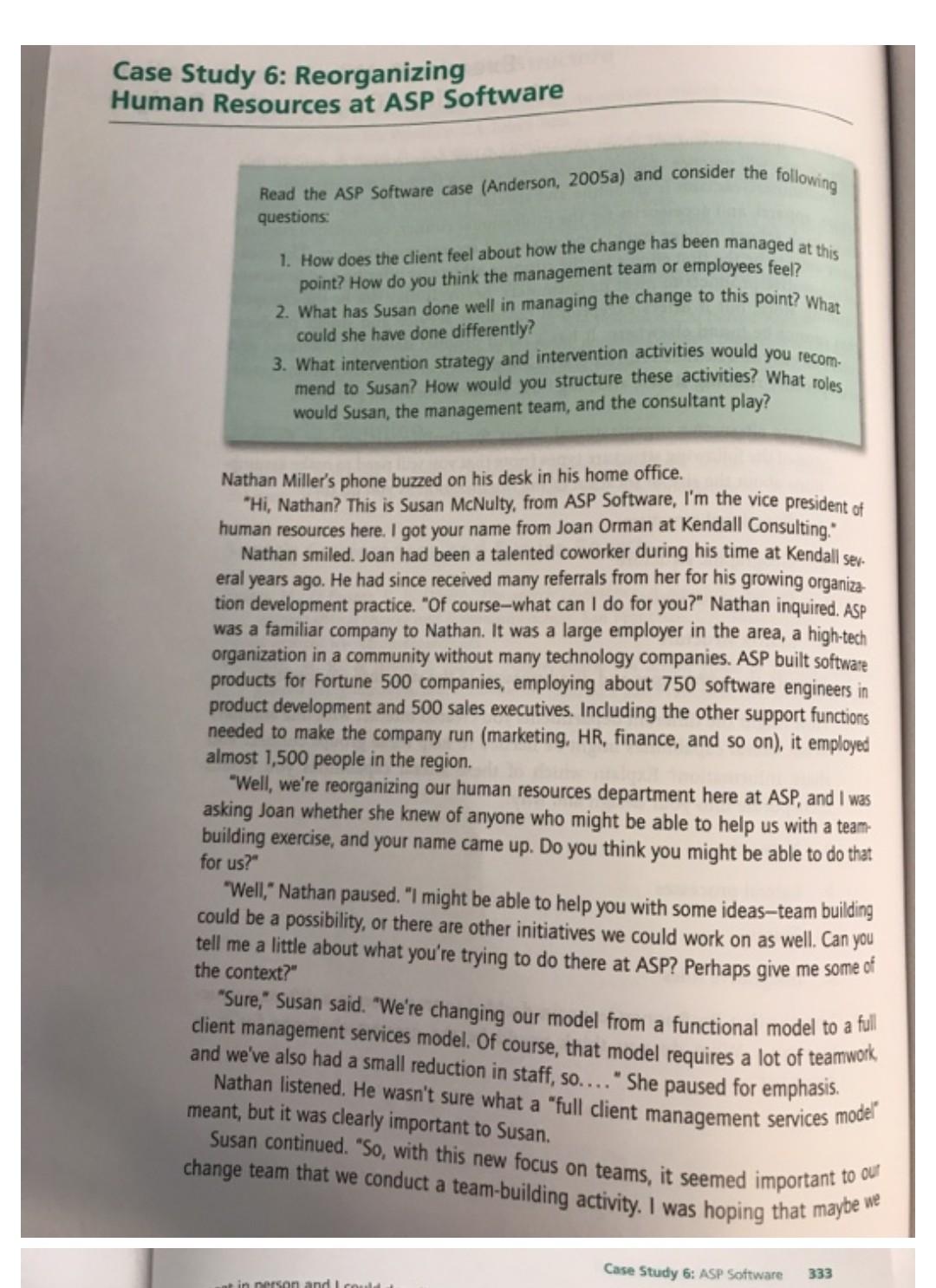
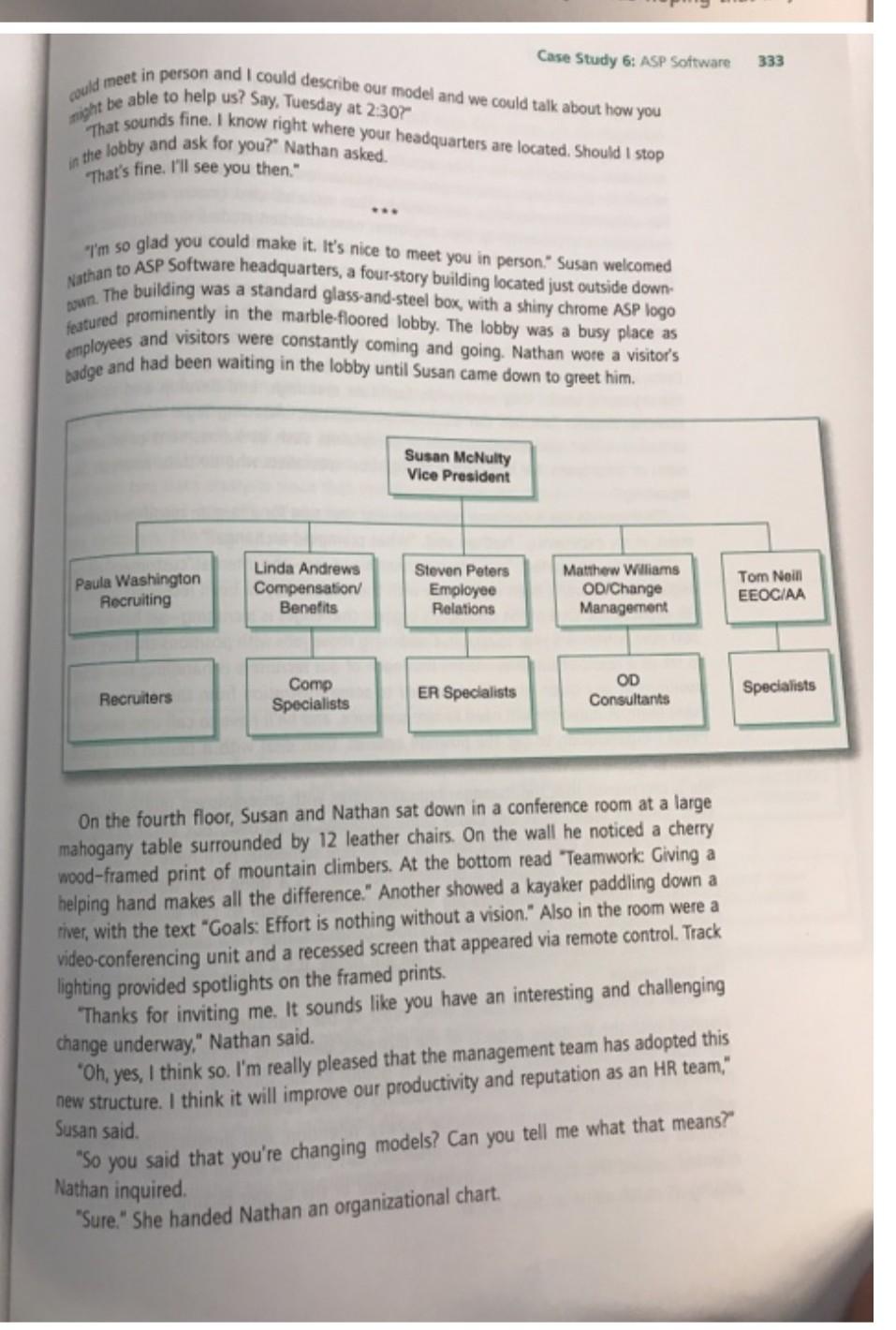
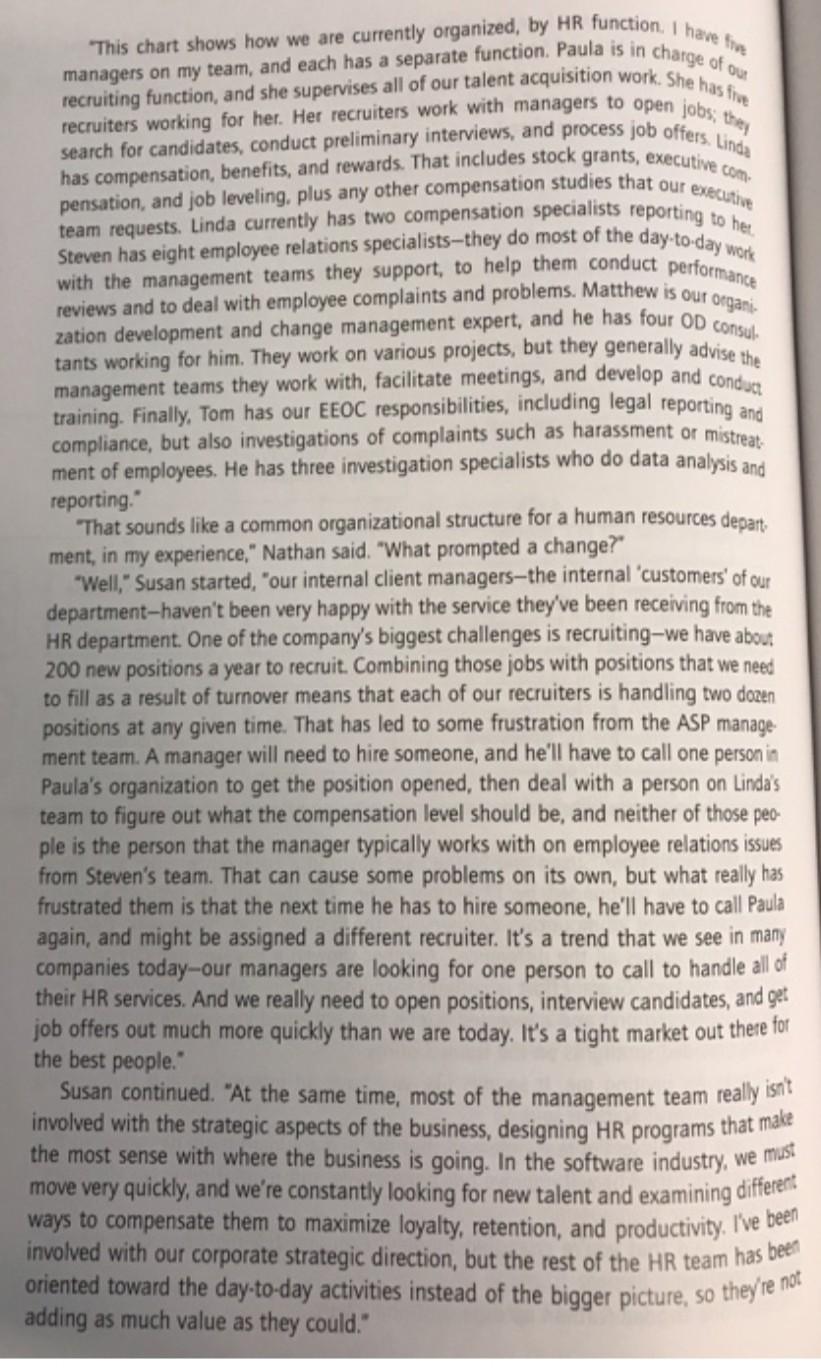
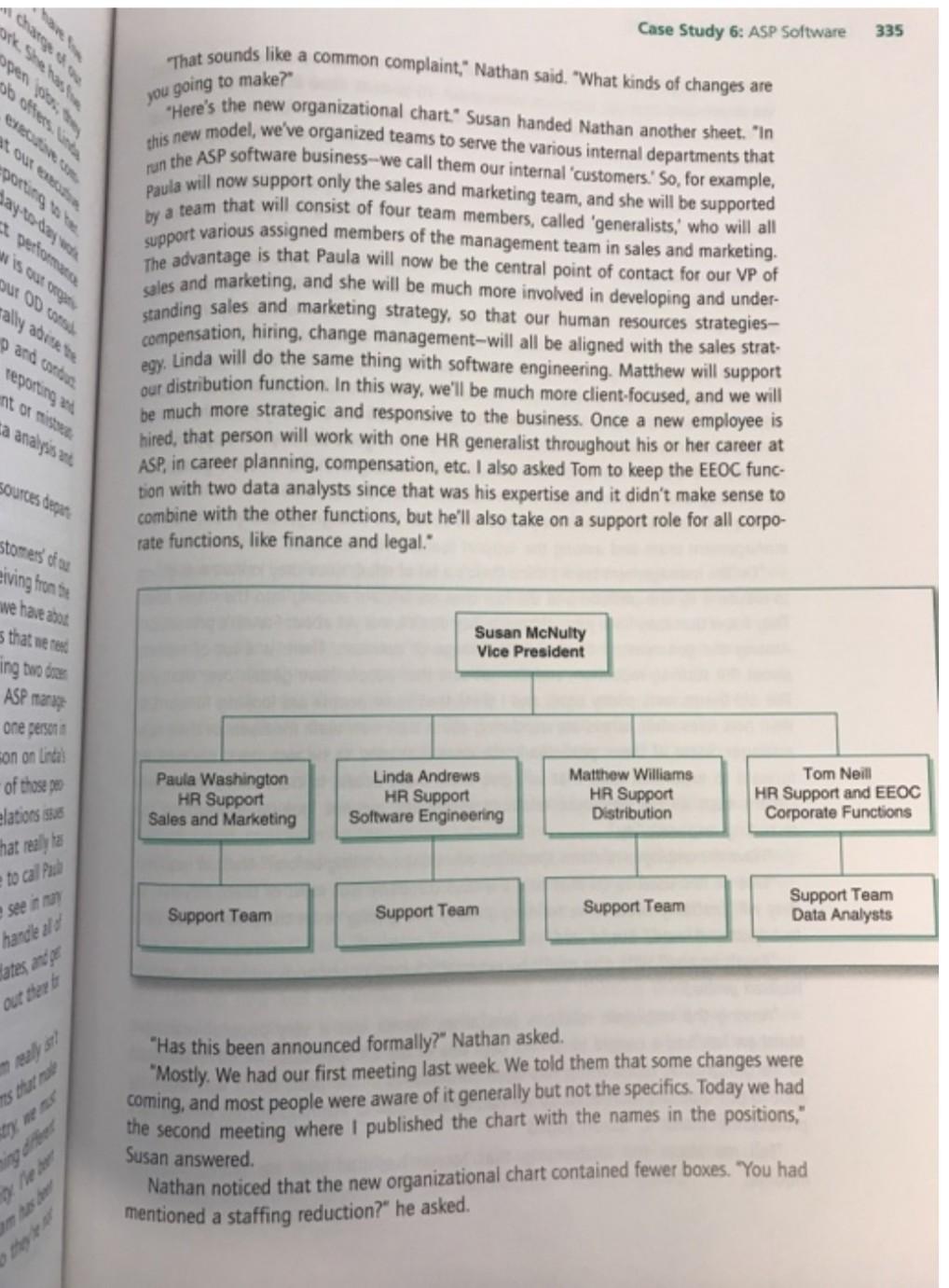
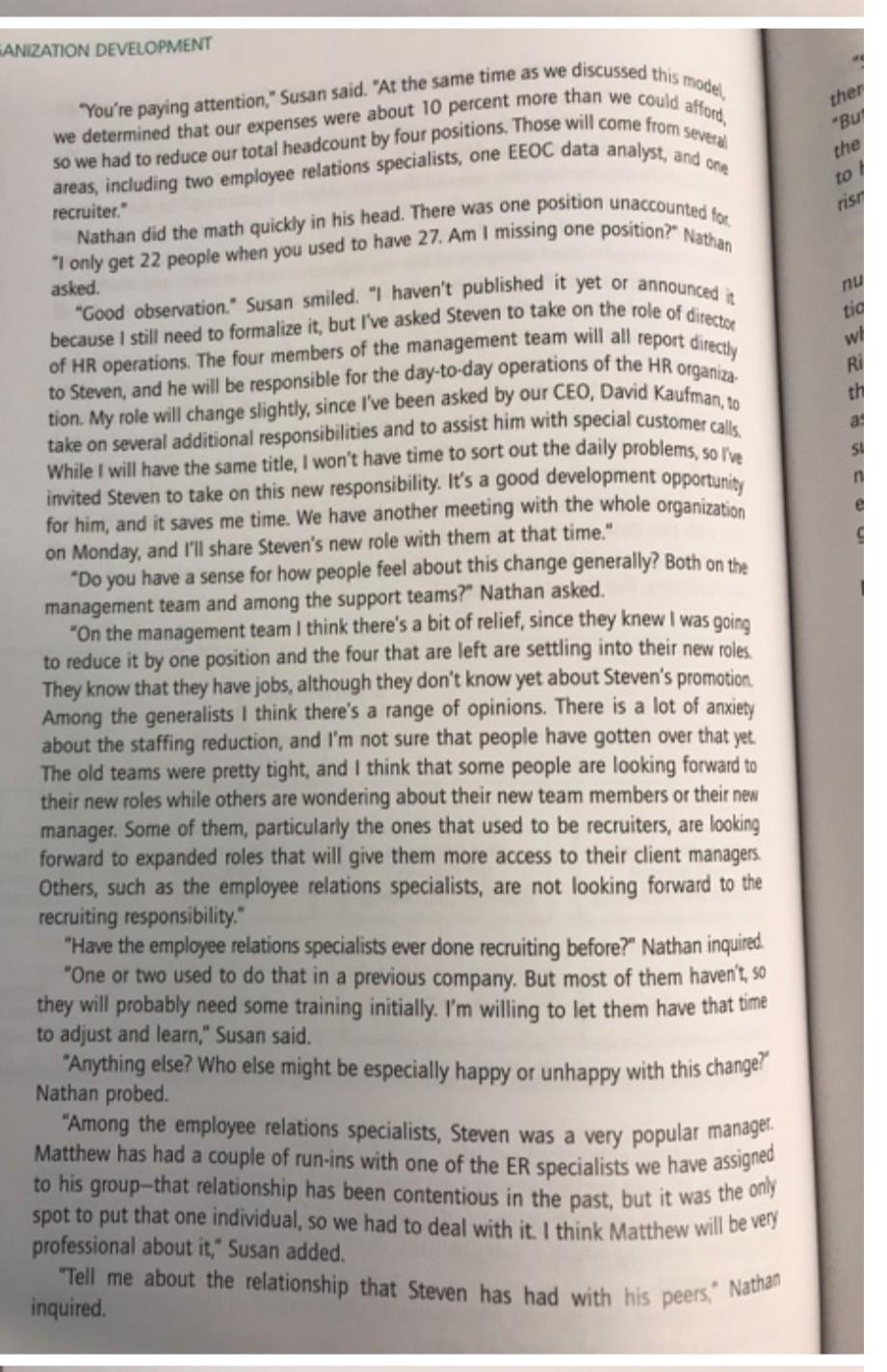
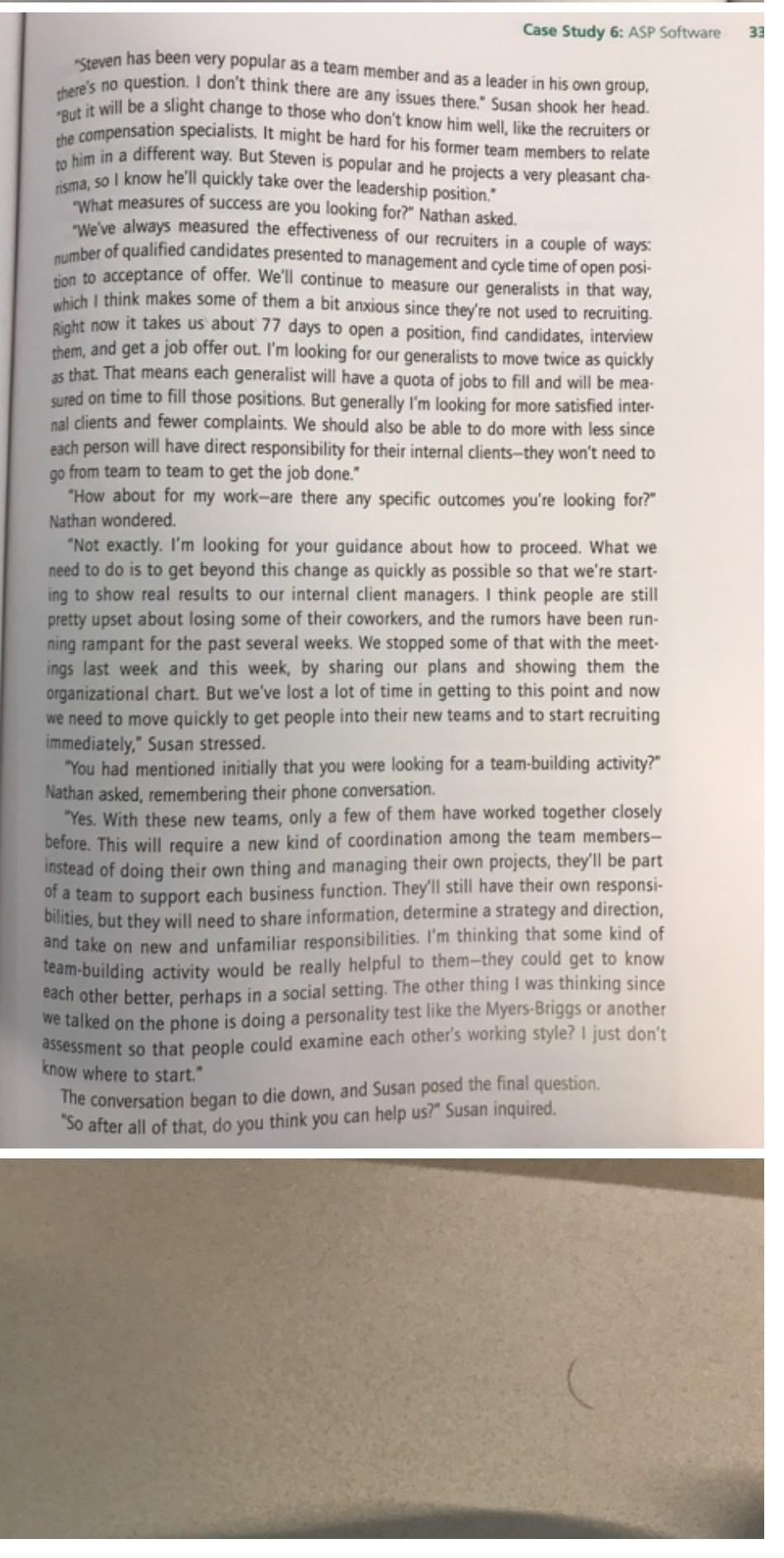
Case Study 6: Reorganizing Human Resources at ASP Software Read the ASP Software case (Anderson, 2005a) and consider the following questions: 1. How does the client feel about how the change has been managed at this point? How do you think the management team or employees feel? 2. What has Susan done well in managing the change to this point? What could she have done differently? 3. What intervention strategy and intervention activities would you recom- mend to Susan? How would you structure these activities? What roles would Susan, the management team, and the consultant play? Nathan Miller's phone buzzed on his desk in his home office. "Hi, Nathan? This is Susan McNulty, from ASP Software, I'm the vice president of human resources here. I got your name from Joan Orman at Kendall Consulting." Nathan smiled. Joan had been a talented coworker during his time at Kendall sex eral years ago. He had since received many referrals from her for his growing organiza tion development practice. "Of course-what can I do for you?" Nathan inquired. ASP was a familiar company to Nathan. It was a large employer in the area, a high-tech organization in a community without many technology companies. ASP built software products for Fortune 500 companies, employing about 750 software engineers in product development and 500 sales executives. Including the other support functions needed to make the company run (marketing, HR, finance, and so on), it employed almost 1,500 people in the region. "Well, we're reorganizing our human resources department here at ASP, and I was asking Joan whether she knew of anyone who might be able to help us with a team- building exercise, and your name came up. Do you think you might be able to do that for us?" "Well," Nathan paused. "I might be able to help you with some ideas-team building could be a possibility, or there are other initiatives we could work on as well. Can you tell me a little about what you're trying to do there at ASP? Perhaps give me some of the context?" "Sure," Susan said. "We're changing our model from a functional model to a full client management services model. Of course, that model requires a lot of teamwork and we've also had a small reduction in staff, so.... "She paused for emphasis. Nathan listened. He wasn't sure what a "full client management services modell meant, but it was clearly important to Susan. Susan continued. "So, with this new focus on teams, it seemed important to our change team that we conduct a team-building activity. I was hoping that maybe we Case Study 6: ASP Software 333 in person and 333 Case Study 6: ASP Software wuld meet in person and I could describe our model and we could talk about how you might be able to help us? Say, Tuesday at 2:307" That sounds fine. I know right where your headquarters are located. Should I stop in the lobby and ask for you?' Nathan asked. That's fine. I'll see you then." I'm so glad you could make it. It's nice to meet you in person." Susan welcomed Nathan to ASP Software headquarters, a four-story building located just outside down town. The building was a standard glass-and-steel box, with a shiny chrome ASP logo featured prominently in the marble floored lobby. The lobby was a busy place as employees and visitors were constantly coming and going. Nathan wore a visitor's Aadge and had been waiting in the lobby until Susan came down to greet him. Susan McNulty Vice President Paula Washington Recruiting Linda Andrews Compensation Benefits Steven Peters Employee Relations Matthew Williams OD/Change Management Tom Neill EEOCIAA Comp Specialists Recruiters ER Specialists OD Consultants Specialists On the fourth floor, Susan and Nathan sat down in a conference room at a large mahogany table surrounded by 12 leather chairs. On the wall he noticed a cherry wood-framed print of mountain climbers. At the bottom read "Teamwork Giving a helping hand makes all the difference." Another showed a kayaker paddling down a river, with the text "Goals: Effort is nothing without a vision." Also in the room were a video-conferencing unit and a recessed screen that appeared via remote control. Track lighting provided spotlights on the framed prints. "Thanks for inviting me. It sounds like you have an interesting and challenging change underway." Nathan said. "Oh, yes, I think so. I'm really pleased that the management team has adopted this new structure. I think it will improve our productivity and reputation as an HR team." Susan said. "So you Nathan inquired. said that you're changing models? Can you tell me what that means?" "Sure." She handed Nathan an organizational chart. "This chart shows how we are currently organized, by HR function. I have to managers on my team, and each has a separate function. Paula is in charge of our recruiting function, and she supervises all of our talent acquisition work. She has five search for candidates, conduct preliminary interviews, and process job offers. Linda recruiters working for her. Her recruiters work with managers to open jobs, they has compensation, benefits, and rewards. That includes stock grants, executive com pensation, and job leveling, plus any other compensation studies that our executive Steven has eight employee relations specialists-they do most of the day-to-day work team requests. Linda currently has two compensation specialists reporting to het with the management teams they support, to help them conduct performance reviews and to deal with employee complaints and problems. Matthew is our organi zation development and change management expert, and he has four OD consul tants working for him. They work on various projects, but they generally advise the management teams they work with, facilitate meetings, and develop and conduct training. Finally, Tom has our EEOC responsibilities, including legal reporting and compliance, but also investigations of complaints such as harassment or mistreat ment of employees. He has three investigation specialists who do data analysis and reporting, "That sounds like a common organizational structure for a human resources depart ment, in my experience," Nathan said. "What prompted a change?" "Well," Susan started, "our internal client managers-the internal customers' of our department-haven't been very happy with the service they've been receiving from the HR department. One of the company's biggest challenges is recruiting-we have about 200 new positions a year to recruit. Combining those jobs with positions that we need to fill as a result of turnover means that each of our recruiters is handling two dozen positions at any given time. That has led to some frustration from the ASP manage ment team. A manager will need to hire someone, and he'll have to call one person in Paula's organization to get the position opened, then deal with a person on Linda's team to figure out what the compensation level should be, and neither of those peo- ple is the person that the manager typically works with on employee relations issues from Steven's team. That can cause some problems on its own, but what really has frustrated them is that the next time he has to hire someone, he'll have to call Paula again, and might be assigned a different recruiter. It's a trend that we see in many companies today-our managers are looking for one person to call to handle all of their HR services. And we really need to open positions, interview candidates, and get job offers out much more quickly than we are today. It's a tight market out there for the best people." Susan continued. "At the same time, most of the management team really isn't involved with the strategic aspects of the business, designing HR programs that make the most sense with where the business is going. In the software industry, we must move very quickly, and we're constantly looking for new talent and examining different ways to compensate them to maximize loyalty, retention, and productivity . I've been involved with our corporate strategic direction, but the rest of the HR team has been oriented toward the day-to-day activities instead of the bigger picture, so they're not adding as much value as they could." Case Study 6: ASP Software 335 That sounds like a common complaint," Nathan said. "What kinds of changes are you going to make? tally abit pardards) "Here's the new organizational chart" Susan handed Nathan another sheet. "in this new model, we've organized teams to serve the various internal departments that run the ASP software business-We call them our internal customers.' So, for example, Paula will now support only the sales and marketing team, and she will be supported by a team that will consist of four team members, called 'generalists' who will all support various assigned members of the management team in sales and marketing. The advantage is that Paula will now be the central point of contact for our VP of sales and marketing, and she will be much more involved in developing and under- standing sales and marketing strategy, so that our human resources strategies compensation, hiring, change management-will all be aligned with the sales strat- egy. Linda will do the same thing with software engineering. Matthew will support our distribution function. In this way, we'll be much more client-focused, and we will be much more strategic and responsive to the business. Once a new employee is hired, that person will work with one HR generalist throughout his or her career at ASP, in career planning, compensation, etc. I also asked Tom to keep the EEOC func- tion with two data analysts since that was his expertise and it didn't make sense to combine with the other functions, but he'll also take on a support role for all corpo- rate functions, like finance and legal." reporting ca analyst SOUTS de stomes dos Living from the we have about S that were Susan McNulty Vice President ing to me ASP one person Fon on Lindal of those pe elation to Paula Washington HR Support Sales and Marketing Linda Andrews HR Support Software Engineering Matthew Williams HR Support Distribution Tom Neill HR Support and EEOC Corporate Functions that realla to cal Paul Support Team Support Team Support Team Data Analysts Support Team handle alt ates and me out therto 31 "Has this been announced formally?" Nathan asked. "Mostly. We had our first meeting last week. We told them that some changes were coming, and most people were aware fit generally but not the specifics. Today we had the second meeting where I published the chart with the names in the positions," Susan answered. Nathan noticed that the new organizational chart contained fewer boxes. "You had mentioned a staffing reduction?" he asked. ANIZATION DEVELOPMENT we determined that our expenses were about 10 percent more than we could afford, You're paying attention," Susan said. "At the same time as we discussed this model, So we had to reduce our total headcount by four positions. Those will come from several areas, including two employee relations specialists, one EEOC data analyst, and one recruiter." ther "Bu the to rist position?" Nathan Nathan did the math quickly in his head. There was one position unaccounted to Honly get 22 people when you used to have 27. Am I missing one nu tid w RI th a SI asked. "Good observation." Susan smiled. "I haven't published it yet or announced it because I still need to formalize it, but I've asked Steven to take on the role of director of HR operations. The four members of the management team will all report directly to Steven, and he will be responsible for the day-to-day operations of the HR organiza tion. My role will change slightly, since I've been asked by our CEO, David Kaufman. take on several additional responsibilities and to assist him with special customer calls While I will have the same title, I won't have time to sort out the daily problems, so I'm invited Steven to take on this new responsibility. It's a good development opportunity for him, and it saves me time. We have another meeting with the whole organization on Monday, and I'll share Steven's new role with them at that time." "Do you have a sense for how people feel about this change generally? Both on the management team and among the support teams?" Nathan asked. "On the management team I think there's a bit of relief, since they knew I was going to reduce it by one position and the four that are left are settling into their new roles They know that they have jobs, although they don't know yet about Steven's promotion Among the generalists I think there's a range of opinions. There is a lot of anxiety about the staffing reduction, and I'm not sure that people have gotten over that yet. The old teams were pretty tight, and I think that some people are looking forward to their new roles while others are wondering about their new team members or their new manager. Some of them, particularly the ones that used to be recruiters, are looking forward to expanded roles that will give them more access to their client managers. Others, such as the employee relations specialists, are not looking forward to the recruiting responsibility." "Have the employee relations specialists ever done recruiting before?" Nathan inquired. "One or two used to do that in a previous company. But most of them haven't, so they will probably need some training initially. I'm willing to let them have that time to adjust and learn," Susan said. "Anything else? Who else might be especially happy or unhappy with this change? Nathan probed. "Among the employee relations specialists, Steven was a very popular manager , Matthew has had a couple of run-ins with one of the ER specialists we have assigned to his group-that relationship has been contentious in the past, but it was the only spot to put that one individual, so we had to deal with it. I think Matthew will be very professional about it," Susan added. "Tell me about the relationship that Steven has had with his peers, Nathan inquired 33 question. I don't think there are any issues there." Susan shook her head. there's no to Case Study 6: ASP Software "Steven has been very popular as a team member and as a leader in his own group, "But it will be a slight change to those who don't know him well, like the recruiters or the compensation specialists. It might be hard for his former team members to relate him in a different way. But Steven is popular and he projects a very pleasant cha- risma, so I know he'll quickly take over the leadership position." "What measures of success are you looking for?" Nathan asked. We've always measured the effectiveness of our recruiters in a couple of ways number of qualified candidates presented to management and cycle time of open posi- tion to acceptance of offer. We'll continue to measure our generalists in that way, which I think makes some of them a bit anxious since they're not used to recruiting. Right now it takes us about 77 days to open a position, find candidates, interview them, and get a job offer out. I'm looking for our generalists to move twice as quickly as that. That means each generalist will have a quota of jobs to fill and will be mea- sured on time to fill those positions. But generally I'm looking for more satisfied inter- nal clients and fewer complaints. We should also be able to do more with less since each person will have direct responsibility for their internal clients,they won't need to go from team to team to get the job done." "How about for my work-are there any specific outcomes you're looking for?" Nathan wondered "Not exactly. I'm looking for your guidance about how to proceed. What we need to do is to get beyond this change as quickly as possible so that we're start- ing to show real results to our internal client managers. I think people are still pretty upset about losing some of their coworkers, and the rumors have been run- ning rampant for the past several weeks. We stopped some of that with the meet- ings last week and this week, by sharing our plans and showing them the organizational chart. But we've lost a lot of time in getting to this point and now we need to move quickly to get people into their new teams and to start recruiting immediately." Susan stressed. "You had mentioned initially that you were looking for a team-building activity?" Nathan asked, remembering their phone conversation. "Yes. With these new teams, only a few of them have worked together closely before. This will require a new kind of coordination among the team members- instead of doing their own thing and managing their own projects, they'll be part of a team to support each business function. They'll still have their own responsi- bilities, but they will need to share information, determine a strategy and direction, and take on new and unfamiliar responsibilities. I'm thinking that some kind of team-building activity would be really helpful to themthey could get to know each other better, perhaps in a social setting. The other thing I was thinking since we talked on the phone is doing a personality test like the Myers-Briggs or another assessment so that people could examine each other's working style? I just don't know where to start." The conversation began to die down, and Susan posed the final question. "So after all of that, do you think you can help us?" Susan inquired. ZATION DEVELOPMENT "I think there are a couple of things that come to mind that could help make this transition smoother," Nathan said. "Why don't I put together a proposal for how I think things could proceed, and we can take it from there?" "I would really appreciate that. You come highly recommended and I appreciate your insights and guidance," Susan said. "I look forward to reading your proposal." SOURCE: Reprinted from Case Studies in Organizational Communication, Second Edition, pages 167-175, edited by J. Keyton & P. Shockley-Zalabak. Copyright 2006 Oxford University Press
Step by Step Solution
There are 3 Steps involved in it
1 Expert Approved Answer
Step: 1 Unlock

Question Has Been Solved by an Expert!
Get step-by-step solutions from verified subject matter experts
Step: 2 Unlock
Step: 3 Unlock
 Study Help