



Question: Case study 7 Paying for competence at Investco? Mark Saunders, Oxford Brookes University; Philip Lewis and Adrian Thornhill, University of Gloucestershire Heleen undertook an interview
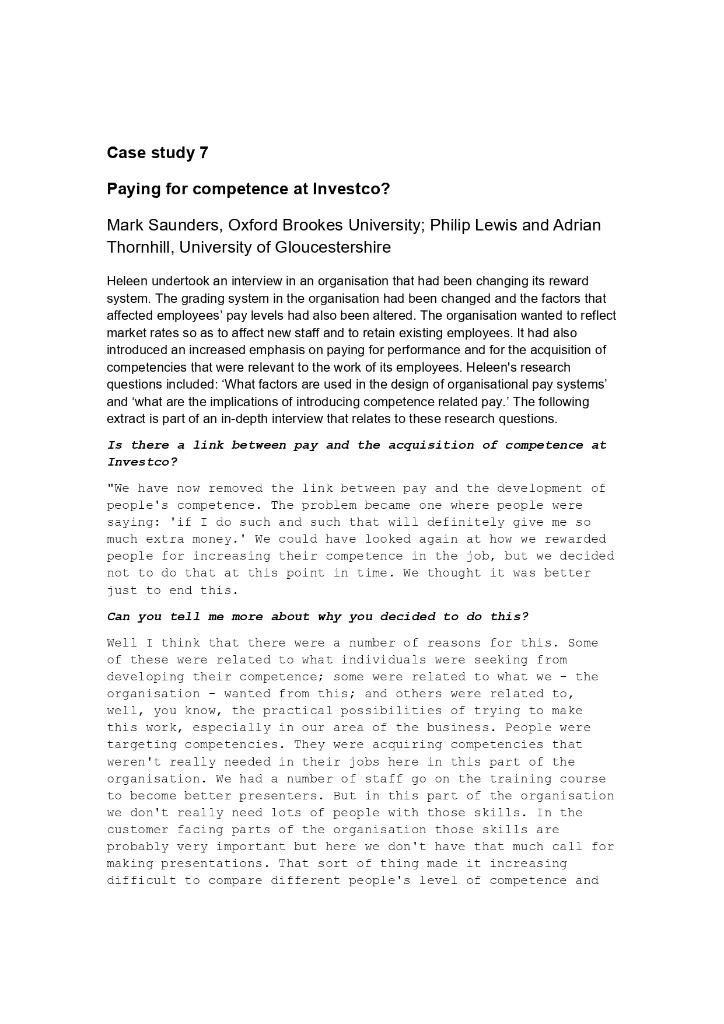

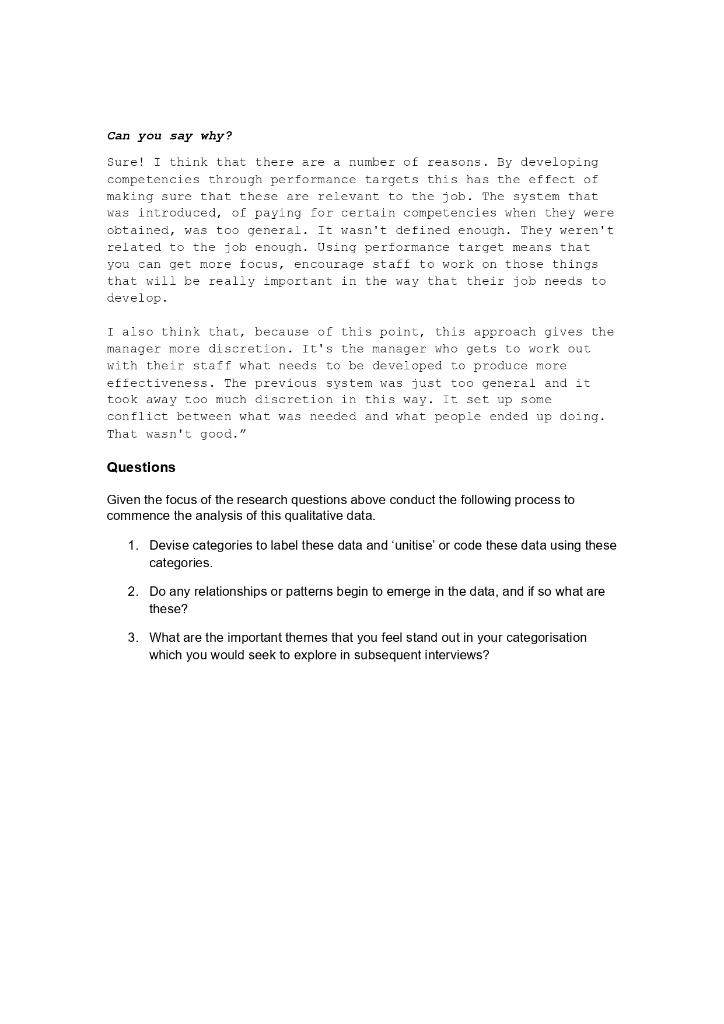
Case study 7 Paying for competence at Investco? Mark Saunders, Oxford Brookes University; Philip Lewis and Adrian Thornhill, University of Gloucestershire Heleen undertook an interview in an organisation that had been changing its reward system. The grading system in the organisation had been changed and the factors that affected employees' pay levels had also been altered. The organisation wanted to reflect market rates so as to affect new staff and to retain existing employees. It had also introduced an increased emphasis on paying for performance and for the acquisition of competencies that were relevant to the work of its employees. Heleen's research questions included: 'What factors are used in the design of organisational pay systems' and 'what are the implications of introducing competence related pay.' The following extract is part of an in-depth interview that relates to these research questions. Is there a link between pay and the acquisition of competence at Investco? "we have now removed the link between pay and the development of people's competence. The problem became one where people were saying: 'if I do such and such that will definitely give me so much extra money.' We could have looked again at how we rewarded people for increasing their competence in the job, but we decided not to do that at this point in time. We thought it was better just to end this. Can you tell me more about why you decided to do this? Well I think that there were a number of reasons for this. Some of these were related to what individuals were seeking from developing their competence; some were related to what we - the organisation - wanted from this; and others were related to, well, you know, the practical possibilities of trying to make this work, especially in our area of the business. People were targeting competencies. They were acquiring competencies that weren't really needed in their jobs here in this part of the organisation. We had a number of staff go on the training course to become better presenters. But in this part of the organisation we don't really need lots of people with those skills. In the customer facing parts of the organisation those skills are probably very important but here we don't have that much call for making presentations. That sort of thing made it increasing difficult to compare different people's level of competence and say, well, who has the most useful to us in relation to what they're being paid. The organisation hadn't really looked at it in this sort of way. The idea of paying people to develop their competence is really great, in theory that is. We want people to develop themselves. We want them to make an extra contribution. We also want them to progress in the organisation, grow into bigger jobs and stay with us. For these reasons this seemed like a great idea. In practice it's just a bit more difficult. In our part of the organisation this made us ask, well, what is it that we really want, what we really need from our staff to do the job really well. This made us think. We decided that we needed a break from what was happening. We needed to gently say, yeah, these competencies look great but let's just think about what we really need. It's also a question of focus. When Im on that two day course imoroving my presentation skills who's answering my phone, who's dealing with that system breakdown. We want to get out people well trained but to do certain things that we really need. But when we sat down and looked at this again we found that it wasn't easy. It may be easier to detine and measure competencies in some parts of the organisation because of the greater degree of standardisation. But in our area we need to realy think hard about defining and measuring the competencies that we really need. This is a really big job in our area so we're still thinking about this. In the meantime we decided to cut the link. So is there any link now between pay and competence - say, any sort of indirect link that remains? Yes there is. We don't pay for the acquisition of competence as I said but there is st ll a link through performance appraisal - an indirect 1 ink. We set staff performance targets and some of these involve level of competence. In this sense there is still a link but it's more in the background. We won't pay someone directly for achieving a particular competence or skill. But they will be rewarded For achieving a particular target that means that they have to go away over the period of the performance review and work away at something in order to be able to meet that target that was set for them. Do you see this approach as being better that the directiy linked one between pay and competence? On yes, I definitely think so. Can you say why? Sure! I think that there are a number of reasons. By developing competencies through performance targets this has the effect of making sure that these are relevant to the job. The system that was introduced, of paying for certain competencies when they were obtained, was too general. It wasn't defined enough. They weren't related to the job enough. Using performance target means that you can get more focus, encourage staff to work on those things that will be really important in the way that their job needs to develop. I also think that, because of this point, this aporoach gives the manager more discretion. It's the manager who gets to work out with their staff what needs to be developed to produce more effectiveness. The previous system was just too general and it took away too much discretion in this way. It set up some conflict between what was needed and what people ended up doing. That wasn't good." Questions Given the focus of the research questions above conduct the following process to commence the analysis of this qualitative data. 1. Devise categories to label these data and 'unitise' or code these data using these categories. 2. Do any relationships or patterns begin to emerge in the data, and if so what are these? 3. What are the important themes that you feel stand out in your categorisation which you would seek to explore in subsequent interviews
Step by Step Solution
There are 3 Steps involved in it

Get step-by-step solutions from verified subject matter experts