Question: Case Study A global company, X3T Ltd, is developing a software tool for the travel industry. The project team consists of 22 members located in
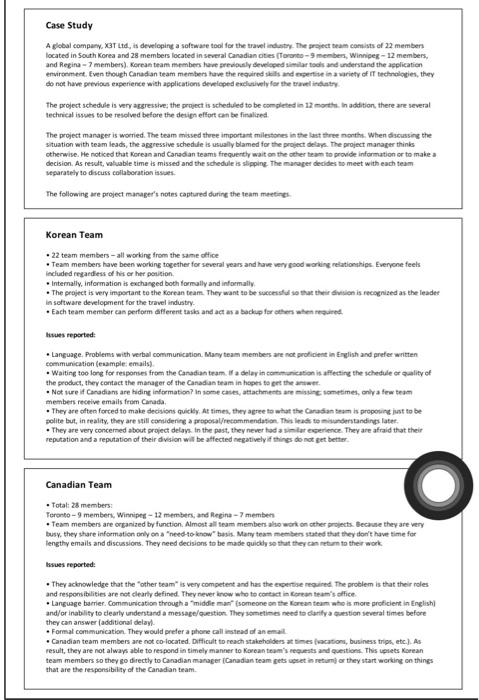
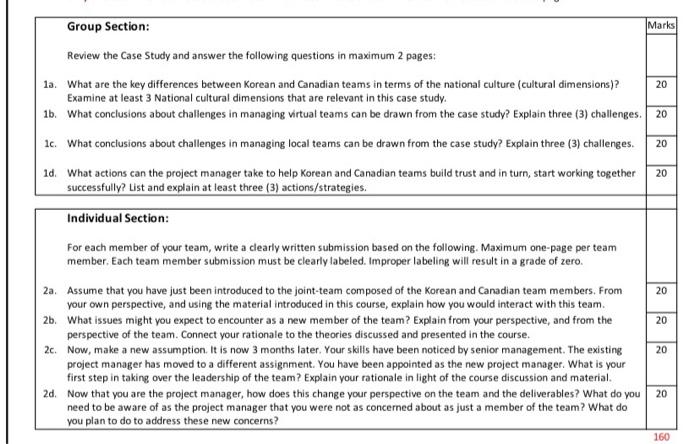
Case Study A global company, X3T Ltd, is developing a software tool for the travel industry. The project team consists of 22 members located in South Korea and 28 members located in several Canadian cities (Toronto-9 members, Winnipeg-12 members, and Regina-7 members). Korean team members have previously developed similar tools and understand the application environment. Even though Canadian team members have the required skills and expertise in a variety of IT technologies, they do not have previous experience with applications developed exclusively for the travel industry. The project schedule is very aggressive; the project is scheduled to be completed in 12 months. In addition, there are several technical issues to be resolved before the design effort can be finalized. The project manager is worried. The team missed three important milestones in the last three months. When discussing the situation with team leads, the aggressive schedule is usually blamed for the project delays. The project manager thinks otherwise. He noticed that Korean and Canadian teams frequently wait on the other team to provide information or to make a decision. As result, valuable time is missed and the schedule is slipping. The manager decides to meet with each team separately to discuss collaboration issues The following are project manager's notes captured during the team meetings Korean Team .22 team members-all working from the same office Team members have been working together for several years and have very good working relationships. Everyone feels included regardless of his or her position. Internally, information is exchanged both formally and informally The project is very important to the Korean team. They want to be successful so that their division is recognized as the leader in software development for the travel industry. Each team member can perform different tasks and act as a backup for others when required. Issues reported: Language. Problems with verbal communication. Many team members are not proficient in English and prefer written communication (example: emails). Waiting too long for responses from the Canadian team. If a delay in communication is affecting the schedule or quality of the product, they contact the manager of the Canadian team in hopes to get the answer. Not sure if Canadians are hiding information? In some cases, attachments are missing sometimes, only a few team members receive emails from Canada. They are often forced to make decisions quickly. At times, they agree to what the Canadian team is proposing just to be polite but, in reality, they are still considering a proposal/recommendation. This leads to misunderstandings later. They are very concerned about project delays. In the past, they never had a similar experience. They are afraid that their reputation and a reputation of their division will be affected negatively if things do not get better. Canadian Team Total: 28 members: Toronto -9 members, Winnipeg-12 members, and Regina-7 members Team members are organized by function. Almost all team members also work on other projects. Because they are very busy, they share information only on a "need-to-know" basis. Many team members stated that they don't have time for lengthy emails and discussions. They need decisions to be made quickly so that they can return to their work Issues reported: They acknowledge that the "other team" is very competent and has the expertise required. The problem is that their roles and responsibilities are not clearly defined. They never know who to contact in Korean team's office Language barrier. Communication through a "middle man" (someone on the Korean team who is more proficient in English) and/or inability to clearly understand a message/question. They sometimes need to clarify a question several times before they can answer (additional delay) *Formal communication. They would prefer a phone call instead of an email Canadian team members are not co-located. Difficult to reach stakeholders at times (vacations, business trips, etc.). As result, they are not always able to respond in timely manner to Korean team's requests and questions. This upsets Korean team members so they go directly to Canadian manager (Canadian team gets upset in retum) or they start working on things that are the responsibility of the Canadian team. Group Section: Marks Review the Case Study and answer the following questions in maximum 2 pages: 1a. What are the key differences between Korean and Canadian teams in terms of the national culture (cultural dimensions)? 20 Examine at least 3 National cultural dimensions that are relevant in this case study. 1b. What conclusions about challenges in managing virtual teams can be drawn from the case study? Explain three (3) challenges. 20 1c. What conclusions about challenges in managing local teams can be drawn from the case study? Explain three (3) challenges. 20 1d. 20 What actions can the project manager take to help Korean and Canadian teams build trust and in turn, start working together successfully? List and explain at least three (3) actions/strategies. Individual Section: For each member of your team, write a clearly written submission based on the following. Maximum one-page per team member. Each team member submission must be clearly labeled. Improper labeling will result in a grade of zero. 20 2a. Assume that you have just been introduced to the joint-team composed of the Korean and Canadian team members. From your own perspective, and using the material introduced in this course, explain how you would interact with this team. What issues might you expect to encounter as a new member of the team? Explain from your perspective, and from the perspective of the team. Connect your rationale to the theories discussed and presented in the course. 2b. 20 20 2c. Now, make a new assumption. It is now 3 months later. Your skills have been noticed by senior management. The existing project manager has moved to a different assignment. You have been appointed as the new project manager. What is your first step in taking over the leadership of the team? Explain your rationale in light of the course discussion and material. 2d. Now that you are the project manager, how does this change your perspective on the team and the deliverables? What do you need to be aware of as the project manager that you were not as concerned about as just a member of the team? What do you plan to do to address these new concerns? 20 160









 Study Help