Question: Case Study A global company, XYZ Ltd., is developing a software tool for the food industry. The project team consists of 20 members located in
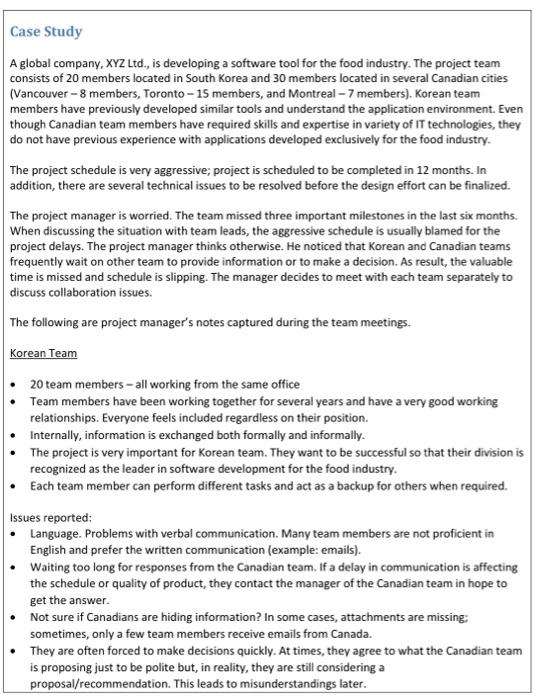
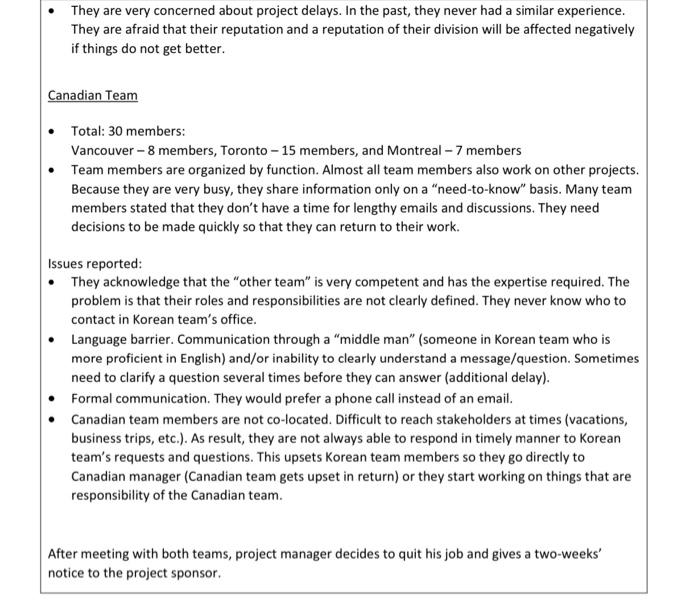
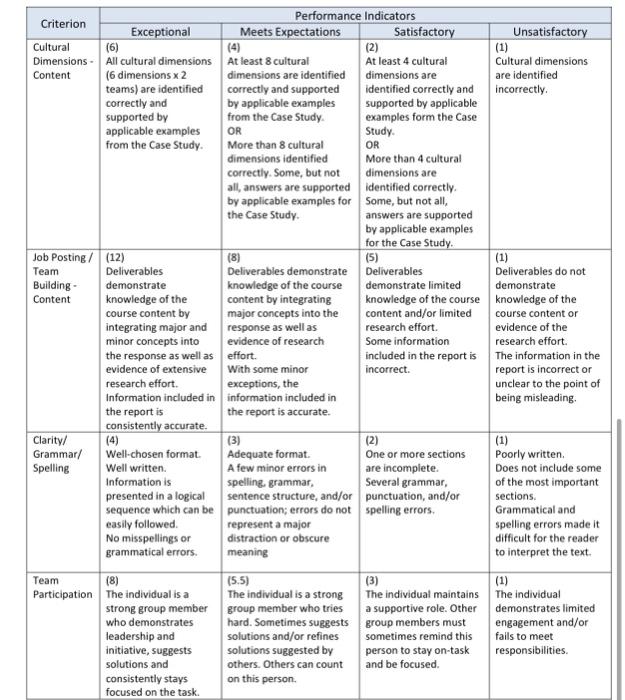
Case Study A global company, XYZ Ltd., is developing a software tool for the food industry. The project team consists of 20 members located in South Korea and 30 members located in several Canadian cities (Vancouver -8 members, Toronto - 15 members, and Montreal 7 members). Korean team members have previously developed similar tools and understand the application environment. Even though Canadian team members have required skills and expertise in variety of IT technologies, they do not have previous experience with applications developed exclusively for the food industry. The project schedule is very aggressive; project is scheduled to be completed in 12 months. In addition, there are several technical issues to be resolved before the design effort can be finalized. The project manager is worried. The team missed three important milestones in the last six months. When discussing the situation with team leads, the aggressive schedule is usually blamed for the project delays. The project manager thinks otherwise. He noticed that Korean and Canadian teams frequently wait on other team to provide information or to make a decision. As result, the valuable time is missed and schedule is slipping. The manager decides to meet with each team separately to discuss collaboration issues. The following are project manager's notes captured during the team meetings. Korean Team 20 team members - all working from the same office Team members have been working together for several years and have a very good working relationships. Everyone feels included regardless on their position. Internally, information is exchanged both formally and informally. The project is very important for Korean team. They want to be successful so that their division is recognized as the leader in software development for the food industry. Each team member can perform different tasks and act as a backup for others when required. Issues reported: Language. Problems with verbal communication. Many team members are not proficient in English and prefer the written communication (example: emails). Waiting too long for responses from the Canadian team. If a delay in communication is affecting the schedule or quality of product, they contact the manager of the Canadian team in hope to get the answer. Not sure if Canadians are hiding information? In some cases, attachments are missing: sometimes, only a few team members receive emails from Canada. They are often forced to make decisions quickly. At times, they agree to what the Canadian team is proposing just to be polite but, in reality, they are still considering a proposal/recommendation. This leads to misunderstandings later. They are very concerned about project delays. In the past, they never had a similar experience. They are afraid that their reputation and a reputation of their division will be affected negatively if things do not get better. Canadian Team Total: 30 members: Vancouver - 8 members, Toronto - 15 members, and Montreal - 7 members Team members are organized by function. Almost all team members also work on other projects. Because they are very busy, they share information only on a "need-to-know" basis. Many team members stated that they don't have a time for lengthy emails and discussions. They need decisions to be made quickly so that they can return to their work. Issues reported: They acknowledge that the "other team" is very competent and has the expertise required. The problem is that their roles and responsibilities are not clearly defined. They never know who to contact in Korean team's office. Language barrier. Communication through a "middle man" (someone in Korean team who is more proficient in English) and/or inability to clearly understand a message/question. Sometimes need to clarify a question several times before they can answer (additional delay). Formal communication. They would prefer a phone call instead of an email. Canadian team members are not co-located. Difficult to reach stakeholders at times (vacations, business trips, etc.). As result, they are not always able to respond in timely manner to Korean team's requests and questions. This upsets Korean team members so they go directly to Canadian manager (Canadian team gets upset in return) or they start working on things that are responsibility of the Canadian team. After meeting with both teams, project manager decides to quit his job and gives a two-weeks' notice to the project sponsor. Criterion Performance Indicators Exceptional Meets Expectations Satisfactory Unsatisfactory Cultural (6) (4) (2) (1) Dimensions - All cultural dimensions At least 8 cultural At least 4 cultural Cultural dimensions Content (6 dimensions x2 dimensions are identified dimensions are are identified teams) are identified correctly and supported identified correctly and incorrectly. correctly and by applicable examples supported by applicable supported by from the Case Study examples form the Case applicable examples OR Study. from the Case Study More than 8 cultural OR dimensions identified More than 4 cultural correctly. Some, but not dimensions are all, answers are supported identified correctly. by applicable examples for some, but not all, the Case Study answers are supported by applicable examples for the Case Study. Job Posting / (12) (8) (5) (1) Team Deliverables Deliverables demonstrate Deliverables Deliverables do not Building - demonstrate knowledge of the course demonstrate limited demonstrate Content knowledge of the content by integrating knowledge of the course knowledge of the course content by major concepts into the content and/or limited course content or integrating major and response as well as research effort. evidence of the minor concepts into evidence of research Some information research effort. the response as well as effort. included in the report is The information in the evidence of extensive With some minor incorrect. report is incorrector research effort. exceptions, the unclear to the point of Information included in information included in being misleading the report is the report is accurate consistently accurate Clarity/ (4) (3) (2) (1) Grammar/ Well-chosen format Adequate format One or more sections Poorly written Spelling Well written A few minor errors in are incomplete Does not include some Information is spelling, grammar, Several grammar, of the most important presented in a logical sentence structure, and/or punctuation, and/or sections. sequence which can be punctuation; errors do not spelling errors. Grammatical and casily followed represent a major spelling errors made it No misspellings or distraction or obscure difficult for the reader grammatical errors. meaning to interpret the text Team (8) (5.5) (3) (1) Participation The individual is a The individual is a strong The individual maintains the individual strong group member group member who tries a supportive role. Other demonstrates limited who demonstrates hard. Sometimes suggests group members must engagement and/or leadership and solutions and/or refines sometimes remind this fails to meet initiative, suggests solutions suggested by person to stay on-task responsibilities solutions and others. Others can count and be focused consistently stays on this person focused on the task. Case Study A global company, XYZ Ltd., is developing a software tool for the food industry. The project team consists of 20 members located in South Korea and 30 members located in several Canadian cities (Vancouver -8 members, Toronto - 15 members, and Montreal 7 members). Korean team members have previously developed similar tools and understand the application environment. Even though Canadian team members have required skills and expertise in variety of IT technologies, they do not have previous experience with applications developed exclusively for the food industry. The project schedule is very aggressive; project is scheduled to be completed in 12 months. In addition, there are several technical issues to be resolved before the design effort can be finalized. The project manager is worried. The team missed three important milestones in the last six months. When discussing the situation with team leads, the aggressive schedule is usually blamed for the project delays. The project manager thinks otherwise. He noticed that Korean and Canadian teams frequently wait on other team to provide information or to make a decision. As result, the valuable time is missed and schedule is slipping. The manager decides to meet with each team separately to discuss collaboration issues. The following are project manager's notes captured during the team meetings. Korean Team 20 team members - all working from the same office Team members have been working together for several years and have a very good working relationships. Everyone feels included regardless on their position. Internally, information is exchanged both formally and informally. The project is very important for Korean team. They want to be successful so that their division is recognized as the leader in software development for the food industry. Each team member can perform different tasks and act as a backup for others when required. Issues reported: Language. Problems with verbal communication. Many team members are not proficient in English and prefer the written communication (example: emails). Waiting too long for responses from the Canadian team. If a delay in communication is affecting the schedule or quality of product, they contact the manager of the Canadian team in hope to get the answer. Not sure if Canadians are hiding information? In some cases, attachments are missing: sometimes, only a few team members receive emails from Canada. They are often forced to make decisions quickly. At times, they agree to what the Canadian team is proposing just to be polite but, in reality, they are still considering a proposal/recommendation. This leads to misunderstandings later. They are very concerned about project delays. In the past, they never had a similar experience. They are afraid that their reputation and a reputation of their division will be affected negatively if things do not get better. Canadian Team Total: 30 members: Vancouver - 8 members, Toronto - 15 members, and Montreal - 7 members Team members are organized by function. Almost all team members also work on other projects. Because they are very busy, they share information only on a "need-to-know" basis. Many team members stated that they don't have a time for lengthy emails and discussions. They need decisions to be made quickly so that they can return to their work. Issues reported: They acknowledge that the "other team" is very competent and has the expertise required. The problem is that their roles and responsibilities are not clearly defined. They never know who to contact in Korean team's office. Language barrier. Communication through a "middle man" (someone in Korean team who is more proficient in English) and/or inability to clearly understand a message/question. Sometimes need to clarify a question several times before they can answer (additional delay). Formal communication. They would prefer a phone call instead of an email. Canadian team members are not co-located. Difficult to reach stakeholders at times (vacations, business trips, etc.). As result, they are not always able to respond in timely manner to Korean team's requests and questions. This upsets Korean team members so they go directly to Canadian manager (Canadian team gets upset in return) or they start working on things that are responsibility of the Canadian team. After meeting with both teams, project manager decides to quit his job and gives a two-weeks' notice to the project sponsor. Criterion Performance Indicators Exceptional Meets Expectations Satisfactory Unsatisfactory Cultural (6) (4) (2) (1) Dimensions - All cultural dimensions At least 8 cultural At least 4 cultural Cultural dimensions Content (6 dimensions x2 dimensions are identified dimensions are are identified teams) are identified correctly and supported identified correctly and incorrectly. correctly and by applicable examples supported by applicable supported by from the Case Study examples form the Case applicable examples OR Study. from the Case Study More than 8 cultural OR dimensions identified More than 4 cultural correctly. Some, but not dimensions are all, answers are supported identified correctly. by applicable examples for some, but not all, the Case Study answers are supported by applicable examples for the Case Study. Job Posting / (12) (8) (5) (1) Team Deliverables Deliverables demonstrate Deliverables Deliverables do not Building - demonstrate knowledge of the course demonstrate limited demonstrate Content knowledge of the content by integrating knowledge of the course knowledge of the course content by major concepts into the content and/or limited course content or integrating major and response as well as research effort. evidence of the minor concepts into evidence of research Some information research effort. the response as well as effort. included in the report is The information in the evidence of extensive With some minor incorrect. report is incorrector research effort. exceptions, the unclear to the point of Information included in information included in being misleading the report is the report is accurate consistently accurate Clarity/ (4) (3) (2) (1) Grammar/ Well-chosen format Adequate format One or more sections Poorly written Spelling Well written A few minor errors in are incomplete Does not include some Information is spelling, grammar, Several grammar, of the most important presented in a logical sentence structure, and/or punctuation, and/or sections. sequence which can be punctuation; errors do not spelling errors. Grammatical and casily followed represent a major spelling errors made it No misspellings or distraction or obscure difficult for the reader grammatical errors. meaning to interpret the text Team (8) (5.5) (3) (1) Participation The individual is a The individual is a strong The individual maintains the individual strong group member group member who tries a supportive role. Other demonstrates limited who demonstrates hard. Sometimes suggests group members must engagement and/or leadership and solutions and/or refines sometimes remind this fails to meet initiative, suggests solutions suggested by person to stay on-task responsibilities solutions and others. Others can count and be focused consistently stays on this person focused on the task









 Study Help