Question: CASE STUDY: BMW In 2018, BMW, whose headquarters are in Munich, was (with Daimler) one of the world's two leading premium automobile companies. BMW employed
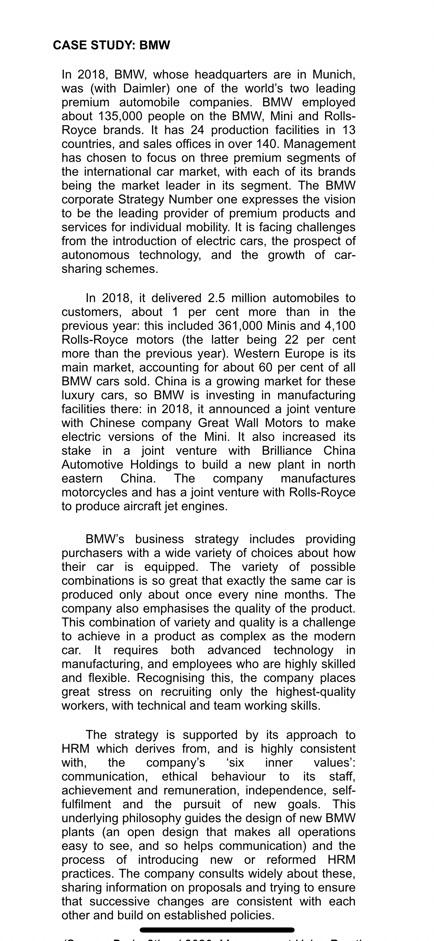
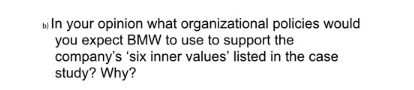
CASE STUDY: BMW In 2018, BMW, whose headquarters are in Munich, was (with Daimler) one of the world's two leading premium automobile companies. BMW employed about 135,000 people on the BMW, Mini and RollsRoyce brands. It has 24 production facilities in 13 countries, and sales offices in over 140. Management has chosen to focus on three premium segments of the international car market, with each of its brands being the market leader in its segment. The BMW corporate Strategy Number one expresses the vision to be the leading provider of premium products and services for individual mobility. It is facing challenges from the introduction of electric cars, the prospect of autonomous technology, and the growth of carsharing schemes. In 2018, it delivered 2.5 million automobiles to customers, about 1 per cent more than in the previous year: this included 361,000 Minis and 4,100 Rolls-Royce motors (the latter being 22 per cent more than the previous year). Western Europe is its main market, accounting for about 60 per cent of all BMW cars sold. China is a growing market for these luxury cars, so BMW is investing in manufacturing facilities there: in 2018, it announced a joint venture with Chinese company Great Wall Motors to make electric versions of the Mini. It also increased its stake in a joint venture with Brilliance China Automotive Holdings to build a new plant in north eastern China. The company manufactures motorcycles and has a joint venture with Rolls-Royce to produce aircraft jet engines. BMW's business strategy includes providing purchasers with a wide variety of choices about how their car is equipped. The variety of possible combinations is so great that exactly the same car is produced only about once every nine months. The company also emphasises the quality of the product. This combination of variety and quality is a challenge to achieve in a product as complex as the modern car. It requires both advanced technology in manufacturing, and employees who are highly skilled and flexible. Recognising this, the company places great stress on recruiting only the highest-quality workers, with technical and team working skills. The strategy is supported by its approach to HRM which derives from, and is highly consistent with, the company's 'six inner values': communication, ethical behaviour to its staff, achievement and remuneration, independence, selffulfilment and the pursuit of new goals. This underlying philosophy guides the design of new BMW plants (an open design that makes all operations easy to see, and so helps communication) and the process of introducing new or reformed HRM practices. The company consults widely about these, sharing information on proposals and trying to ensure that successive changes are consistent with each other and build on established policies. b) In your opinion what organizational policies would you expect BMW to use to support the company's 'six inner values' listed in the case study? Why









 Study Help