







Question: Case study Chapter 16 - CAFTA What arguments does Hubbard make in support of DR-CAFTA? Why do Scott and Ratner believe DR-CAFTA will not benefit
Case study 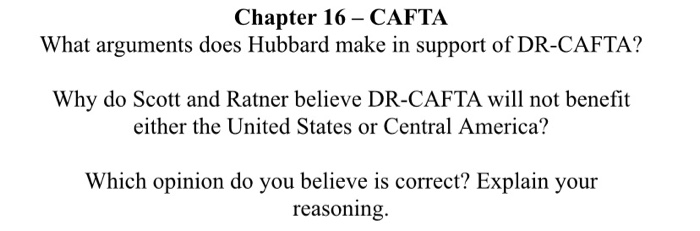
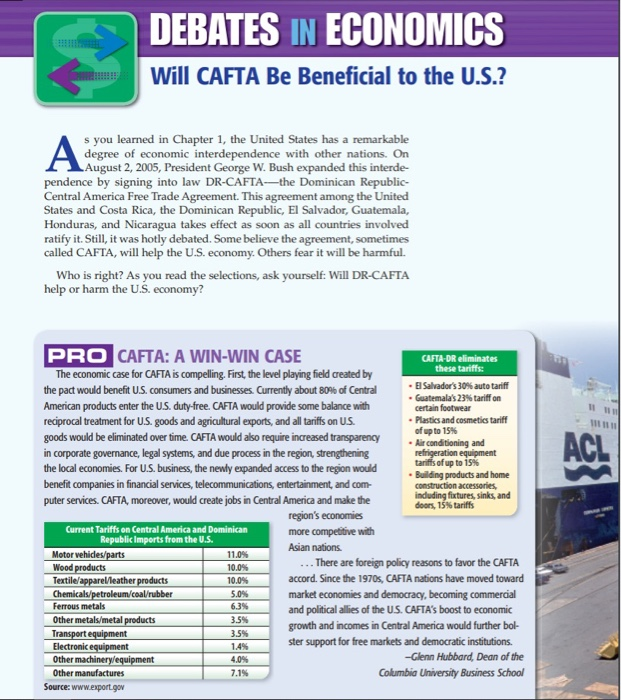
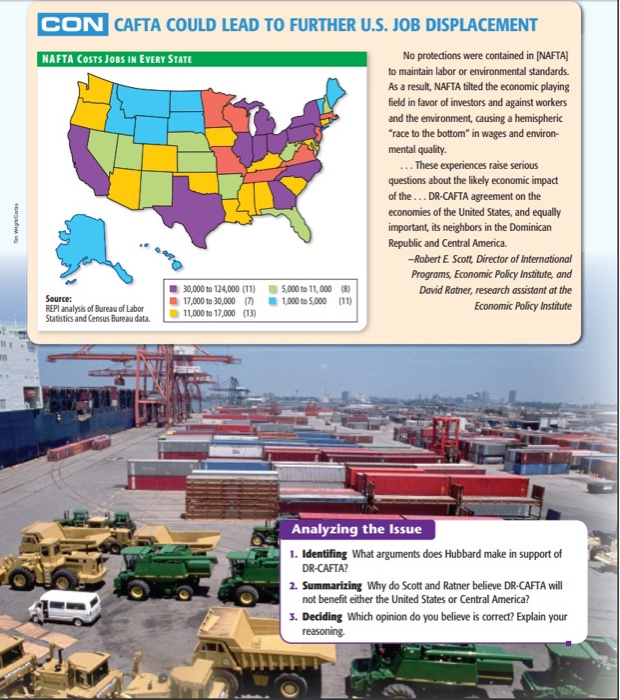
Chapter 16 - CAFTA What arguments does Hubbard make in support of DR-CAFTA? Why do Scott and Ratner believe DR-CAFTA will not benefit either the United States or Central America? Which opinion do you believe is correct? Explain your reasoning DEBATES IN ECONOMICS Will CAFTA Be Beneficial to the U.S.? s you learned in Chapter 1, the United States has a remarkable degree of economic interdependence with other nations. On August 2, 2005, President George W. Bush expanded this interde pendence by signing into law DR-CAFTA--the Dominican Republic- Central America Free Trade Agreement. This agreement among the United States and Costa Rica, the Dominican Republic, El Salvador, Guatemala, Honduras, and Nicaragua takes effect as soon as all countries involved ratify it. Still, it was hotly debated. Some believe the agreement, sometimes called CAFTA, will help the U.S. economy. Others fear it will be harmful. Who is right? As you read the selections, ask yourself: Will DR-CAFTA help or harm the U.S. economy? PRO CAFTA: A WIN-WIN CASE CAFTA-DR eliminates these tariffs: The economic case for CAFTA is compelling. First, the level playing field created by the pact would benefit U.S. consumers and businesses. Currently about 80% of Central - El Salvador's 30% auto tariff Guatemala's 23 tariffon American products enter the U.S. duty-free. CAFTA would provide some balance with certain footwear reciprocal treatment for U.S. goods and agricultural exports, and all tariffs on US. Plastics and cosmetics tariff of up to 15% goods would be eliminated over time. CAFTA would also require increased transparency Air conditioning and in corporate governance, legal systems, and due process in the region, strengthening refrigeration equipment tariffs of up to 15% the local economies. For U.S. business, the newly expanded access to the region would Building products and home benefit companies in financial services, telecommunications, entertainment, and com construction accessories, induding fixtures, sinks, and puter services. CAFTA, moreover, would create jobs in Central America and make the doors, 15% tariffs region's economies Current Tariffs on Central America and Dominican more competitive with Republic Imports from the U.S. Asian nations. Motor vehicles/parts 11.0% Wood products 10.04 ... There are foreign policy reasons to favor the CAFTA Textile/apparelleather products 10.0% accord. Since the 1970s, CAFTA nations have moved toward Chemicals/petroleum/coal/rubber 5.0% market economies and democracy, becoming commercial Ferrous metals 6.3% and political allies of the US. CAFTA's boost to economic Other metals/metal products 3.5% growth and incomes in Central America would further bol- Transport equipment 3.5% Electronic equipment 1.4% ster support for free markets and democratic institutions. Other machinery/equipment T 4.0% -Glenn Hubbard, Dean of the Other manufactures 7.15 Columbia University Business School Source: www.export.gov CON CAFTA COULD LEAD TO FURTHER U.S. JOB DISPLACEMENT NAFTA COSTS JOBS IN EVERY STATE No protections were contained in NAFTA) to maintain labor or environmental standards. As a result, NAFTA tilted the economic playing field in favor of investors and against workers and the environment, causing a hemispheric "race to the bottom" in wages and environ- mental quality. ... These experiences raise serious questions about the likely economic impact of the ... DR-CAFTA agreement on the economies of the United States, and equally important, its neighbors in the Dominican Republic and Central America. -Robert E Scott, Director of International Programs, Economic Policy Institute, and David Ratner, research assistant at the Economic Policy Institute The Wigatie 30,000 to 124,000 (11) 17,000 to 30,000 (7) 11,000 to 17,000 (13) 5,000 to 11,000 1,000 to 5,000 18 (11) Source: REPI analysis of Bureau of Labor Statistics and Census Bureau data. Analyzing the Issue 1. Identifing What arguments does Hubbard make in support of DR-CAFTA? 2. Summarizing Why do Scott and Ratner believe DR-CAFTA will not benefit either the United States or Central America? 3. Deciding Which opinion do you believe is correct? Explain your reasoning Step by Step Solution
There are 3 Steps involved in it
1 Expert Approved Answer
Step: 1 Unlock

Question Has Been Solved by an Expert!
Get step-by-step solutions from verified subject matter experts
Step: 2 Unlock
Step: 3 Unlock
 Study Help