







Question: CASE STUDY Computer Publishing Inc. in only a decade, Computer Publishing Inc. (CPI) grew from a small textbook publishing house into a large, inter- national
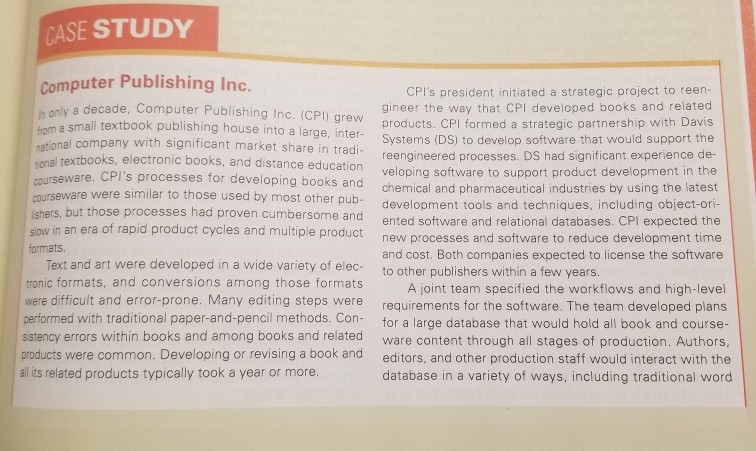
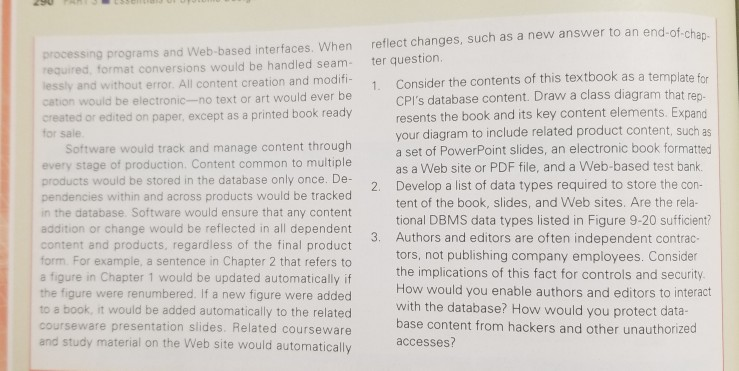
CASE STUDY Computer Publishing Inc. in only a decade, Computer Publishing Inc. (CPI) grew from a small textbook publishing house into a large, inter- national company with significant market share in tradi- tional textbooks, electronic books, and distance education courseware. CPI's processes for developing books and courseware were similar to those used by most other pub- ishers, but those processes had proven cumbersome and slow in an era of rapid product cycles and multiple product formats Text and art were developed in a wide variety of elec- tronic formats, and conversions among those formats were difficult and error-prone. Many editing steps were performed with traditional paper-and-pencil methods. Con- sistency errors within books and among books and related products were common. Developing or revising a book and all its related products typically took a year or more. CPI's president initiated a strategic project to reen- gineer the way that CPI developed books and related products. CPI formed a strategic partnership with Davis Systems (DS) to develop software that would support the reengineered processes. DS had significant experience de- veloping software to support product development in the chemical and pharmaceutical industries by using the latest development tools and techniques, including object-ori- ented software and relational databases. CPI expected the new processes and software to reduce development time and cost. Both companies expected to license the software to other publishers within a few years. A joint team specified the workflows and high-level requirements for the software. The team developed plans for a large database that would hold all book and course- ware content through all stages of production. Authors, editors, and other production staff would interact with the database in a variety of ways, including traditional word 1 processing programs and Web-based interfaces. When required format conversions would be handled seam- lessly and without error. All content creation and modifi- cation would be electronic-no text or art would ever be created or edited on paper, except as a printed book ready for sale Software would track and manage content through every stage of production Content common to multiple products would be stored in the database only once. De- pendencies within and across products would be tracked in the database. Software would ensure that any content addition or change would be reflected in all dependent content and products, regardless of the final product form. For example, a sentence in Chapter 2 that refers to a figure in Chapter 1 would be updated automatically if the figure were renumbered. If a new figure were added to a book, it would be added automatically to the related courseware presentation slides. Related courseware and study material on the Web site would automatically reflect changes, such as a new answer to an end-of-chap- ter question Consider the contents of this textbook as a template for CPI's database content. Draw a class diagram that rep- resents the book and its key content elements. Expand your diagram to include related product content, such as a set of PowerPoint slides, an electronic book formatted as a Web site or PDF file, and a Web-based test bank. 2. Develop a list of data types required to store the con- tent of the book, slides, and Web sites. Are the rela- tional DBMS data types listed in Figure 9-20 sufficient? Authors and editors are often independent contrac- tors, not publishing company employees. Consider the implications of this fact for controls and security How would you enable authors and editors to interact with the database? How would you protect data- base content from hackers and other unauthorized accesses? 3
Step by Step Solution
There are 3 Steps involved in it
1 Expert Approved Answer
Step: 1 Unlock

Question Has Been Solved by an Expert!
Get step-by-step solutions from verified subject matter experts
Step: 2 Unlock
Step: 3 Unlock
 Study Help