







Question: Case Study: Data Changes how NFL teams Play the game and how fans see it Q1) What kinds of systems are illustrated in this case
Case Study: Data Changes how NFL teams Play the game and how fans see it
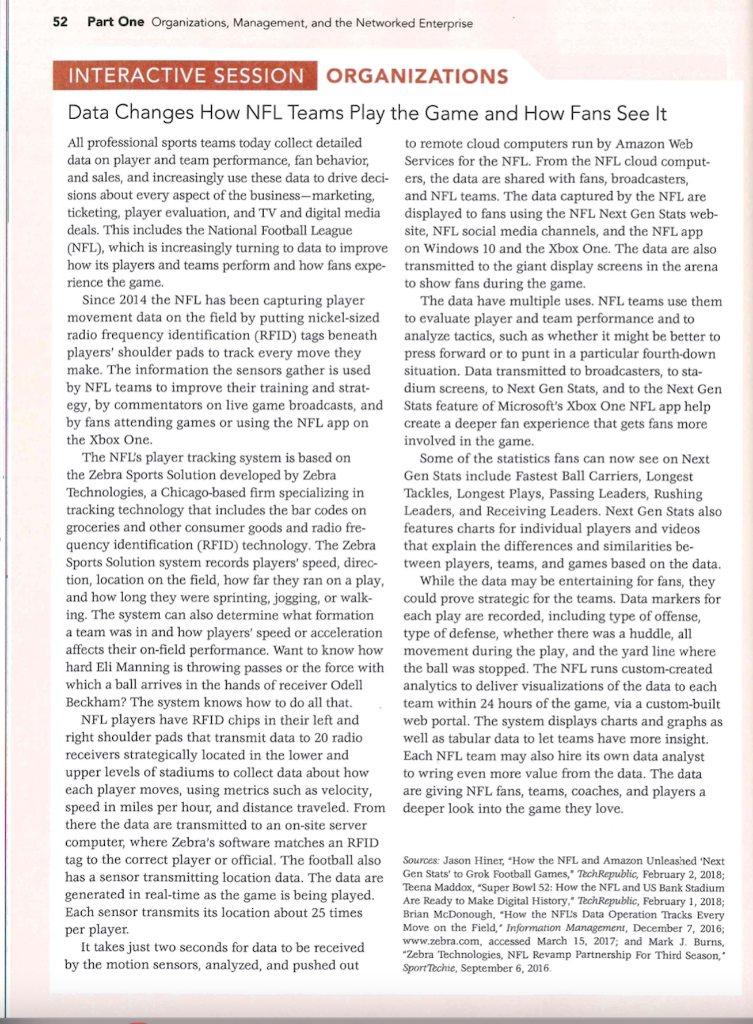
Q1) What kinds of systems are illustrated in this case study? Why do they obtain their data? What do they do with the data? Describe some of the inputs and outputs of these systems.
Q2) What business functions do these systems support? Explain your answer.
Q3) How do the data about teams and players captured by the NFL help NFL football teams and the NFL itself make better decisions? Give examples of two decisions that were improved by the systems described in this case/
Q4) How did using data help the NFL and its teams improve the way they run their business
52 Part One Organizations, Management, and the Networked Enterprise INTERACTIVE SESSION ORGANIZATIONS Data Changes How NFL Teams Play the Game and How Fans See It All professional sports teams today collect detailed to remote cloud computers run by Amazon Web data on player and team performance, fan behavior, Services for the NFL. From the NFL cloud comput- and sales, and increasingly use these data to drive deci- ers, the data are shared with fans, broadcasters, sions about every aspect of the business-marketing, and NFL teams. The data captured by the NFL are ticketing, player evaluation, and TV and digital media displayed to fans using the NFL Next Gen Stats web- deals. This includes the National Football League site, NFL social media channels, and the NFL app (NFL), which is increasingly turning to data to improve on Windows 10 and the Xbox One. The data are also how its players and teams perform and how fans expe- transmitted to the giant display screens in the arena rience the game. to show fans during the game. Since 2014 the NFL has been capturing player The data have multiple uses. NFL teams use them movement data on the field by putting nickel-sized to evaluate player and team performance and to radio frequency identification (RFID) tags beneath analyze tactics, such as whether it might be better to players' shoulder pads to track every move they press forward or to punt in a particular fourth-down make. The information the sensors gather is used situation. Data transmitted to broadcasters, to sta- by NFL teams to improve their training and strat- dium screens, to Next Gen Stats, and to the Next Gen egy, by commentators on live game broadcasts, and Stats feature of Microsoft's Xbox One NFL app help by fans attending games or using the NFL app on create a deeper fan experience that gets fans more the Xbox One. involved in the game. The NFL's player tracking system is based on Some of the statistics fans can now see on Next the Zebra Sports Solution developed by Zebra Gen Stats include Fastest Ball Carriers, Longest Technologies, a Chicago-based firm specializing in Tackles, Longest Plays, Passing Leaders, Rushing tracking technology that includes the bar codes on Leaders, and Receiving Leaders. Next Gen Stats also groceries and other consumer goods and radio fre- features charts for individual players and videos quency identification (RFID) technology. The Zebra that explain the differences and similarities be- Sports Solution system records players' speed, direc- tween players, teams, and games based on the data. tion, location on the field, how far they ran on a play, While the data may be entertaining for fans, they and how long they were sprinting, jogging, or walk- could prove strategic for the teams. Data markers for ing. The system can also determine what formation each play are recorded, including type of offense, a team was in and how players' speed or acceleration type of defense, whether there was a huddle, all affects their on-field performance. Want to know how movement during the play, and the yard line where hard Eli Manning is throwing passes or the force with the ball was stopped. The NFL runs custom-created which a ball arrives in the hands of receiver Odell analytics to deliver visualizations of the data to each Beckham? The system knows how to do all that. team within 24 hours of the game, via a custom-built NFL players have RFID chips in their left and web portal. The system displays charts and graphs as right shoulder pads that transmit data to 20 radio well as tabular data to let teams have more insight. receivers strategically located in the lower and Each NFL team may also hire its own data analyst upper levels of stadiums to collect data about how to wring even more value from the data. The data each player moves, using metrics such as velocity, are giving NFL fans, teams, coaches, and players a speed in miles per hour, and distance traveled. From deeper look into the game they love. there the data are transmitted to an on-site server computer, where Zebra's software matches an RFID tag to the correct player or official. The football also Sources: Jason Hiner, 'How the NFL and Amazon Unleashed 'Next has a sensor transmitting location data. The data are Gen Stats' to Grok Football Games, Tech Republic, February 2, 2018; Teena Maddox, "Super Bowl 52: How the NFL and US Bank Stadium generated in real-time as the game is being played. Are Ready to Make Digital History," Tech Republic, February 1, 2018; Each sensor transmits its location about 25 times Brian McDonough. "How the NFL's Data Operation Tracks Every per player Move on the field, Information Management, December 7, 2016; It takes just two seconds for data to be received www.zebra.com, accessed March 15, 2017; and Mark J. Burns, "Zebra Technologies, NFL Revamp Partnership For Third Season, by the motion sensors, analyzed, and pushed out Sport Techie, September 6, 2016Step by Step Solution
There are 3 Steps involved in it
1 Expert Approved Answer
Step: 1 Unlock

Question Has Been Solved by an Expert!
Get step-by-step solutions from verified subject matter experts
Step: 2 Unlock
Step: 3 Unlock
 Study Help