Question: Case Study Design a Toll Plaza System and its Work Schedule Western Motorway Authority (WMA) operates a network of toll roads connecting three urban- ized
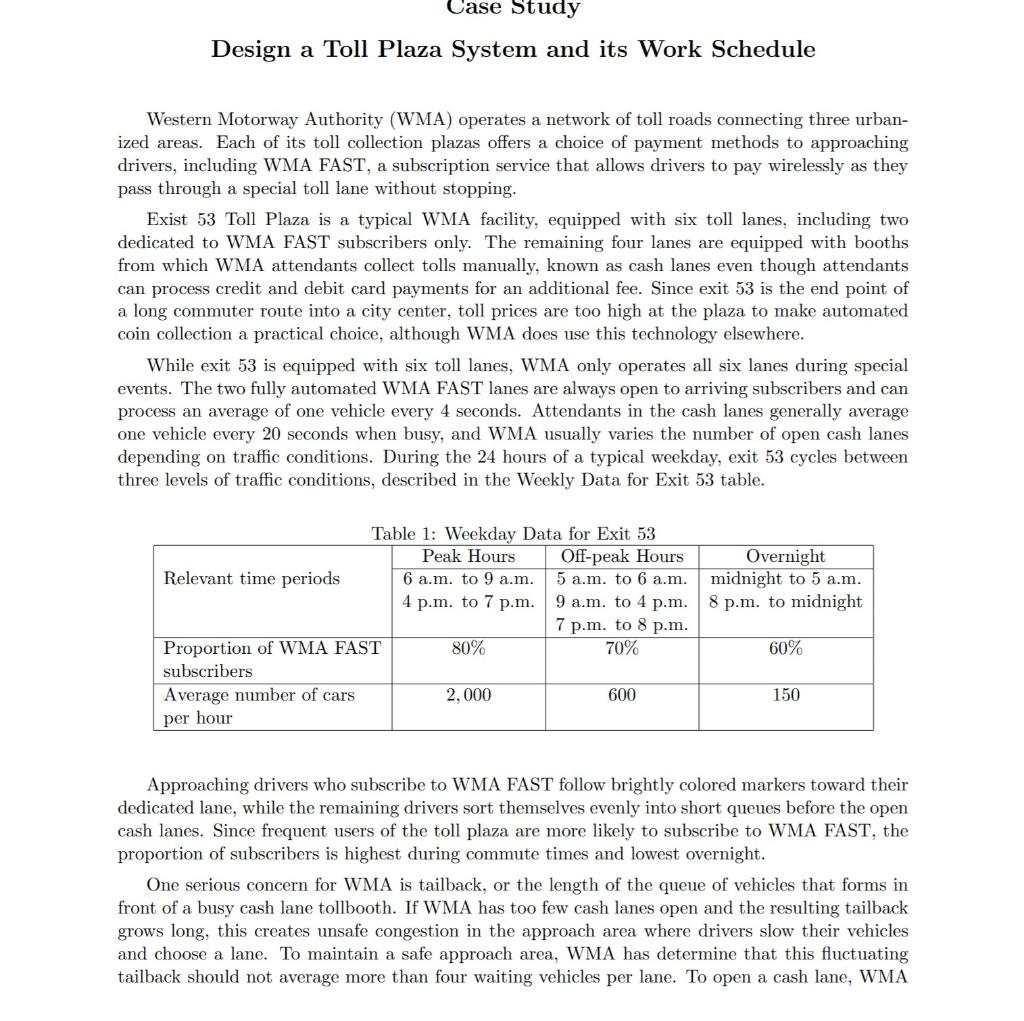
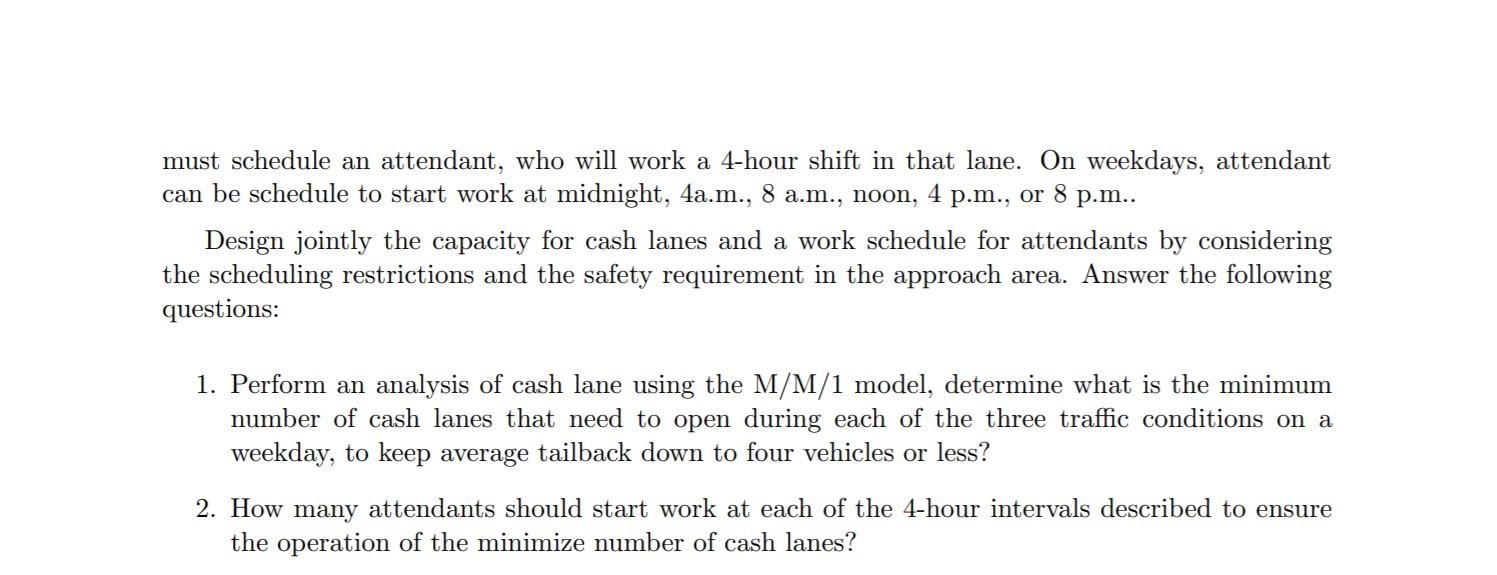
Case Study Design a Toll Plaza System and its Work Schedule Western Motorway Authority (WMA) operates a network of toll roads connecting three urban- ized areas. Each of its toll collection plazas offers a choice of payment methods to approaching drivers, including WMA FAST, a subscription service that allows drivers to pay wirelessly as they pass through a special toll lane without stopping. Exist 53 Toll Plaza is a typical WMA facility, equipped with six toll lanes, including two dedicated to WMA FAST subscribers only. The remaining four lanes are equipped with booths from which WMA attendants collect tolls manually, known as cash lanes even though attendants can process credit and debit card payments for an additional fee. Since exit 53 is the end point of a long commuter route into a city center, toll prices are too high at the plaza to make automated coin collection a practical choice, although WMA does use this technology elsewhere. While exit 53 is equipped with six toll lanes, WMA only operates all six lanes during special events. The two fully automated WMA FAST lanes are always open to arriving subscribers and can process an average of one vehicle every 4 seconds. Attendants in the cash lanes generally average one vehicle every 20 seconds when busy, and WMA usually varies the number of open cash lanes depending on traffic conditions. During the 24 hours of a typical weekday, exit 53 cycles between three levels of traffic conditions, described in the Weekly Data for Exit 53 table. Table 1: Weekday Data for Exit 53 Peak Hours Off-peak Hours Relevant time periods 6 a.m. to 9 a.m. 5 a.m. to 6 a.m. 4 p.m. to 7 p.m. 9 a.m. to 4 p.m. 7 p.m. to 8 p.m. Proportion of WMA FAST 80% 70% subscribers Average number of cars 2,000 600 Overnight midnight to 5 a.m. 8 p.m. to midnight 60% 150 per hour Approaching drivers who subscribe to WMA FAST follow brightly colored markers toward their dedicated lane, while the remaining drivers sort themselves evenly into short queues before the open cash lanes. Since frequent users of the toll plaza are more likely to subscribe to WMA FAST, the proportion of subscribers is highest during commute times and lowest overnight. One serious concern for WMA is tailback, or the length of the queue of vehicles that forms in front of a busy cash lane tollbooth. If WMA has too few cash lanes open and the resulting tailback grows long, this creates unsafe congestion in the approach area where drivers slow their vehicles and choose a lane. To maintain a safe approach area, WMA has determine that this fluctuating tailback should not average more than four waiting vehicles per lane. To open a cash lane, WMA must schedule an attendant, who will work a 4-hour shift in that lane. On weekdays, attendant can be schedule to start work at midnight, 4a.m., 8 a.m., noon, 4 p.m., or 8 p.m.. Design jointly the capacity for cash lanes and a work schedule for attendants by considering the scheduling restrictions and the safety requirement in the approach area. Answer the following questions: 1. Perform an analysis of cash lane using the M/M/1 model, determine what is the minimum number of cash lanes that need to open during each of the three traffic conditions on a weekday, to keep average tailback down to four vehicles or less? 2. How many attendants should start work at each of the 4-hour intervals described to ensure the operation of the minimize number of cash lanes









 Study Help