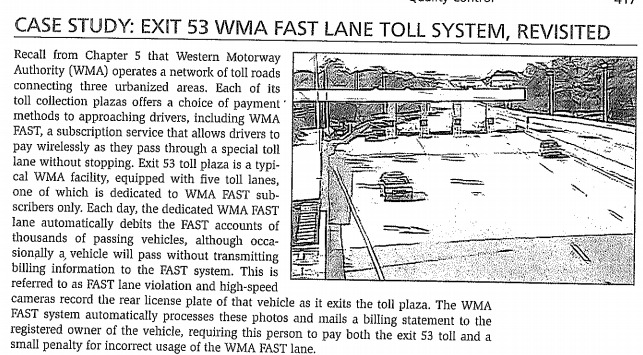
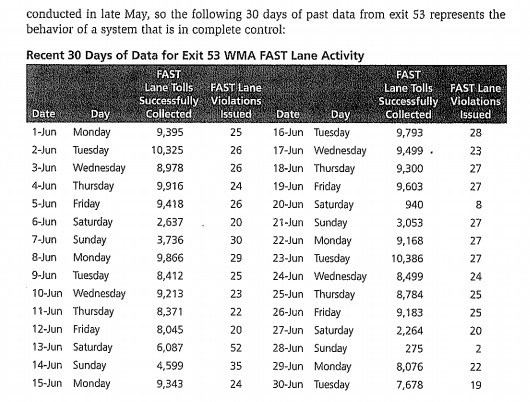
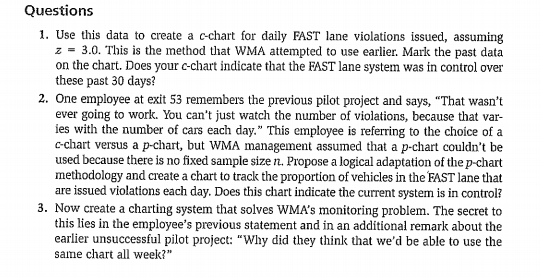
CASE STUDY: EXIT 53 WMA FAST LANE TOLL SYSTEM, REVISITED Recall from Chapter 5 that Western Motorway Authority (WMA) operates a network of toll roads connecting three urbanized areas. Each of its toll collection plazas offers a choice of payment methods to approaching drivers, including WMA FAST, a subscription service that allows drivers to pay wirelessly as they pass through a special toll lane without stopping. Exit 53 toll plaza is a typi- cal WMA facility, equipped with five toll lanes, one of which is dedicated to WMA FAST sub- scribers only. Each day, the dedicated WMA FAST lane automatically debits the FAST accounts of thousands of passing vehicles, although occa- sionally a vehicle will pass without transmitting billing information to the FAST system. This is referred to as FAST lane violation and high-speed cameras record the rear license plate of that vehicle as it exits the toll plaza. The WMA FAST system automatically processes these photos and mails a billing statement to the registered owner of the vehicle, requiring this person to pay both the exit 53 toll and a small penalty for incorrect usage of the WMA FAST lane. A WMA FAST lane toll violation is usually caused by a nonsubscription vehicle incorrectly choosing the FAST lane when passing the toll plaza, although sometimes it is caused by inadequate funds in the FAST account of a subscription vehicle. Another pos- sible but less common cause is a malfunctioning onboard FAST transceiver in a passing subscription vehicle, failing to identify itself to the WMA FAST lane wireless system. All of these scenarios are natural outcomes in a system used by thousands of vehicles a day, appropriately addressed by the automatic paper billing of the registered owner. However, one other potential cause of a FAST lane violation is that the FAST system itself malfunc- tioned, failing to record the signals from a correctly functioning onboard transceiver. This causes failure to debit any account, which automatically triggers the lane violation sys- tem. This scenario is the most troublesome to WMA management, in that the automatic billing for FAST lane violation assumes the vehicle was at fault, not the FAST lane system itself. A FAST lane system should not malfunction if it is properly maintained, although a small possibility exists that some part of it could fail between maintenance cycles. This disturbing possibility was the subject of heated discussions at a recent toll plaza manag- ers' meeting, after a FAST lane installation malfunctioned and issued over a thousand bill- ing statements to unsuspecting vehicle owners before employees recognized the problem and closed the malfunctioning lane. Some managers at the meeting pointed out WMA's need for some tool to monitor the number of FAST lane violations each day, to make any unusual change in that activity more visible. Other managers at the meeting remembered previous attempts to use control charts, particularly c-charts, to plot the daily number of violations issued by a FAST lane, and how those pilot projects failed. "We've been over this before," said one of those managers. "The usual quality control c-chart stuff doesn't work for FAST lanes. Every time we draw up a chart from the data of a flawlessly func- tioning lane, it just indicates that lane is out of control. We're stuck before we even start using the chart." The manager at exit 53 volunteered its FAST lane as the site for yet another pilot proj- ect to develop a relevant tool to monitor FAST lane violations, one that would correctly signal any unusual changes, to be acted on quickly by closing the lane. Exit 53's FAST lane equipment was upgraded less than a year ago, and preventative maintenance was conducted in late May, so the following 30 days of past data from exit 53 represents the behavior of a system that is in complete control: Recent 30 Days of Data for Exit 53 WMA FAST Lane Activity FAST FAST Lane Tolls FAST Lane Lane Tolls FAST Lane Successfully Violations Successfully Violations Date Day Collected Issued Date Day Collected issued 1-Jun Monday 9,395 25 16-Jun Tuesday 9,793 28 2-Jun Tuesday 10,325 26 17-Jun Wednesday 9,499. 23 3-Jun Wednesday 8,978 26 18-Jun Thursday 9,300 27 4-Jun Thursday 9,916 24 19-Jun Friday 9,603 27 5-Jun Friday 9,418 26 20-Jun Saturday 940 8 6-Jun Saturday 2,637 20 21-Jun Sunday 3,053 27 7-Jun Sunday 3,736 30 22-Jun Monday 9,168 27 8-Jun Monday 9,866 29 23-Jun Tuesday 10,386 27 9-Jun Tuesday 8,412 25 24-Jun Wednesday 8,499 24 10-Jun Wednesday 9,213 23 25-Jun Thursday 8,784 25 11-Jun Thursday 8,371 22 26-Jun Friday 9,183 25 12-Jun Friday 8,045 20 27-Jun Saturday 2,264 20 13-Jun Saturday 6,087 52 28-Jun Sunday 275 2 14-Jun Sunday 4,599 35 29-Jun Monday 8,076 22 15-Jun Monday 9,343 24 30-Jun Tuesday 7,678 19 Questions 1. Use this data to create a c-chart for daily FAST lane violations issued, assuming z = 3.0. This is the method that WMA attempted to use earlier. Mark the past data on the chart. Does your c-chart indicate that the FAST lane system was in control over these past 30 days? 2. One employee at exit 53 remembers the previous pilot project and says, "That wasn't ever going to work. You can't just watch the number of violations, because that var- ies with the number of cars each day." This employee is referring to the choice of a c-chart versus a p-chart, but WMA management assumed that a p-chart couldn't be used because there is no fixed sample size n. Propose a logical adaptation of the p-chart methodology and create a chart to track the proportion of vehicles in the FAST lane that are issued violations each day. Does this chart indicate the current system is in control? 3. Now create a charting system that solves WMA's monitoring problem. The secret to this lies in the employee's previous statement and in an additional remark about the earlier unsuccessful pilot project: "Why did they think that we'd be able to use the same chart all week




