Question: CASE STUDY Designing the Distribution Network for Michael's Hardware Ellen Lin, vice president of supply chain at Michael's store. Using larger trucks would lower transporta-
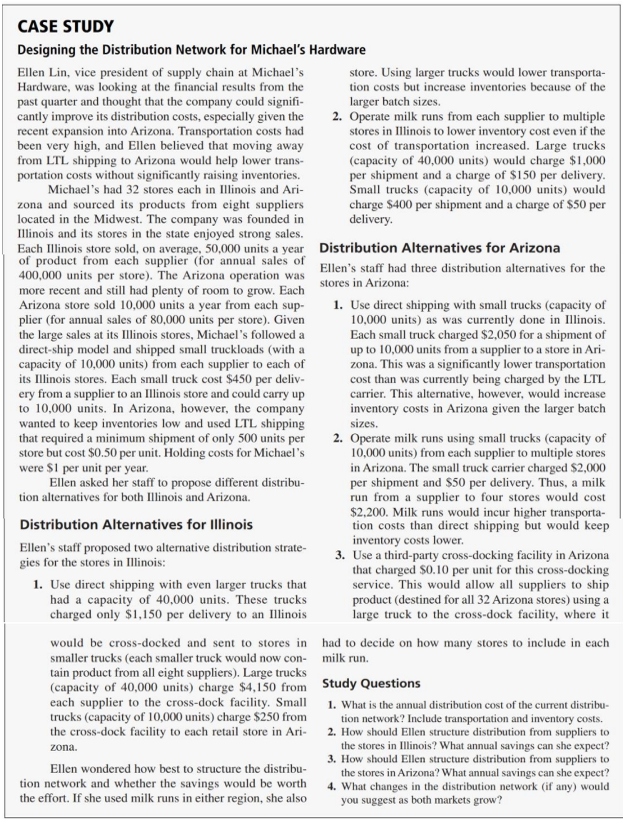
CASE STUDY Designing the Distribution Network for Michael's Hardware Ellen Lin, vice president of supply chain at Michael's store. Using larger trucks would lower transporta- Hardware, was looking at the financial results from the tion costs but increase inventories because of the past quarter and thought that the company could signifi- larger batch sizes. cantly improve its distribution costs, especially given the 2. Operate milk runs from each supplier to multiple recent expansion into Arizona. Transportation costs had stores in Illinois to lower inventory cost even if the been very high, and Ellen believed that moving away cost of transportation increased. Large trucks from LTL shipping to Arizona would help lower trans- (capacity of 40,000 units) would charge $1,000 portation costs without significantly raising inventories. per shipment and a charge of $150 per delivery. Michael's had 32 stores each in Illinois and Ari- Small trucks (capacity of 10,000 units) would zona and sourced its products from eight suppliers charge $400 per shipment and a charge of $50 per located in the Midwest. The company was founded in delivery Illinois and its stores in the state enjoyed strong sales. Each Illinois store sold, on average, 50,000 units a year Distribution Alternatives for Arizona of product from each supplier (for annual sales of 400,000 units per store). The Arizona operation was Ellen's staff had three distribution alternatives for the more recent and still had plenty of room to grow. Each stores in Arizona: Arizona store sold 10,000 units a year from each sup 1. Use direct shipping with small trucks (capacity of plier (for annual sales of 80,000 units per store). Given 10,000 units) as was currently done in Illinois. the large sales at its Illinois stores, Michael's followed a Each small truck charged $2,050 for a shipment of direct-ship model and shipped small truckloads (with a up to 10,000 units from a supplier to a store in Ari- capacity of 10,000 units) from each supplier to each of zona. This was a significantly lower transportation its Illinois stores. Each small truck cost $450 per deliv- cost than was currently being charged by the LTL ery from a supplier to an Illinois store and could carry up carrier. This alternative, however, would increase to 10,000 units. In Arizona, however, the company inventory costs in Arizona given the larger batch wanted to keep inventories low and used LTL shipping sizes. that required a minimum shipment of only 500 units per 2. Operate milk runs using small trucks (capacity of store but cost $0.50 per unit. Holding costs for Michael's 10,000 units) from each supplier to multiple stores were $1 per unit per year. in Arizona. The small truck carrier charged $2,000 Ellen asked her staff to propose different distribu- per shipment and $50 per delivery. Thus, a milk tion alternatives for both Illinois and Arizona. run from a supplier to four stores would cost $2,200. Milk runs would incur higher transporta- Distribution Alternatives for Illinois tion costs than direct shipping but would keep Ellen's staff proposed two alternative distribution strate- inventory costs lower gies for the stores in Illinois: 3. Use a third-party cross-docking facility in Arizona that charged $0.10 per unit for this cross-docking 1. Use direct shipping with even larger trucks that service. This would allow all suppliers to ship had a capacity of 40,000 units. These trucks product (destined for all 32 Arizona stores) using a charged only $1,150 per delivery to an Illinois large truck to the cross-dock facility, where it would be cross-docked and sent to stores in had to decide on how many stores to include in each smaller trucks (each smaller truck would now con- milk run. tain product from all eight suppliers). Large trucks (capacity of 40,000 units) charge $4,150 from Study Questions each supplier to the cross-dock facility. Small 1. What is the annual distribution cost of the current distribu- trucks (capacity of 10,000 units) charge $250 from tion network? Include transportation and inventory costs. the cross-dock facility to each retail store in Ari- 2. How should Ellen structure distribution from suppliers to zona. the stores in Illinois? What annual savings can she expect? 3. How should Ellen structure distribution from suppliers to Ellen wondered how best to structure the distribu- the stores in Arizona? What annual savings can she expect? tion network and whether the savings would be worth 4. What changes in the distribution network (if any) would the effort. If she used milk runs in either region, she also you suggest as both markets grow









 Study Help