Question: CASE STUDY Designing the Distribution Network for Michael's Ellen Lin, vice president of supply chain at Michael's Hardware, was looking at the financial results from
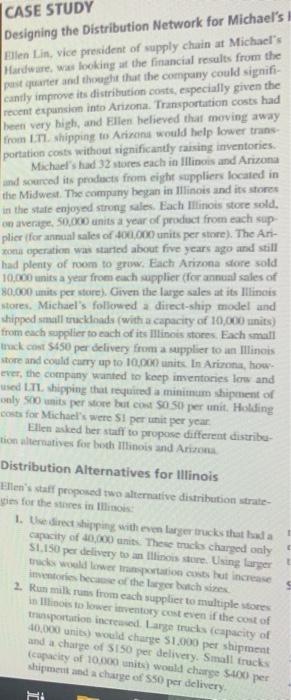
CASE STUDY Designing the Distribution Network for Michael's Ellen Lin, vice president of supply chain at Michael's Hardware, was looking at the financial results from the past quarter and thought that the company could signifi cantly improve its distribution costs, especially given the recent expansion into Arizona. Transportation costs had been very high, and Ellen believed that moving away from LT shipping to Arizon would help lower trans- portation costs without significantly raising inventories Michael's had 32 stores each in Illinois and Arizona und sourced its products from eight suppliers located in the Midwest. The company began in Illinois and its stores in the state enjoyed strong sales. Each Illinois store sold on average 50.000 units a year of product from each sup plier for annual sales of 400,000 units per store). The An- zona operation was started about five years ago and still had plenty of room to grow. Each Arizona dore sold 10,000 units a year from each supplier (for annual sales of 80,000 units per store). Given the large sales at its Illinois stores. Michael's followed a direct ship model and shipped small truckloads (with a capacity of 10,000 units) from each supplier to each of its Illinois stores. Each small track cost $450 per delivery from a supplier to an Illinois store and could curry up to 10.000 units. In Arizona, how ever, the company wanted to keep inventories low and used ETL shipping that required a minimum shipment of only 500 units per store but cost SO S per unit. Holding costs for Michael's were si permit per year Ellen asked her staff to propose different distribe tion alternatives for both Thinois and Art Distribution Alternatives for Illinois Ellen's staff proposed two alternative distribution strate- gies for the stores in Illinois 1. Ue direct shipping with larger trucks that ada capacity of 40.000 unit. These tracks charged only SL.150 per delivery to an Illinons store. Using larger tracks we wet sportation but increase to be the larger bunch sizes 2. Run milk runs from each supplier to multiple stores in los to lower inventory cost even if the cost of transportation increased. Large trucks (capacity of 40,000 units) would charge 51.000 per shipment and a charge of $150 per delivery. Small tracks capacity of 10.000 units) would change S400 per shipment and a charge of $50 per delivery CASE STUDY Designing the Distribution Network for Michael's Ellen Lin, vice president of supply chain at Michael's Hardware, was looking at the financial results from the past quarter and thought that the company could signifi cantly improve its distribution costs, especially given the recent expansion into Arizona. Transportation costs had been very high, and Ellen believed that moving away from LT shipping to Arizon would help lower trans- portation costs without significantly raising inventories Michael's had 32 stores each in Illinois and Arizona und sourced its products from eight suppliers located in the Midwest. The company began in Illinois and its stores in the state enjoyed strong sales. Each Illinois store sold on average 50.000 units a year of product from each sup plier for annual sales of 400,000 units per store). The An- zona operation was started about five years ago and still had plenty of room to grow. Each Arizona dore sold 10,000 units a year from each supplier (for annual sales of 80,000 units per store). Given the large sales at its Illinois stores. Michael's followed a direct ship model and shipped small truckloads (with a capacity of 10,000 units) from each supplier to each of its Illinois stores. Each small track cost $450 per delivery from a supplier to an Illinois store and could curry up to 10.000 units. In Arizona, how ever, the company wanted to keep inventories low and used ETL shipping that required a minimum shipment of only 500 units per store but cost SO S per unit. Holding costs for Michael's were si permit per year Ellen asked her staff to propose different distribe tion alternatives for both Thinois and Art Distribution Alternatives for Illinois Ellen's staff proposed two alternative distribution strate- gies for the stores in Illinois 1. Ue direct shipping with larger trucks that ada capacity of 40.000 unit. These tracks charged only SL.150 per delivery to an Illinons store. Using larger tracks we wet sportation but increase to be the larger bunch sizes 2. Run milk runs from each supplier to multiple stores in los to lower inventory cost even if the cost of transportation increased. Large trucks (capacity of 40,000 units) would charge 51.000 per shipment and a charge of $150 per delivery. Small tracks capacity of 10.000 units) would change S400 per shipment and a charge of $50 per delivery









 Study Help