







Question: case study how does the use of RFID increase EFFICENCY in supply chain ? CASE Hassia Waters International locations. Green and red are used to
case study
how does the use of RFID increase EFFICENCY in supply chain ?
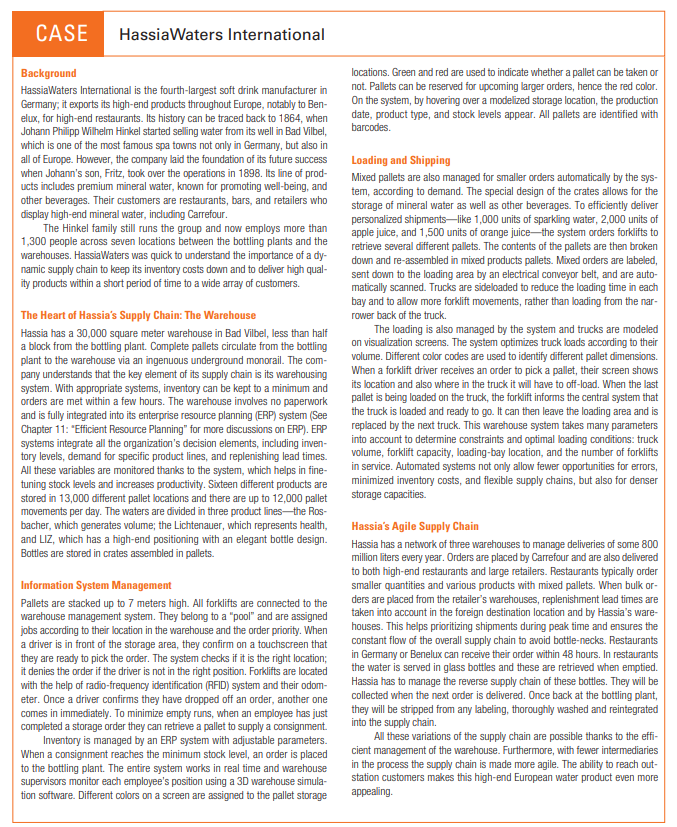
CASE Hassia Waters International locations. Green and red are used to indicate whether a pallet can be taken or not. Pallets can be reserved for upcoming larger orders, hence the red color. On the system, by hovering over a modelized storage location, the production date, product type, and stock levels appear. All pallets are identified with barcodes. Background HassiaWaters International is the fourth-largest soft drink manufacturer in Germany; it exports its high-end products throughout Europe, notably to Ben- elux, for high-end restaurants. Its history can be traced back to 1864, when Johann Philipp Wilhelm Hinkel started selling water from its well in Bad Vilbel, which is one of the most famous spa towns not only in Germany, but also in all of Europe. However, the company laid the foundation of its future success when Johann's son, Fritz, took over the operations in 1898. Its line of prod- ucts includes premium mineral water, known for promoting well-being, and other beverages. Their customers are restaurants, bars, and retailers who display high-end mineral water, including Carrefour. The Hinkel family still runs the group and now employs more than 1,300 people across seven locations between the bottling plants and the warehouses. Hassia Waters was quick to understand the importance of a dy- namic supply chain to keep its inventory costs down and to deliver high qual- ity products within a short period of time to a wide array of customers. 1 The Heart of Hassia's Supply Chain: The Warehouse Hassia has a 30,000 square meter warehouse in Bad Vilbel, less than half a block from the bottling plant. Complete pallets circulate from the bottling plant to the warehouse via an ingenuous underground monorail. The com- pany understands that the key element of its supply chain is its warehousing system. With appropriate systems, inventory can be kept to a minimum and orders are met within a few hours. The warehouse involves no paperwork and is fully integrated into its enterprise resource planning (ERP) system (See Chapter 11: "Efficient Resource Planning" for more discussions on ERP). ERP systems integrate all the organization's decision elements, including inven- tory levels, demand for specific product lines, and replenishing lead times. All these variables are monitored thanks to the system, which helps in fine- tuning stock levels and increases productivity. Sixteen different products are stored in 13,000 different pallet locations and there are up to 12,000 pallet movements per day. The waters are divided in three product lines-the Ros- bacher, which generates volume; the Lichtenauer, which represents health, and LIZ, which has a high-end positioning with an elegant bottle design. Bottles are stored in crates assembled in pallets. Loading and Shipping Mixed pallets are also managed for smaller orders automatically by the sys- tem, according to demand. The special design of the crates allows for the storage of mineral water as well as other beverages. To efficiently deliver personalized shipmentslike 1,000 units of sparkling water, 2,000 units of apple juice, and 1,500 units of orange juicethe system orders forklifts to retrieve several different pallets. The contents of the pallets are then broken down and re-assembled in mixed products pallets. Mixed orders are labeled, sent down to the loading area by an electrical conveyor belt, and are auto- matically scanned. Trucks are sideloaded to reduce the loading time in each bay and to allow more forklift movements, rather than loading from the nar- rower back of the truck The loading is also managed by the system and trucks are modeled on visualization screens. The system optimizes truck loads according to their volume. Different color codes are used to identify different pallet dimensions. When a forklift driver receives an order to pick a pallet, their screen shows its location and also where in the truck it will have to off-load. When the last pallet is being loaded on the truck, the forklift informs the central system that the truck is loaded and ready to go. It can then leave the loading area and is replaced by the next truck. This warehouse system takes many parameters into account to determine constraints and optimal loading conditions: truck volume, forklift capacity, loading-bay location, and the number of forklifts in service. Automated systems not only allow fewer opportunities for errors, minimized inventory costs, and flexible supply chains, but also for denser storage capacities. Information System Management Pallets are stacked up to 7 meters high. All forklifts are connected to the warehouse management system. They belong to a "pool" and are assigned jobs according to their location in the warehouse and the order priority. When a driver is in front of the storage area, they confirm on a touchscreen that they are ready to pick the order. The system checks if it is the right location; it denies the order if the driver is not in the right position. Forklifts are located with the help of radio-frequency identification (RFID) system and their odom- eter. Once a driver confirms they have dropped off an order, another one comes in immediately. To minimize empty runs, when an employee has just completed a storage order they can retrieve a pallet to supply a consignment. Inventory is managed by an ERP system with adjustable parameters. When a consignment reaches the minimum stock level, an order is placed to the bottling plant. The entire system works in real time and warehouse supervisors monitor each employee's position using a 3D warehouse simula- tion software. Different colors on a screen are assigned to the pallet storage Hassia's Agile Supply Chain Hassia has a network of three warehouses to manage deliveries of some 800 million liters every year. Orders are placed by Carrefour and are also delivered to both high-end restaurants and large retailers. Restaurants typically order smaller quantities and various products with mixed pallets. When bulk or- ders are placed from the retailer's warehouses, replenishment lead times are taken into account in the foreign destination location and by Hassia's ware- houses. This helps prioritizing shipments during peak time and ensures the constant flow of the overall supply chain to avoid bottle-necks. Restaurants in Germany or Benelux can receive their order within 48 hours. In restaurants the water is served in glass bottles and these are retrieved when emptied. Hassia has to manage the reverse supply chain of these bottles. They will be collected when the next order is delivered. Once back at the bottling plant, they will be stripped from any labeling, thoroughly washed and reintegrated into the supply chain All these variations of the supply chain are possible thanks to the effi- cient management of the warehouse. Furthermore, with fewer intermediaries in the process the supply chain is made more agile. The ability to reach out- station customers makes this high-end European water product even more appealingStep by Step Solution
There are 3 Steps involved in it
1 Expert Approved Answer
Step: 1 Unlock

Question Has Been Solved by an Expert!
Get step-by-step solutions from verified subject matter experts
Step: 2 Unlock
Step: 3 Unlock
 Study Help