







Question: case study human resource i will relate to the readings I Three years ago, Jackson Pharmaceuticals (JP) initiated a mentorship program to develop talent for
case study human resource 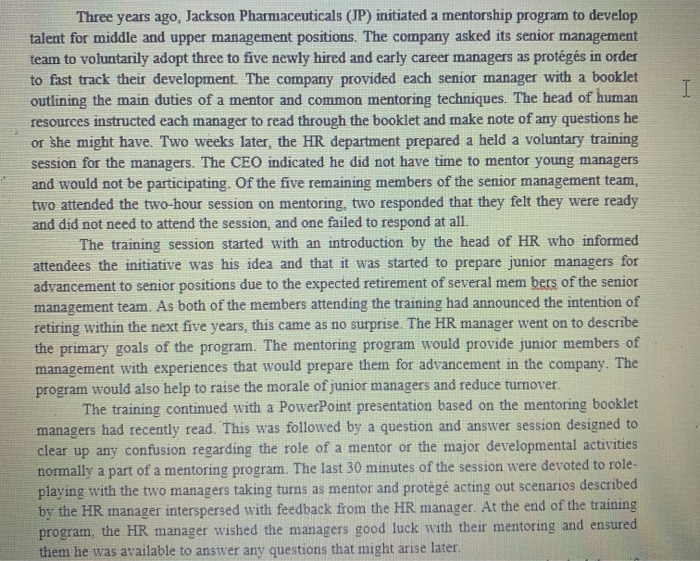
i will relate to the readings
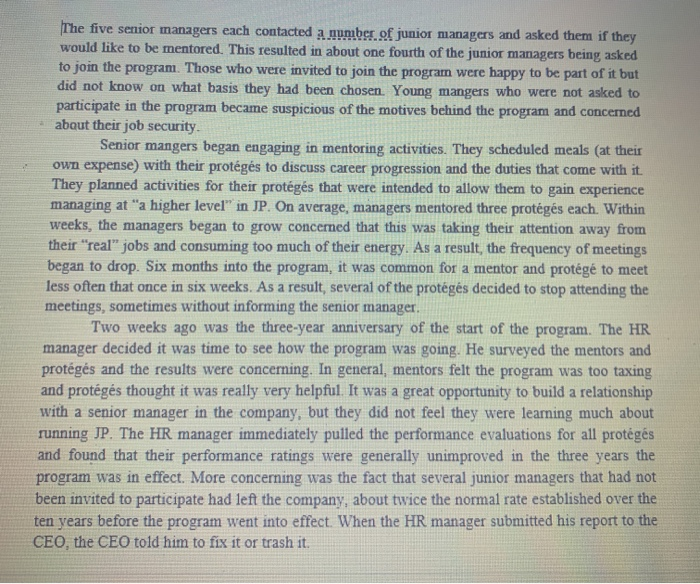
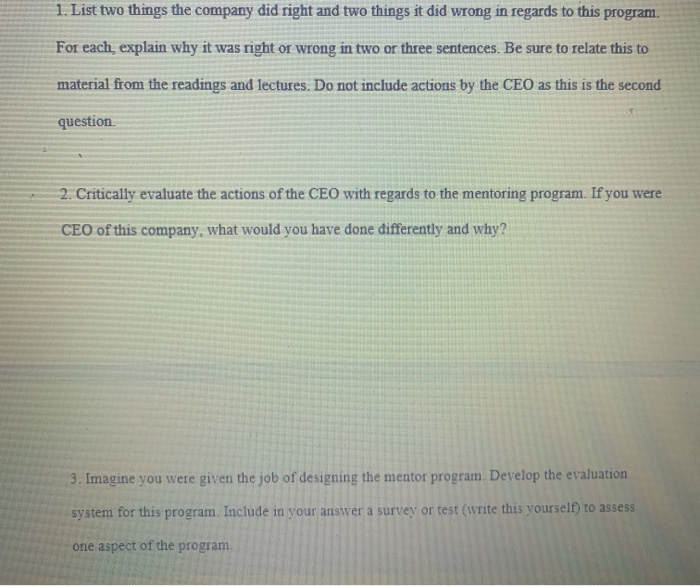
I Three years ago, Jackson Pharmaceuticals (JP) initiated a mentorship program to develop talent for middle and upper management positions. The company asked its senior management team to voluntarily adopt three to five newly hired and early career managers as protgs in order to fast track their development. The company provided each senior manager with a booklet outlining the main duties of a mentor and common mentoring techniques. The head of human resources instructed each manager to read through the booklet and make note of any questions he or she might have. Two weeks later, the HR department prepared a held a voluntary training session for the managers. The CEO indicated he did not have time to mentor young managers and would not be participating. Of the five remaining members of the senior management team, two attended the two-hour session on mentoring, two responded that they felt they were ready and did not need to attend the session, and one failed to respond at all. The training session started with an introduction by the head of HR who informed attendees the initiative was his idea and that it was started to prepare junior managers for advancement to senior positions due to the expected retirement of several members of the senior management team. As both of the members attending the training had announced the intention of retiring within the next five years, this came as no surprise. The HR manager went on to describe the primary goals of the program. The mentoring program would provide junior members of management with experiences that would prepare them for advancement in the company. The program would also help to raise the morale of junior managers and reduce turnover. The training continued with a PowerPoint presentation based on the mentoring booklet managers had recently read. This was followed by a question and answer session designed to clear up any confusion regarding the role of a mentor or the major developmental activities normally a part of a mentoring program. The last 30 minutes of the session were devoted to role- playing with the two managers taking turns as mentor and protg acting out scenarios described by the HR manager interspersed with feedback from the HR manager. At the end of the training program, the HR manager wished the managers good luck with their mentoring and ensured them he was available to answer any questions that might arise later. The five senior managers each contacted a number of junior managers and asked them if they would like to be mentored. This resulted in about one fourth of the junior managers being asked to join the program. Those who were invited to join the program were happy to be part of it but did not know on what basis they had been chosen. Young mangers who were not asked to participate in the program became suspicious of the motives behind the program and concerned about their job security. Senior mangers began engaging in mentoring activities. They scheduled meals (at their own expense) with their protgs to discuss career progression and the duties that come with it. They planned activities for their protgs that were intended to allow them to gain experience managing at a higher level" in JP. On average, managers mentored three protgs each. Within weeks, the managers began to grow concerned that this was taking their attention away from their "real" jobs and consuming too much of their energy. As a result, the frequency of meetings began to drop. Six months into the program, it was common for a mentor and protg to meet less often that once in six weeks. As a result, several of the protgs decided to stop attending the meetings, sometimes without informing the senior manager. Two weeks ago was the three-year anniversary of the start of the program. The HR manager decided it was time to see how the program was going. He surveyed the mentors and protgs and the results were concerning. In general, mentors felt the program was too taxing and protgs thought it was really very helpful. It was a great opportunity to build a relationship with a senior manager in the company, but they did not feel they were learning much about running JP. The HR manager immediately pulled the performance evaluations for all protgs and found that their performance ratings were generally unimproved in the three years the program was in effect. More concerning was the fact that several junior managers that had not been invited to participate had left the company, about twice the normal rate established over the ten years before the program went into effect. When the HR manager submitted his report to the CEO, the CEO told him to fix it or trash it. 1. List two things the company did right and two things it did wrong in regards to this program. For each explain why it was right or wrong in two or three sentences. Be sure to relate this to material from the readings and lectures. Do not include actions by the CEO as this is the second question 2. Critically evaluate the actions of the CEO with regards to the mentoring program. If you were CEO of this company, what would you have done differently and why? 3. Imagine you were given the job of designing the mentor program. Develop the evaluation system for this program. Include in your answer a survey or test (write this yourself) to assess one aspect of the program
Step by Step Solution
There are 3 Steps involved in it
1 Expert Approved Answer
Step: 1 Unlock

Question Has Been Solved by an Expert!
Get step-by-step solutions from verified subject matter experts
Step: 2 Unlock
Step: 3 Unlock
 Study Help