







Question: I NEED IT ALL CORRECT 1 Considering the facts about Kazakhstan, please discuss which staffing strategy according to the EPRG Model by Perlmutter would be
I NEED IT ALL CORRECT
1 Considering the facts about Kazakhstan, please discuss which staffing strategy according to the EPRG Model by Perlmutter would be the most suitable for Kazakhstan. Please justify your answer. Comment on advantages and disadvantages of your decision.
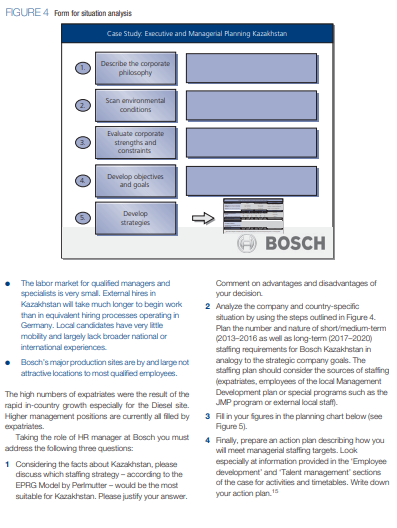
2 Analyze the company and country-specific situation by using the steps outlined in Figure 4. Plan the number and nature of short/medium-term (20132016 as well as long-term (20172020) staffing requirements for Bosch Kazakhstan in analogy to the strategic company goals. The staffing plan should consider the sources of staffing (expatriates, employees of the local Management Development plan or special programs such as the JMP program or external local staff).
3 Fill in your figures in the planning chart below (see Figure 5).
4 Finally, prepare an action plan describing how you will meet managerial staffing targets. Look especially at information provided in the Employee development and Talent management sections of the case for activities and timetables. Write down your action plan.15
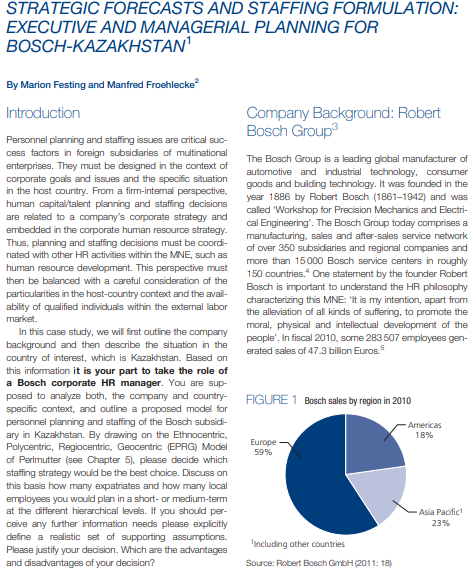
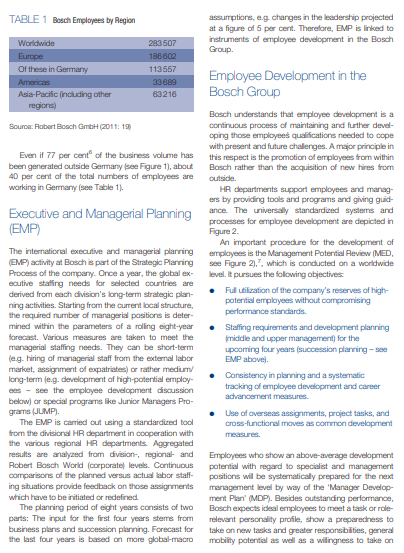
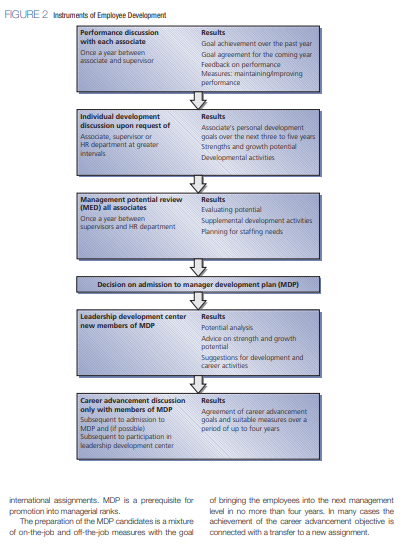
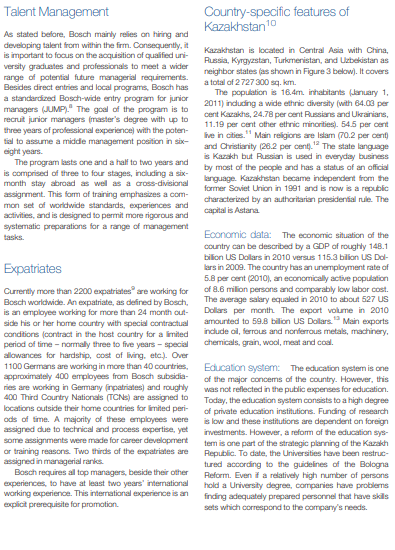
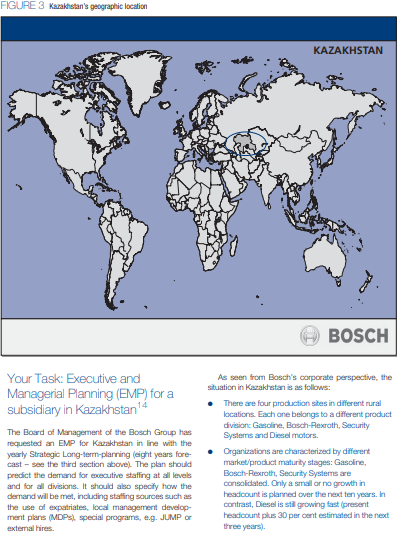
STRATEGIC FORECASTS AND STAFFING FORMULATION: EXECUTIVE AND MANAGERIAL PLANNING FOR BOSCH-KAZAKHSTAN By Marion Festing and Manfred Froehlecke? Introduction Company Background: Robert Bosch Group Personnel planning and staffing issues are critical suc- cess factors in foreign subsidiaries of multinational enterprises. They must be designed in the context of corporate goals and issues and the specific situation in the host country. From a firm-internal perspective, human capital talent planning and staffing decisions are related to a company's corporate strategy and embedded in the corporate human resource strategy Thus, planning and staffing decisions must be coordi- nated with other HR activities within the MNE, such as human resource development. This perspective must then be balanced with a careful consideration of the particularities in the host-country context and the avail ability of qualified individuals within the external labor market. In this case study, we will first outline the company background and then describe the situation in the country of interest, which is Kazakhstan. Based on this information it is your part to take the role of a Bosch corporate HR manager. You are sup- posed to analyze both, the company and country- specific context, and outline a proposed model for personnel planning and staffing of the Bosch subsidi- ary in Kazakhstan. By drawing on the Ethnocentric, Polycentric, Regiocentric, Geocentric (EPRG) Model of Perlmutter (see Chapter 5), please decide which staffing strategy would be the best choice. Discuss on this basis how many expatriates and how many local employees you would plan in a short-or medium-term at the different hierarchical levels. If you should per- ceive any further information needs please explicitly define a realistic set of supporting assumptions. Please justify your decision. Which are the advantages and disadvantages of your decision? The Bosch Group is a leading global manufacturer of automotive and industrial technology, consumer goods and building technology. It was founded in the year 1886 by Robert Bosch (1861-1942) and was called 'Workshop for Precision Mechanics and Electri- cal Engineering. The Bosch Group today comprises a manufacturing, sales and after-sales service network of over 350 subsidiaries and regional companies and more than 15000 Bosch service centers in roughly 150 countries. One statement by the founder Robert Bosch is important to understand the HR philosophy characterizing this MNE: 'It is my intention, apart from the alleviation of all kinds of suffering, to promote the moral, physical and intellectual development of the people". In fiscal 2010, some 283 507 employees gen- erated sales of 47.3 bilion Euros. FIGURE 1 Bosch sales by region in 2010 Americas 18% Europe 59% Asia Pacific 23% including other countries Source: Robert Bosch GmbH (2011:18) TABLE 1 Bosch Employees by Region assumptions, e.g changes in the leadership projected at a figure of 5 per cent. Therefore, EMP is linked to instruments of employee development in the Bosch Group. Worldwide 283507 186602 113557 Europe Of these in Germany Americas Asia-Pacific (including other regions) 33 689 Employee Development in the Bosch Group 63216 Source: Robert Bosch GmbH (2011:19 Even if 77 per cent of the business volume has been generated outside Germany (see Figure 1), about 40 per cent of the total numbers of employees are working in Germany (see Table 1) Executive and Managerial Planning (EMP) Bosch understands that employee development is a continuous process of maintaining and further devel- oping those employees qualifications needed to cope with present and future challenges. A major principle in this respect is the promotion of employees from within Bosch rather than the acquisition of new hires from outside HR departments support employees and manag- ers by providing tools and programs and giving guid- ance. The universally standardized systems and processes for employee development are depicted in Figure 2. An important procedure for the development of employees is the Management Potential Review MED, see Figure 2)," which is conducted on a worldwide level. It pursues the following objectives Full utilization of the company's reserves of high- potential employees without compromising performance standards. Staffing requirements and development planning micidle and upper management for the upcoming four years (succession planning - see EMP above Consistency in planning and a systematic tracking of employee development and career The international executive and managerial planning (EMP) activity at Bosch is part of the Strategic Planning Process of the company. Once a year, the global ex ecutive stating needs for selected countries are derived from each division's long-term strategic plan- ning activities. Starting from the current local structure, the required number of managerial positions is deter- mined within the parameters of a rolling eight-year forecast. Various measures are taken to meet the managerial staffing needs. They can be short-term le.g. hiring of managerial staff from the external labor market, assignment of expatriates) or rather medium long-term le.g. development of high-potential employ ees - see the employee development discussion below) or special programs like Junior Maregers Pro- grams (JUMP). The EMP is carried out using a standardized tool from the divisional HR department in cooperation with the various regional HR departments. Aggregated results are analyzed from division, regional and Robert Bosch World (corporate levels. Continuous comparison of the planned versus actual labor staff ing situations provide feedback on those assignments which have to be initiated or redefined The planning period of eight years consists of two parts: The input for the first four years sters from business plans and succession planning. Forecast for the last four years is based on more global-macro advancement measures Lise of overseas assignments, project tasks, and cross-functional moves as common development measures Employees who show an above average development potential with regard to specialist and management positions will be systematically prepared for the next menagement level by way of the Manager Develop merit Plan (MDP). Besides outstanding performance, Bosch expects ideal employees to meet a task or role relevant personality profile, show a preparedness to take on new tasks and greater responsibilities, general mobility potential as well as a willingness to take on FIGURE 2 Instruments of Employee Development Results Performance discussion with each associate Once a year between associate and supervisor Goal achievement over the past year Goal agreement for the coming your Feedback on performance Measures: maintaining improving performance Results Individual development discussion upon request of Associate, supervisor or HR department at greater intervals Associate's personal development goals over the next three to five years Strengths and growth potential Developmental activities Results Management potential review (MED) all associates Once a year between supervisors and HR department Evaluating potential Supplemental development activities Planning for staffing needs Decision on admission to manager development plan (MDP) Leadership development center new members of MDP Results Potential analysis Advice on strength and growth potential Suggestions for development and career activities Results Career advancement discussion only with members of MDP Subsequent to admission to MDP and if possible Subsequent to participation in leadership development center Agreement of career advancement goals and suitable measures over a period of up to four years international assignments. MDP is a prerequisite for promotion into managerial ranks. The preparation of the MDP candidates is a mixture of on-the-job and off-the-job measures with the goal of bringing the employees into the rest management level in no more than four years. In many cases the achievement of the career advancement objective is connected with a transfer to a new assignment Talent Management Country-specific features of Kazakhstan 10 As stated before, Bosch mainly relies on hiring and developing talent from within the firm. Consequently, it is important to focus on the acquisition of qualified uni- versity graduates and professionals to meet a wider range of potential future managerial requirements. Besides direct entries and local programs. Bosch has a standardized Bosch-wide entry program for junior managers (JUMP). The goal of the program is to recruit junior managers (master's degree with up to three years of professional experience with the poten- tical to assume a midde management position in six- eight years. The program lasts one and a half to two years and is comprised of three to four stages, including a six- month stay abroad as well as a cross-divisional assignment. This form of training emphasizes a com mon set of worldwide standards, experiences and activities, and is designed to permit more rigorous and systematic preparations for a range of management tasks. Kazakhstan is located in Central Asia with China, Russia, Kyrgyzstan, Turkmenistan, and Uzbekistan as neighbor states (as shown in Figure 3 below). It covers a total of 2727 300 sq. km. The population is 16.4m. inhabitants (anuary 1, 2011) indluding a wide ethnic diversity (with 64.02 per cent Kazakhs, 24.78 per cent Russians and Ukrainians, 11.19 per cent other ethnic minorities). 54.5 percent live in cities." Main religions are Islam (70.2 percent) and Christianity (28.2 per cent). The state language is Kazakh but Russion is used in everyday business by most of the people and has a status of an official language. Kazakhstan became independent from the former Soviet Union in 1991 and is now is a republic characterized by an authoritarian presidential rule. The capitalis Astana Expatriates Economic data: The economic situation of the country can be described by a GDP of roughly 148.1 billion US Dollars in 2010 versus 115.3 billion US Dol- bars in 2009. The country has an unemployment rate of 5.8 per cent (2010), an economically active population of 8.6 million persons and comparably low labor cost. The average salary equaled in 2010 to about 527 US Dollars per month The export volume in 2010 amounted to 59.8 bilion US Dollars Main exports include oil, ferrous and nonferrous metals, machinery, chemicals, grain, wool, meat and coal. Currently more than 2200 expatriates are working for Bosch worldwide. An expatriate, as defined by Bosch, is an employee working for more than 24 month out- side his or her home country with special contractual conditions (contract in the host country for a limited period of time - normally three to five years - special allowances for hardship, cost of living, etc.). Over 1100 Germans are working in more than 40 countries. approacimately 400 employees from Bosch subsidia ries are working in Germany inpatriates) and roughly 400 Third Country Nationals (TCN) are assigned to locations outside their home countries for limited peri- ods of time. A majority of these employees were assigned due to technical and process expertise, yet some assignments were made for career development or training reasons. Two thirds of the expatriates are assigned in managerial ranks Bosch requires al top managers, beside their other experiences to have at least two years' international working experience. This international experience is an explicit prerequisite for promotion Education system: The education system is one of the major concems of the country. However, this was not reflected in the public expenses for education Today, the education system consists to a high degree of private education institutions. Funding of research is low and these institutions are dependent on foreign investments. However, a reform of the education sys- tem is one part of the strategic planning of the Kazach Republic. To date, the Universities have been restruc- tured according to the guidelines of the Bologna Reform. Even if a relatively high number of persons hold a University degree, companies have problems finding adequately prepared personnel that have skils sets which correspond to the company's needs. FIGURE 3 Kazakistan's geographic location KAZAKHSTAN BOSCH As seen from Bosch's corporate perspective, the situation in Kazakhstan is as follows: Your Task: Executive and Managerial Planning (EMP) for a subsidiary in Kazakhstan There are four production sites in different rural locations. Each one belongs to a different product division Gasolina, Bosch Rexroth, Security Systems and Diesel motors. The Board of Management of the Bosch Group has requested an EMP for Kazakhstan in line with the yearly Strategic Long-term-plarning eight years fore- cast - see the third section above. The plan should predict the demand for executive staffing at all levels and for all divisions. It should also specify how the derand will be met, including staffing sources such as the use of expatriates, local management develop ment plans (MDPS special programs, e.g. JUMP or extemal hires Organizations are characterized by different market/product maturity stages: Gasoline, Bosch-Rexroth, Security Systems are consolidated. Only a small or no growth in headcount is planned over the next ten years. In contrast, Diesel is still growing fast present headcount plus 30 per cent estimated in the next three years) FIGURE 4 Form for situation analysis Case Study. Executive and Managerial Planning Kazakhstan Describe the corporate philosophy Scan environmental conditions 11 Evaluate corporate strengths and constraints Develop objectives and goals Develop strategies -> BOSCH Comment on advantages and disadvantages of your decision The labor market for qualified managers and specialists is very smal. External hires in Kazakhstan will take much longer to begin work than in equivalent hiring processes operating in Germany. Local candidates have very little mobility and largely lack broader national or international experiences 2 Analyze the company and country-specific situation by using the steps outlined in Figure 4. Plan the number and nature of short/medium-term (2013-2016 as well as long-term (2017-2020) staffing requirements for Bosch Kazakhstan in analogy to the strategic company goals. The staffing plan should consider the sources of stating (expatriates, errployees of the local Management Development plan or special programs such as the JMP program or external local staff). Bosch's major production sites are by and large not attractive locations to most qualified employees. The high numbers of espatriates were the result of the rapid in-country growth especially for the Diesel site. Higher management positions are currently all filled by expatriates. Taking the role of HR manager at Bosch you must address the folowing three questions: 3 Fil in your figures in the planning chart below (see Figure 5). 1 Considering the facts about Kazakhstan, please discuss which staffing strategy - according to the EPRG Modelby Perlmutter-would be the most suitable for Kazakhstan. Please justify your answer 4 Finally, prepare an action plan describing how you wil meet managerial staffing targets. Look especially at information provided in the 'Employee development and Talent management sections of the case for activities and timetables. Write down your action plantsStep by Step Solution
There are 3 Steps involved in it

Get step-by-step solutions from verified subject matter experts
 Study Help