







Question: CASE STUDY: JEANS THERAPY - LEVI'S FACTORY WORKERS ARE ASSIGNED TO TEAMS, AND MORALE TAKES A HIT SAN FRANCISCO.CAL. LEVI STRAUSS & CO. ORIGINAL RIVETED
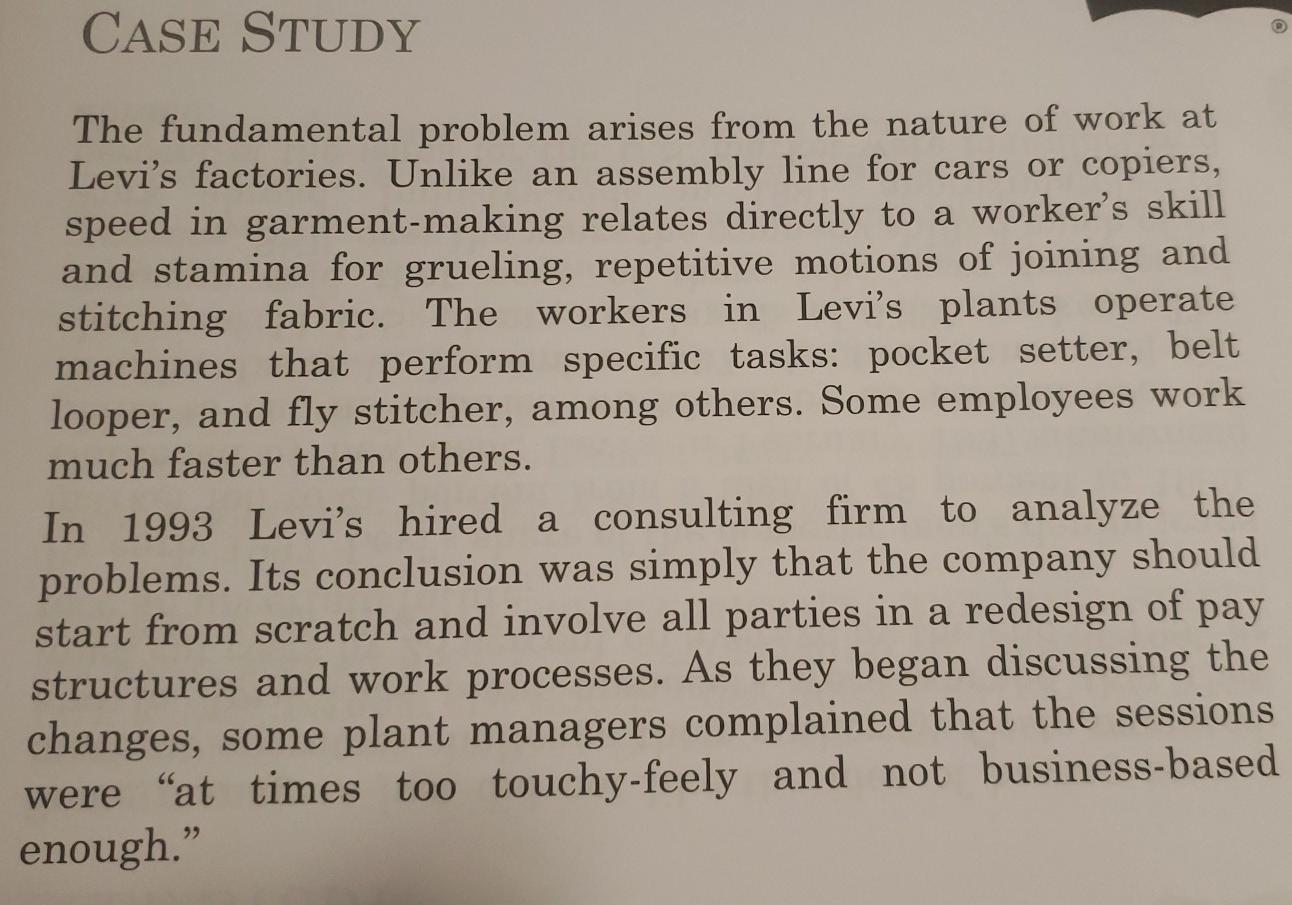
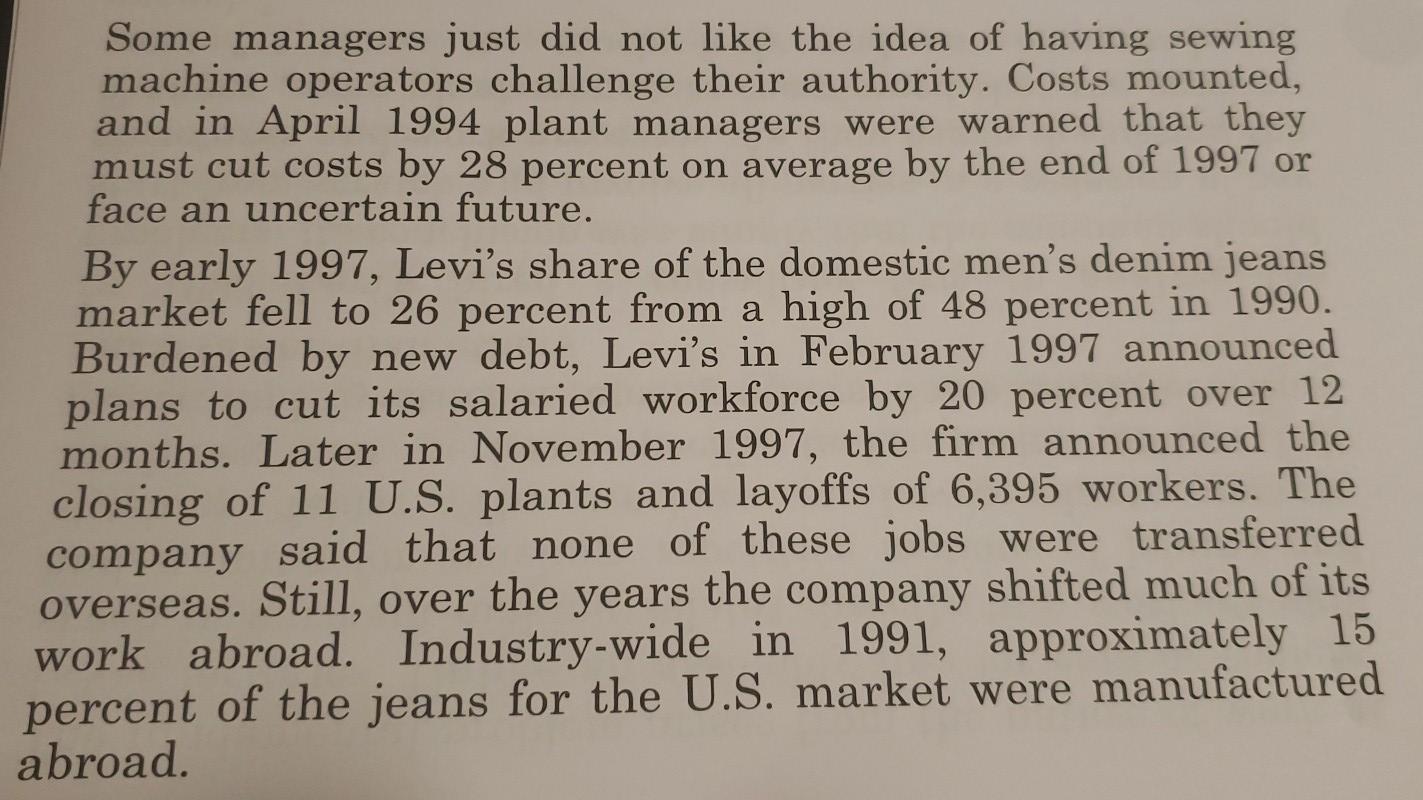
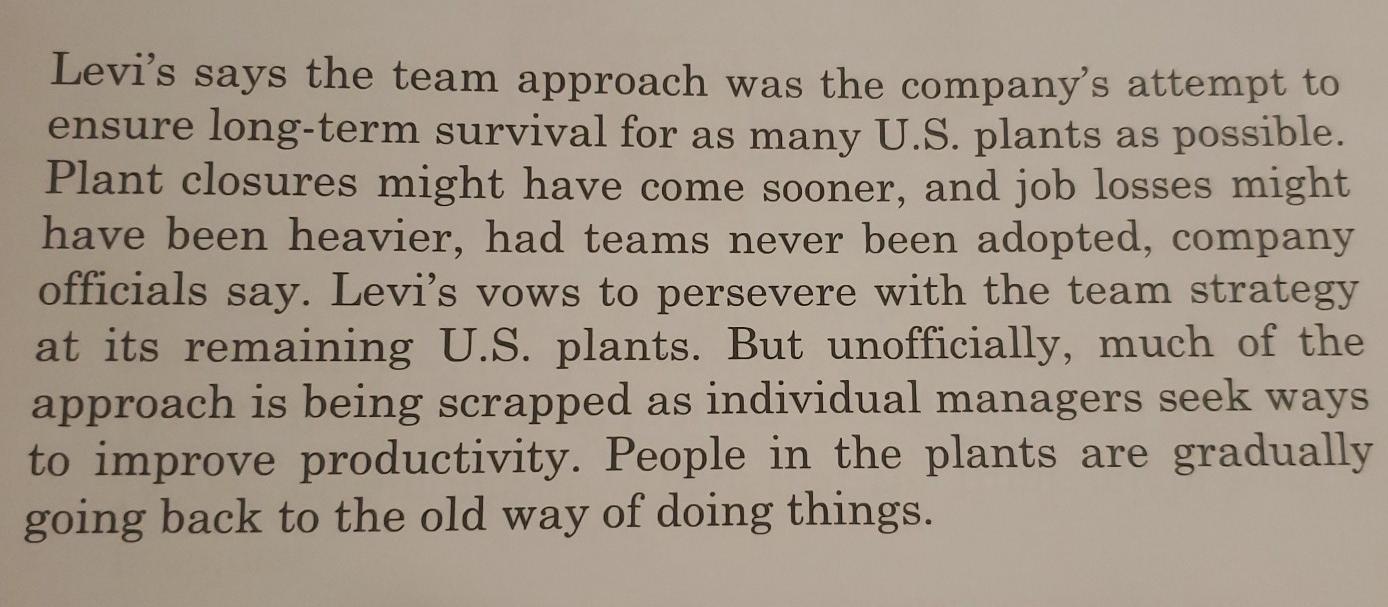
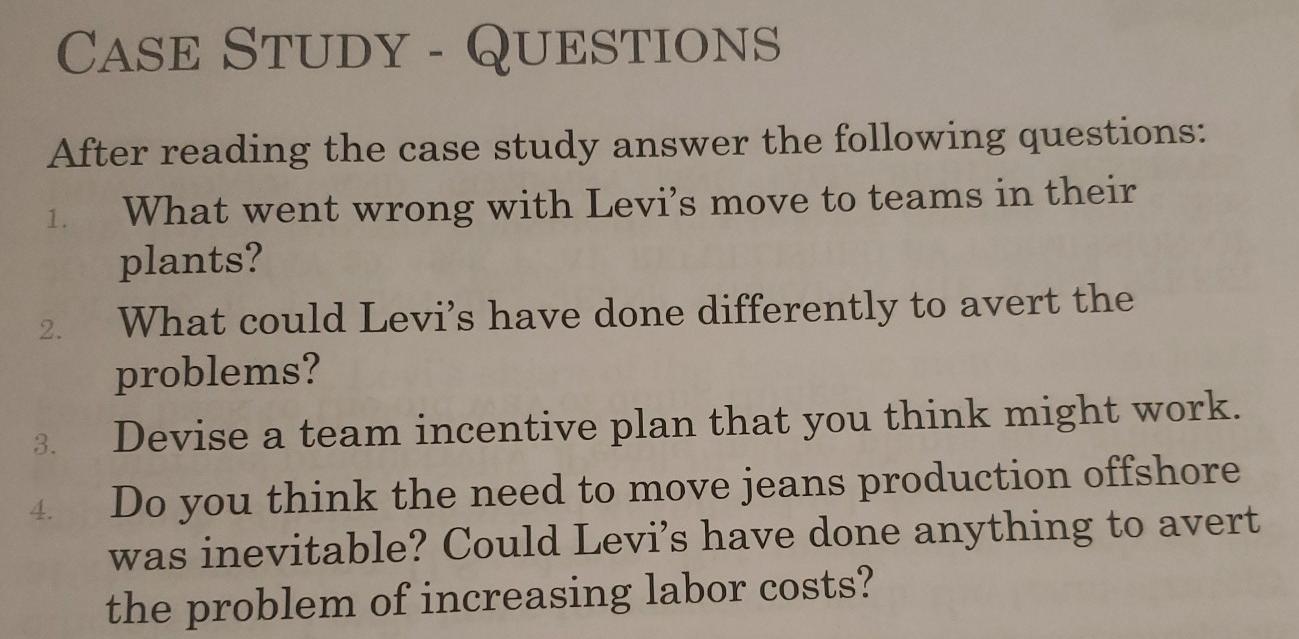
CASE STUDY: JEANS THERAPY - LEVI'S FACTORY WORKERS ARE ASSIGNED TO TEAMS, AND MORALE TAKES A HIT SAN FRANCISCO.CAL. LEVI STRAUSS & CO. ORIGINAL RIVETED QUALITY CLOTHING MARK TRADE Levi's CASE STUDY In an industry notorious for low wages and lousy working conditions, Levi's has prided itself on being a grand exception. It offered generous pay plus plenty of charity support in factory townsall financed by the phenomenal profitability of its brilliantly marketed brand name. It clung to a large U.S. manufacturing base long after other apparel firms began moving offshore, and it often was ranked among the best companies to work for. But to many of Levi's workers, the company's image has not fit for some time. In 1992 the company directed its U.S. plants to abandon the old piecework system, under which a worker repeatedly performed a single, specialized task (like sewing zippers or attaching belt loops) and was paid according to the amount of work he or she completed CASE STUDY In the new system, groups of 10 to 35 workers would share the tasks and be paid according to the total number of trousers the group completed. Levi's figured that this would cut down on the monotony of the old system and enable stitchers to do different tasks, thus reducing repetitive-stress injuries. At the time, the team concept was a much-touted movement designed to empower factory workers in many industries, and Levi's unions agreed to the effort. But there was more to it than that for Levi's. Faced with low-cost competitors manufacturing overseas, the San Francisco-based company did not feel it could keep many of its U.S. plants open unless it could raise productivity and reduce costs, particularly those incurred by injured workers pushing to make piecework goals. Teamwork, Levi's felt, would be more humane, safe, and profitable. CASE STUDY Instead, the new system led to a quagmire in which skilled workers found themselves pitted against slower colleagues, damaging morale and triggering corrosive infighting. Many top performers said the first thing they noticed about teams was that their pay shrankand some of them decided to throttle back. They felt cheated because they were making less. Whenever a team member was absent, inexperienced, or just slow, the rest of the team had to make up for it. That infuriated some team members who felt they were carrying subpar workers. With limited supervision from coaches, groups were forced to resolve most workflow and personality issues themselves. CASE STUDY The fundamental problem arises from the nature of work at Levi's factories. Unlike an assembly line for cars or copiers, speed in garment-making relates directly to a worker's skill and stamina for grueling, repetitive motions of joining and stitching fabric. The workers in Levi's plants operate machines that perform specific tasks: pocket setter, belt looper, and fly stitcher, among others. Some employees work much faster than others. In 1993 Levi's hired a consulting firm to analyze the problems. Its conclusion was simply that the company should start from scratch and involve all parties in a redesign of pay structures and work processes. As they began discussing the changes, some plant managers complained that the sessions were at times too touchy-feely and not business-based enough." Some managers just did not like the idea of having sewing machine operators challenge their authority. Costs mounted, and in April 1994 plant managers were warned that they must cut costs by 28 percent on average by the end of 1997 or face an uncertain future. By early 1997, Levi's share of the domestic men's denim jeans market fell to 26 percent from a high of 48 percent in 1990. Burdened by new debt, Levi's in February 1997 announced plans to cut its salaried workforce by 20 percent over 12 months. Later in November 1997, the firm announced the closing of 11 U.S. plants and layoffs of 6,395 workers. The company said that none of these jobs were transferred overseas. Still, over the years the company shifted much of its work abroad. Industry-wide in 1991, approximately 15 percent of the jeans for the U.S. market were manufactured abroad. Levi's says the team approach was the company's attempt to ensure long-term survival for as many U.S. plants as possible. Plant closures might have come sooner, and job losses might have been heavier, had teams never been adopted, company officials say. Levi's vows to persevere with the team strategy at its remaining U.S. plants. But unofficially, much of the approach is being scrapped as individual managers seek ways to improve productivity. People in the plants are gradually going back to the old way of doing things. CASE STUDY - QUESTIONS 1. 2. After reading the case study answer the following questions: What went wrong with Levi's move to teams in their plants? What could Levi's have done differently to avert the problems? Devise a team incentive plan that you think might work. Do you think the need to move jeans production offshore was inevitable? Could Levi's have done anything to avert the problem of increasing labor costs? 3
Step by Step Solution
There are 3 Steps involved in it
1 Expert Approved Answer
Step: 1 Unlock

Question Has Been Solved by an Expert!
Get step-by-step solutions from verified subject matter experts
Step: 2 Unlock
Step: 3 Unlock
 Study Help