







Question: CASE STUDY looking ideas focused on environmentally friendly manufac- new life: turing. transportation, and distribution processes. For some companies, however, the key to jump-starting supply
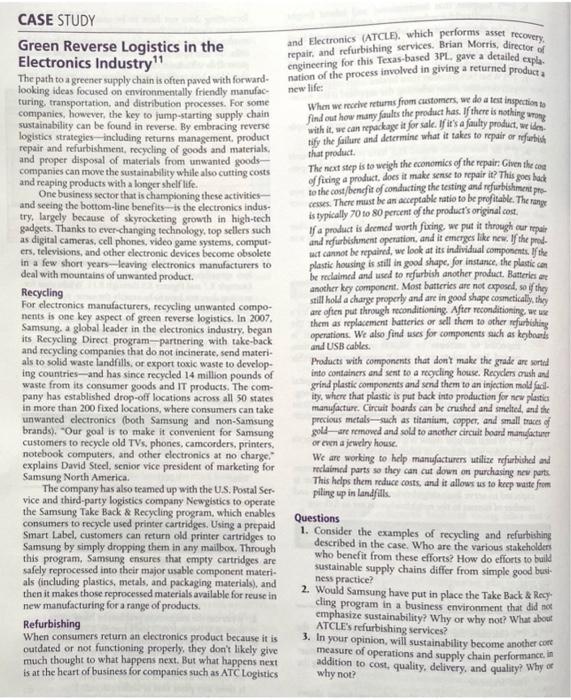
CASE STUDY looking ideas focused on environmentally friendly manufac- new life: turing. transportation, and distribution processes. For some companies, however, the key to jump-starting supply chain sustainability can be found in reverse. By embracing reverse logistics strategies - including returns management, product repair and refurbishment, recycling of goods and materials. and proper disposal of materials from unwanted goodscompanies can move the sustainability whille also cutting costs and reaping products with a longer shelf life. One business sector that is championing these activitiesand seeing the bottom-line benefits - is the electronics industry, largcly because of skyrocketing growth in high-tech gadgets. Thanks to ever-changing technology, top sellers such as digital cameras, cell phones, video game systems, computers, televisions, and other electronic devices become obsolete in a few short years-leaving electronics manufacturers to deal with mountains of unwanted product. Recycling For electronics manufacturers, recycling unwanted components is one key aspect of green reverse logistics. In 2007 , Samsung, a global leader in the electronics industry, began its Recycling Dircet program-partnering with take-back and recycling companies that do not incinerate, send materials to solid waste landfills, or export toxic waste to develop- When we reche retums from customers, we do a tect inspection ts ing countries - and has since recycled 14 million pounds of find out how many faules the product has. If there is nothing woong with it, we can repackage it for sale. If ir's a faulty product, we ides. tify the failure and determine what it takes to repuir or nofubis that product. waste from its consumer goods and IT products. The com- The next step is to weigh the economics of the repair: Given the cog pany has established drop-off locations across all 50 states of fixing a product, does it make sense to repair it? This goe hat in more than 200 fixed locations, where consumers can take to the cost/bengft of conducting the testing and refurbishment preunwanted electronics (both Samsung and non-Samsung ceses. There must be an acceptable natio to be profitable. The range is typically 70 to 80 persent of the product's original cost. brands), "Our goal is to make it convenicnt for Samsung If a product is decmed worth fixing. we put it through cur topar and rofurbishment openation. and it encroes like new. If the prod. uct cannot be repaind, we look at its individual components. If the customers to recycle old TVs, phones, camcorders, printers. plastic housing is still in good shape, for instance, the plastic ier be rolaimed and used to nefurbish another product. Batteries at Samsung North America. another kry component. Most batteries are not exposed, s0 if thyy still hold a change properly and are in good shape cosmctically, thy are often put thrvugh reconditioning After reconditioning we ure them as replasement butteries or sell them to other ngurbishisg operations. We also find uses for compoeicnts aach as kobourds and USB cables. Products with components that dont make the grade are sortd into containers and seat to a regcling house. Regclers onsh and grind plastic components and send them to an injection mold fari. ify. where that plastic is put back into production for new plastia manufacturr. Circuit boards can be crushed and smeled, and the precious metals - auch as titanium, copper, and sonall traces of g.L - are remoned and sold to another circait bodnd mamblacturer or cien a jewriry house. The company has also teamed up with the U.S. Postal Service and third-party logistics company Newgistics to operate the Samsung Take Back \& Recycling program, which enables consumers to recycle used printer cartridges. Using a prepaid Smart Label, customers can return old printer cartridges to Samsung by simply dropping them in any mailbox. Through this program, Samsung ensures that empty cartridges are safely reprocessed into their major usable component materials (including plastics, metals, and packaging materials), and then it makes those reprocessed materials available for reuse in new manufacturing for a range of products. Cling program in a business environment that did not Questions 1. Consider the examples of recycling and refurbishing deseribed in the case. Who are the various stakeholden who benefit from these efforts? How do efforts to baild Refurbishing When consumers retum an electronics product because it is outdated or not functioning properly, they don't likely give much thought to what happens next. But what happens next is at the heart of business for companies such as ATC Loginics. sustainable supply chains differ from simple good beri- 2. Would Samsung have put in place the Take Back \& Recy' emphasize sustainability? Why or why not? What aboet ATCLE's refurbishing services? 3. In your opinion, will sustainability become another coet measure of operations and supply chain performance, in addition to cost, quality, delivery, and quality? Why of why not
Step by Step Solution
There are 3 Steps involved in it

Get step-by-step solutions from verified subject matter experts
 Study Help