



Question: Case Study: MANDEXOR MEMORY QUESTIONS: 1 What level of output will be required each month for the plant to meet its demand? 2 What combination
Case Study: MANDEXOR MEMORY
QUESTIONS:
1 What level of output will be required each month for the plant to meet its demand? 2 What combination of 'strategies' would you recommend in order to meet the production plan? 3 How might production levels be changed in the light of changes in the forecast demand?
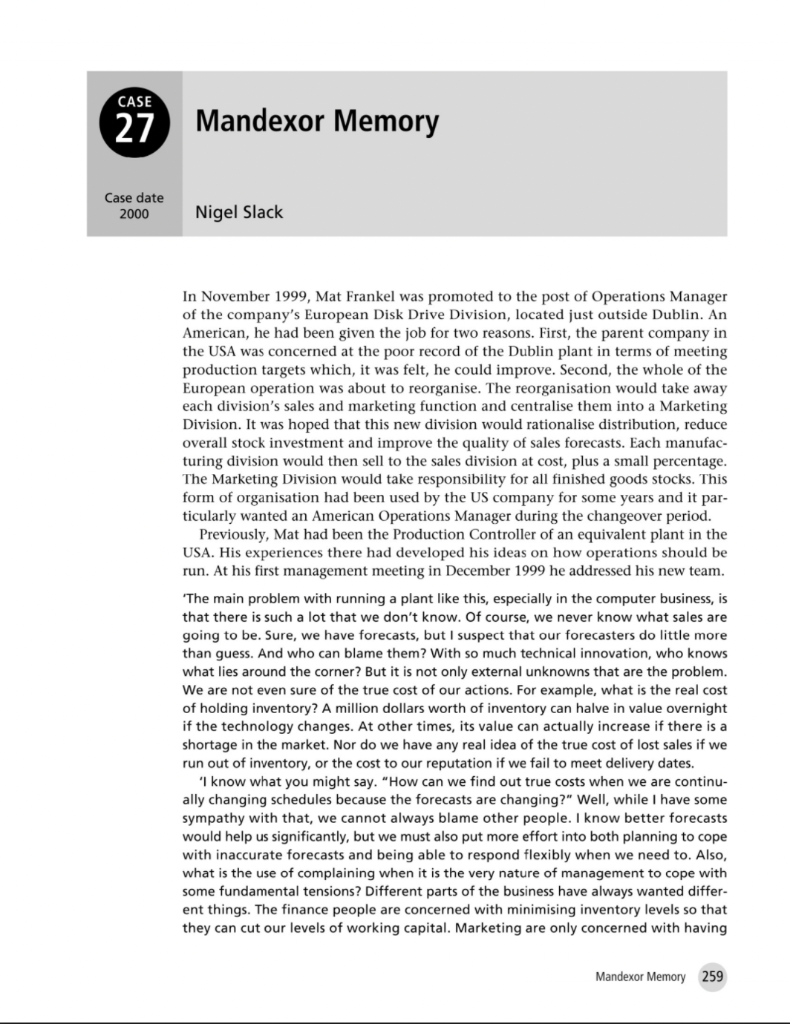
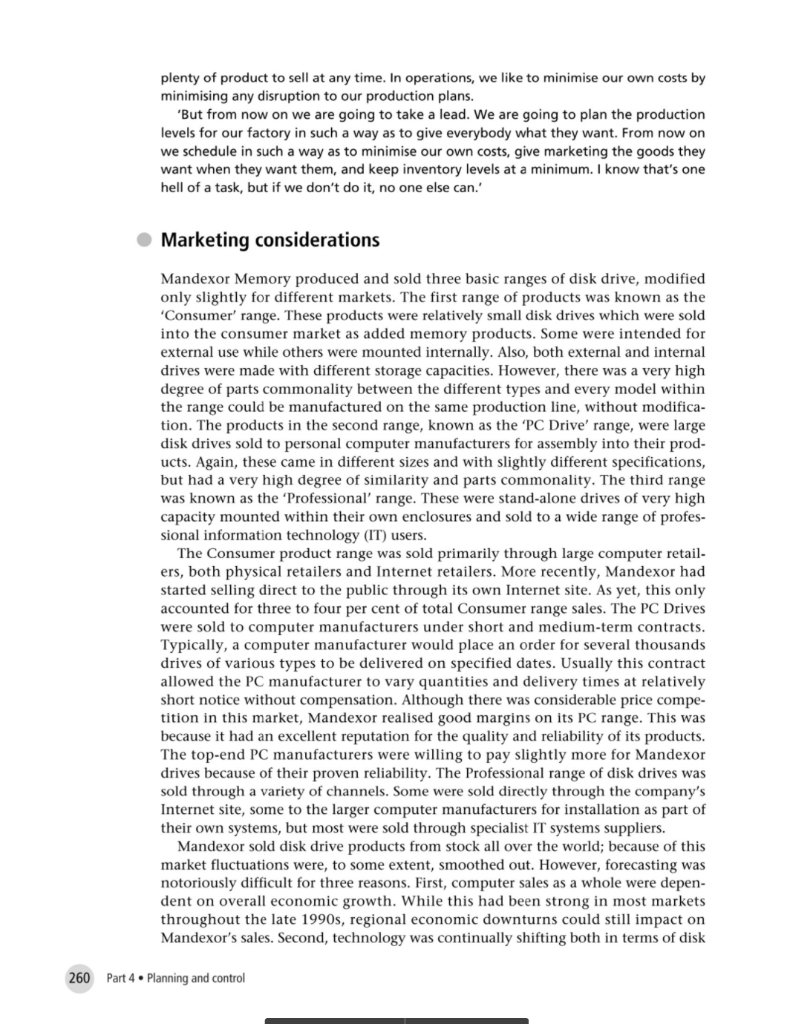
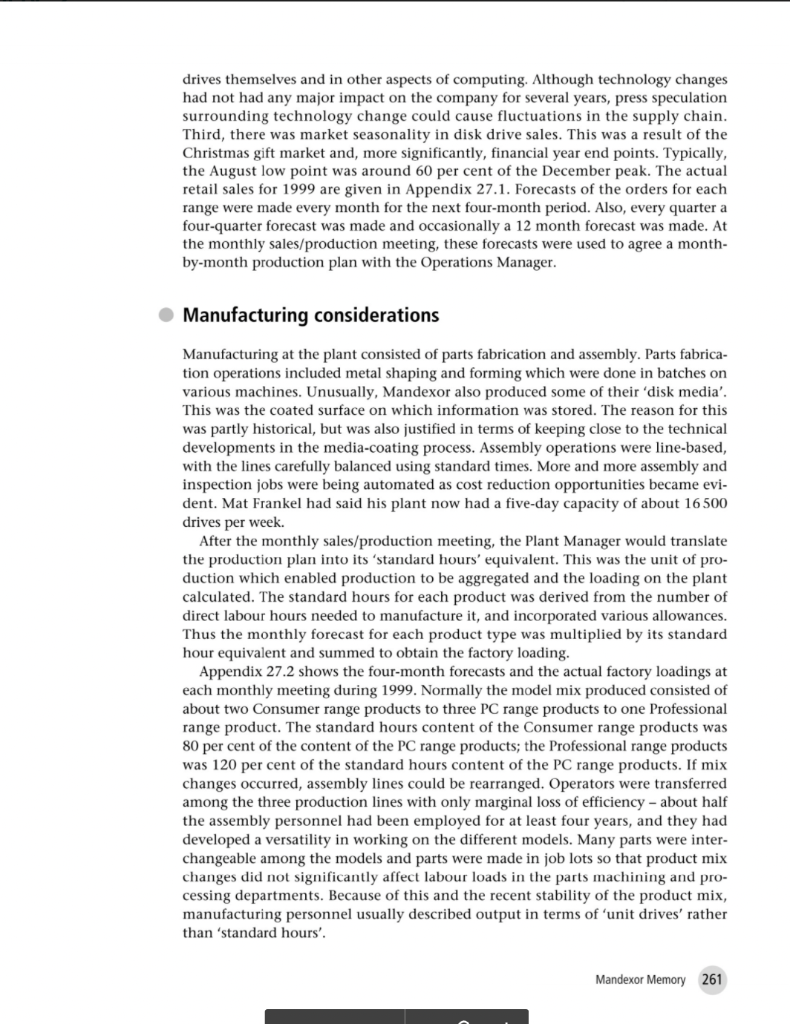
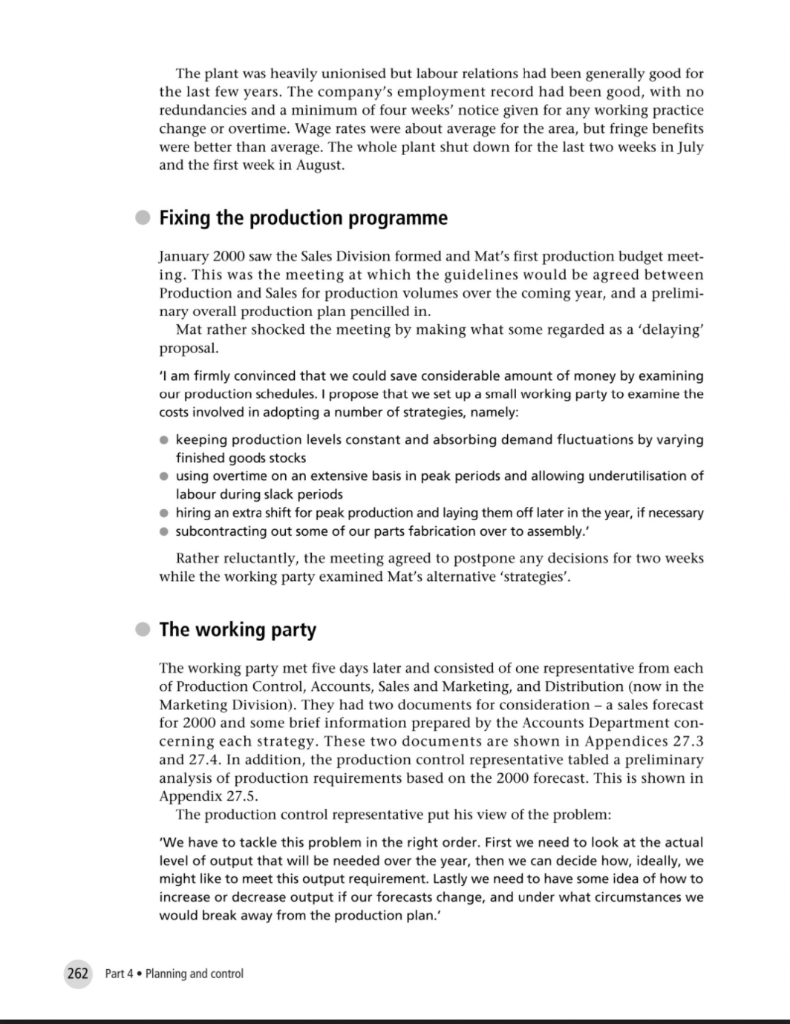
CASE 27 Mandexor Memory Case date 2000 Nigel Slack In November 1999, Mat Frankel was promoted to the post of Operations Manager of the company's European Disk Drive Division, located just outside Dublin. An American, he had been given the job for two reasons. First, the parent company in the USA was concerned at the poor record of the Dublin plant in terms of meeting production targets which, it was felt, he could improve. Second, the whole of the European operation was about to reorganise. The reorganisation would take away each division's sales and marketing function and centralise them into a Marketing Division. It was hoped that this new division would rationalise distribution, reduce overall stock investment and improve the quality of sales forecasts. Each manufac- turing division would then sell to the sales division at cost, plus a small percentage. The Marketing Division would take responsibility for all finished goods stocks. This form of organisation had been used by the US company for some years and it par- ticularly wanted an American Operations Manager during the changeover period. Previously, Mat had been the Production Controller of an equivalent plant in the USA. His experiences there had developed his ideas on how operations should be run. At his first management meeting in December 1999 he addressed his new team. The main problem with running a plant like this, especially in the computer business, is that there is such a lot that we don't know. Of course, we never know what sales are going to be. Sure, we have forecasts, but I suspect that our forecasters do little more than guess. And who can blame them? With so much technical innovation, who knows what lies around the corner? But it is not only external unknowns that are the problem. We are not even sure of the true cost of our actions. For example, what is the real cost of holding inventory? A million dollars worth of inventory can halve in value overnight if the technology changes. At other times, its value can actually increase if there is a shortage in the market. Nor do we have any real idea of the true cost of lost sales if we run out of inventory, or the cost to our reputation if we fail to meet delivery dates. 'I know what you might say. "How can we find out true costs when we are continu- ally changing schedules because the forecasts are changing?" Well, while I have some sympathy with that, we cannot always blame other people. I know better forecasts would help us significantly, but we must also put more effort into both planning to cope with inaccurate forecasts and being able to respond flexibly when we need to. Also, what is the use of complaining when it is the very nature of management to cope with some fundamental tensions? Different parts of the business have always wanted differ- ent things. The finance people are concerned with minimising inventory levels so that they can cut our levels of working capital. Marketing are only concerned with having Mandexor Memory 259 plenty of product to sell at any time. In operations, we like to minimise our own costs by minimising any disruption to our production plans. 'But from now on we are going to take a lead. We are going to plan the production levels for our factory in such a way as to give everybody what they want. From now on we schedule in such a way as to minimise our own costs, give marketing the goods they want when they want them, and keep inventory levels at a minimum. I know that's one hell of a task, but if we don't do it, no one else can.' Marketing considerations Mandexor Memory produced and sold three basic ranges of disk drive, modified only slightly for different markets. The first range of products was known as the 'Consumer' range. These products were relatively small disk drives which were sold into the consumer market as added memory products. Some were intended for external use while others were mounted internally. Also, both external and internal drives were made with different storage capacities. However, there was a very high degree of parts commonality between the different types and every model within the range could be manufactured on the same production line, without modifica- tion. The products in the second range, known as the 'PC Drive' range, were large disk drives sold to personal computer manufacturers for assembly into their prod- ucts. Again, these ca different sizes and with slightly different specifications but had a very high degree of similarity and parts commonality. The third range was known as the 'Professional range. These were stand-alone drives of very high capacity mounted within their own enclosures and sold to a wide range of profes- sional information technology (IT) users. The Consumer product range was sold primarily through large computer retail- ers, both physical retailers and Internet retailers. More recently, Mandexor had started selling direct to the public through its own Internet site. As yet, this only accounted for three to four per cent of total Consumer range sales. The PC Drives were sold to computer manufacturers under short and medium-term contracts. Typically, a computer manufacturer would place an order for several thousands drives of various types to be delivered on specified dates. Usually this contract allowed the PC manufacturer to vary quantities and delivery times at relatively short notice without compensation. Although there was considerable price compe- tition in this market, Mandexor realised good margins on its PC range. This was because it had an excellent reputation for the quality and reliability of its products. The top-end PC manufacturers were willing to pay slightly more for Mandexor drives because of their proven reliability. The Professional range of disk drives was sold through a variety of channels. Some were sold directly through the company's Internet site, some to the larger computer manufacturers for installation as part of their own systems, but most were sold through specialist IT systems suppliers. Mandexor sold disk drive products from stock all over the world; because of this market fluctuations were, to some extent, smoothed out. However, forecasting was notoriously difficult for three reasons. First, computer sales as a whole were depen- dent on overall economic growth. While this had been strong in most markets throughout the late 1990s, regional economic downturns could still impact on Mandexor's sales. Second, technology was continually shifting both in terms of disk 260 Part 4. Planning and control drives themselves and in other aspects of computing. Although technology changes had not had any major impact on the company for several years, press speculation surrounding technology change could cause fluctuations in the supply chain. Third, there was market seasonality in disk drive sales. This was a result of the Christmas gift market and, more significantly, financial year end points. Typically, the August low point was around 60 per cent of the December peak. The actual retail sales for 1999 are given in Appendix 27.1. Forecasts of the orders for each range were made every month for the next four-month period. Also, every quarter a four-quarter forecast was made and occasionally a 12 month forecast was made. At the monthly sales/production meeting, these forecasts were used to agree a month- by-month production plan with the Operations Manager. Manufacturing considerations Manufacturing at the plant consisted of parts fabrication and assembly. Parts fabrica- tion operations included metal shaping and forming which were done in batches on various machines. Unusually, Mandexor also produced some of their 'disk media'. This was the coated surface on which information was stored. The reason for this was partly historical, but was also justified in terms of keeping close to the technical developments in the media-coating process. Assembly operations were line-based, with the lines carefully balanced using standard times. More and more assembly and inspection jobs were being automated as cost reduction opportunities became evi- dent. Mat Frankel had said his plant now had a five-day capacity of about 16 500 drives per week. After the monthly sales/production meeting, the Plant Manager would translate the production plan into its 'standard hours' equivalent. This was the unit of pro- duction which enabled production to be aggregated and the loading on the plant calculated. The standard hours for each product was derived from the number of direct labour hours needed to manufacture it, and incorporated various allowances. Thus the monthly forecast for each product type was multiplied by its standard hour equivalent and summed to obtain the factory loading. Appendix 27.2 shows the four-month forecasts and the actual factory loadings at each monthly meeting during 1999. Normally the model mix produced consisted of about two Consumer range products to three PC range products to one Professional range product. The standard hours content of the Consumer range products was 80 per cent of the content of the PC range products; the Professional range products was 120 per cent of the standard hours content of the PC range products. If mix changes occurred, assembly lines could be rearranged. Operators were transferred among the three production lines with only marginal loss of efficiency - about half the assembly personnel had been employed for at least four years, and they had developed a versatility in working on the different models. Many parts were inter- changeable among the models and parts were made in job lots so that product mix changes did not significantly affect labour loads in the parts machining and pro- cessing departments. Because of this and the recent stability of the product mix, manufacturing personnel usually described output in terms of 'unit drives' rather than 'standard hours'. Mandexor Memory 261 The plant was heavily unionised but labour relations had been generally good for the last few years. The company's employment record had been good, with no redundancies and a minimum of four weeks' notice given for any working practice change or overtime. Wage rates were about average for the area, but fringe benefits were better than average. The whole plant shut down for the last two weeks in July and the first week in August. Fixing the production programme January 2000 saw the Sales Division formed and Mat's first production budget meet- ing. This was the meeting at which the guidelines would be agreed between Production and Sales for production volumes over the coming year, and a prelimi- nary overall production plan pencilled in. Mat rather shocked the meeting by making what some regarded as a 'delaying' proposal. 'I am firmly convinced that we could save considerable amount of money by examining our production schedules. I propose that we set p a small working party to examine the costs involved in adopting a number of strategies, namely: keeping production levels constant and absorbing demand fluctuations by varying finished goods stocks using overtime on an extensive basis in peak periods and allowing underutilisation of labour during slack periods hiring an extra shift for peak production and laying them off later in the year, if necessary subcontracting out some of our parts fabrication over to assembly. Rather reluctantly, the meeting agreed to postpone any decisions for two weeks while the working party examined Mat's alternative strategies'. The working party The working party met five days later and consisted of one representative from each of Production Control, Accounts, Sales and Marketing, and Distribution (now in the Marketing Division). They had two documents for consideration - a sales forecast for 2000 and some brief information prepared by the Accounts Department con- cerning each strategy. These two documents are shown in Appendices 27.3 and 27.4. In addition, the production control representative tabled a preliminary analysis of production requirements based on the 2000 forecast. This is shown in Appendix 27.5. The production control representative put his view of the problem: 'We have to tackle this problem in the right order. First we need to look at the actual level of output that will be needed over the year, then we can decide how, ideally, we might like to meet this output requirement. Lastly we need to have some idea of how to increase or decrease output if our forecasts change, and under what circumstances we would break away from the production plan.' 262 Part 4. Planning and controlStep by Step Solution
There are 3 Steps involved in it
1 Expert Approved Answer
Step: 1 Unlock

Question Has Been Solved by an Expert!
Get step-by-step solutions from verified subject matter experts
Step: 2 Unlock
Step: 3 Unlock