Question: Case Study - Marketing Problem - Proctor & Gamble Points possible - 15 points Please read the attached articles and gain an understanding of the
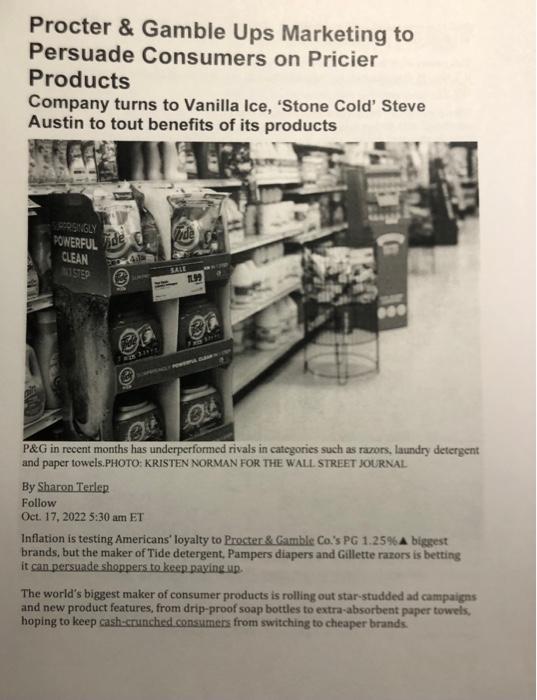
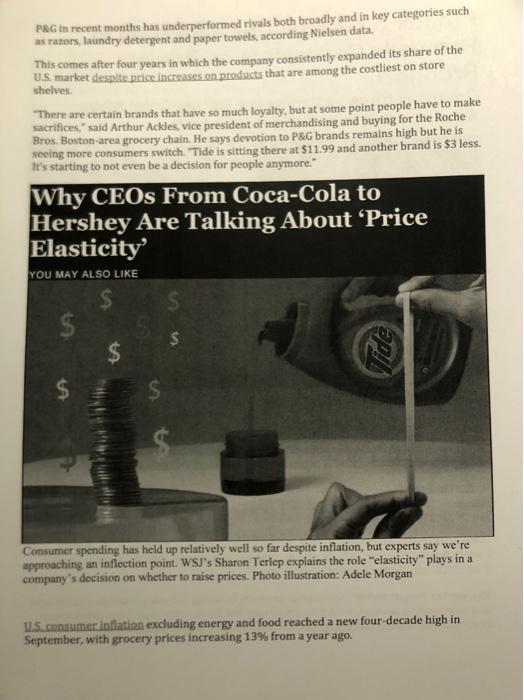
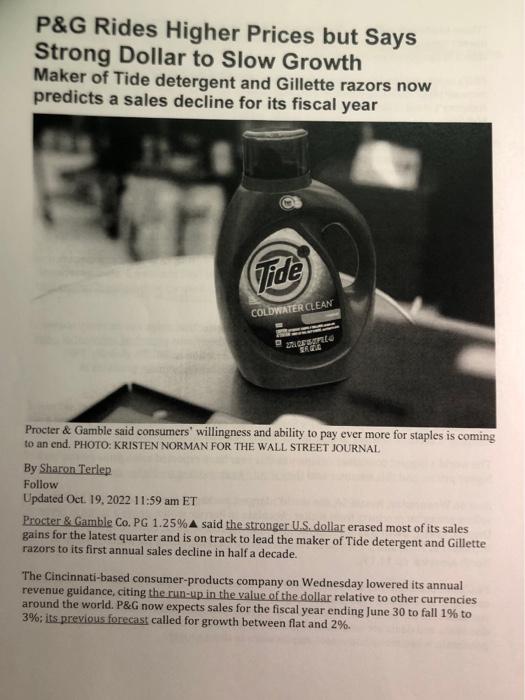
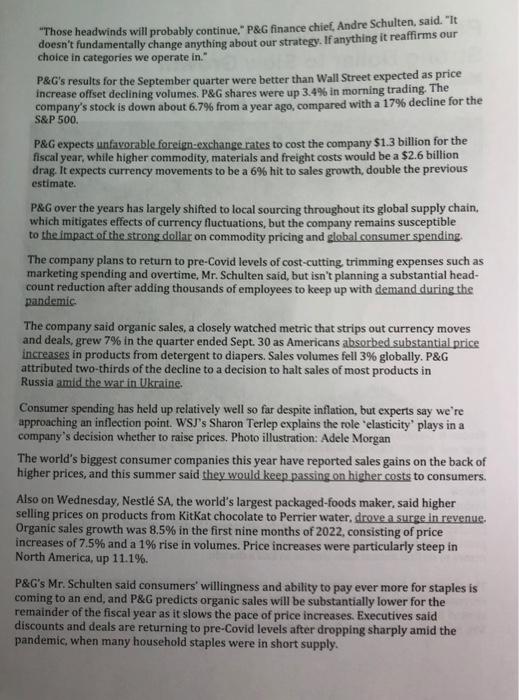
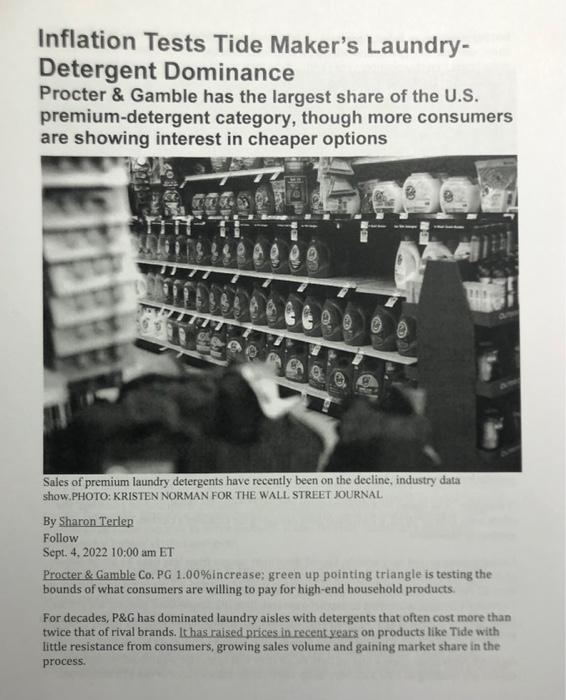
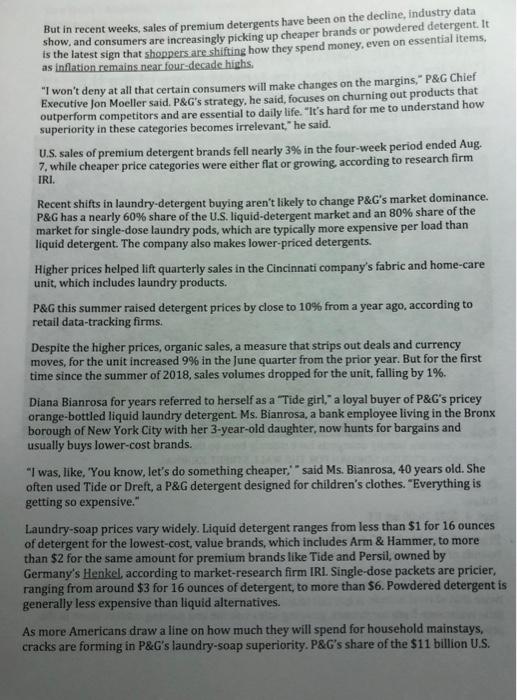
Case Study - Marketing Problem - Proctor \& Gamble Points possible - 15 points Please read the attached articles and gain an understanding of the marketing dilemma for the consumer household products giant. Address the directives and questions below in a write-up, as a Word document or PowerPoint format. - Summarize the challenges P\&G is experiencing, including the competitive landscape. - Describe any macrotrends that are affecting P\&G and whether they present a problem or an opportunity. - What strategies has P\&G implemented and how successful have they been? - What constraints does the company have that may get in the way of achieving their goals? - What are some specific actions that the Marketing team might initiate? (This may include market research, product or pricing decisions, promotional tactics or consumer buying behavior concepts, etc.) Inflation Tests Tide Maker's LaundryDetergent Dominance Procter \& Gamble has the largest share of the U.S. premium-detergent category, though more consumers are showing interest in cheaper options ShOW. PHOTO: KRISTEN NORMAN FOR THE WALL. STREET JOURNAL By Sharon Terlep Follow Sept. 4, 2022 10:00 am EI Procter \& Gamble Co. PG 1.00\%increase; green up pointing triangle is testing the bounds of what consumers are willing to pay for high-end household products. For decades, P\&G has dominated laundry aisles with detergents that often cost mone than twice that of rival brands. Ithas mased prices in recent years on products like Tide with little resistance from consumers, growing sales volume and gaining market share in the process. But in recent weeks, sales of premium detergents have been on the decline, industry data show, and consumers are increasingly picking up cheaper brands or powdered detergent. It is the latest sign that shoppers are shifting how thcy spend money, even on essential items. as inflation remains near four-decade highs. "I won't deny at all that certain consumers will make changes on the margins," P\&G Chief Executive Jon Moeller said. P\&G's strategy, he said, focuses on churning out products that outperform competitors and are essential to daily life. "It's hard for me to understand how superiority in these categories becomes irrelevant," he said. U.S. sales of premium detergent brands fell nearly 3% in the four-week period ended Aug. 7, while cheaper price categories were either flat or growing according to research firm IRI. Recent shifts in laundry-detergent buying aren't likely to change P\&G's market dominance. P\&G has a nearly 60% share of the U.S. liquid-detergent market and an 80% share of the market for single-dose laundry pods, which are typically more expensive per load than liquid detergent. The company also makes lower-priced detergents. Higher prices helped lift quarterly sales in the Cincinnati company's fabric and home-care unit, which includes laundry products. P\&G this summer raised detergent prices by close to 10% from a year ago, according to retail data-tracking firms. Despite the higher prices, organic sales, a measure that strips out deals and currency moves, for the unit increased 9% in the June quarter from the prior year. But for the first time since the summer of 2018 , sales volumes dropped for the unit, falling by 1%. Diana Bianrosa for years referred to herself as a Tide girl," a loyal buyer of P\&C's pricey orange-bottled liquid laundry detergent. Ms. Bianrosa, a bank employee living in the Bronx borough of New York City with her 3-year-old daughter, now hunts for bargains and usually buys lower-cost brands. "I was, like, 'You know, let's do something cheaper," said Ms. Bianrosa, 40 years old. She often used Tide or Dreft, a P\&G detergent designed for children's clothes. "Everything is getting so expensive." Laundry-soap prices vary widely. Liquid detergent ranges from less than $1 for 16 ounces of detergent for the lowest-cost, value brands, which includes Arm \& Hammer, to more than $2 for the same amount for premium brands like Tide and Persil, owned by Germany's Henkel, according to market-research firm IRL. Single-dose packets are pricier, ranging from around $3 for 16 ounces of detergent, to more than $6. Powdered detergent is generally less expensive than liquid alternatives. As more Americans draw a line on how much they will spend for household mainstays, cracks are forming in P\&G's laundry-soap superiority. P\&G's share of the $11 billion U.S. market for liquid detergent in August was roughly 2 percentage points lower than a year ago, according to analysts, company executives and data from research firm Nielsen. Procter \& Gamble also sells lower-priced Gain.PHOTO: TIFFANY HAGLER-GEARD/BLOOMBERG NEWS Dollar General Corp. said last month more people are buying low-cost powdered laundry detergent. Executives at Church \& Dwight Co., maker of lower-cost Arm \& Hammer products including laundry detergent, said they have seen sales take off. "The trade down to value detergent has begun," Church \& Dwight Chief Executive Matthew Farrell said on a July earnings call with analysts. The company's growth is aided by good timing: It recently brought manufacturing of its laundry pods in house, giving it more control to increase capacity to serve demand. It also recently launched a detergent designed for babies' clothes and gear. Mr. Farrell said that industrywide, in the quarter ended June 30, dollar sales of liquid laundry detergent grew 7% overall. Sales were up 11% for value brands and 4% for premium offerings, he said. P\&G, the world's biggest consumer-products company by sales, has managed to notch gains while increasing prices, in part because few corners of the economy have held up amid inflation as solidly as household staples. Shoppers are paying more for fewer goods. They have given priority to food and need-based home staples over clothing and gadgets. P\&G executives say they believe Americans will keep spending on household products. even if inflation and the overall economy worsen. The company, which makes everything from Gillette razors to Pampers diapers, is far better prepared for a downturn than it was before the Great Recession, they say. In advertisements, the company is promoting the cost-saving benefits of its products, such as a detergent that cleans items in cold-water cycles, which could help households save on energy bills. It offers lower-cost alternatives in its Gain and Era brands and in Tide Simply, P\&G said it is also making more products available in smaller package sizes, aimed at people who can't or don't want to spend as much at once. Smaller packages generally are pricier per unit. Tide, in some ways, benefits from its high price tag because people might be hesitant to trade down to cheaper brands amid concerns of a big decline in quality, said Truist analyst Bill Chappell. He predicts that Tide would only suffer serious sales losses in a long and deep recession. Another bright spot for P\&G: Even as some consumers seek out cheaper detergents, another segment of consumers is switching to its pricey detergent pods, the company says. "There is a very strong labor market; consumer balance sheets are very healthy." Mr. Moeller, the CEO, said. "What happens tomorrow? Who knows." Write to Sharon Terlep at sharon terlep@wsicom Appeared in the September 6, 2022, print edition os "PSG Pricing Tests Loyalty in Laundry: Procter \& Gamble Ups Marketing to Persuade Consumers on Pricier Products Company turns to Vanilla Ice, 'Stone Cold' Steve Austin to tout benefits of its products P\&G in recent months has underperformed rivals in categories such as ramors, laundry detergent and paper towels. PHOTO: KRISTEN NORMAN FOR THE WAL.L STREET JOURNAL. By Sharon Terlep. Follow Oct. 17, 20225:30 am ET Inflation is testing Americans' loyalty to Procter & Camble Co.'s PG 1.25% a bilegest brands, but the maker of Tide detergent, Pampers diapers and Gillette razors is betting it can persuade shoppers to keep paving up. The world's biggest maker of consumer products is rolling out star-studded ad campaigns and new product features, from drip-proof soap bottles to extra-absorbent paper towels, hoping to keep cash-crunched consumers from switching to cheaper brands. P\&G in recent months has underperformed rivals both broadly and in key categories such as ramors, laundry detergent and paper towels, according Nielsen data. This comes after four years in which the company consistently expanded its share of the U.S. market despiteprice increases on products that are among the costliest on store shelves. There are certain brands that have so much loyalty, but at some point people have to make sacrifices," said Arthur Ackles, vice president of merchandising and buying for the Roche Bros. Boston-area grocery chain. He says devotion to P\&G brands remains high but he is seeing more consumers switch. Tide is sitting there at $11.99 and another brand is $3 less. It's starting to not even be a decision for people anymore." approaching an inflection point. WSy's Sharon Terlep explains the role telasticity US. consumerinflation excluding energy and food reached a new four-decade high in September, with grocery prices increasing 13% from a year ago. PAG Chief Executive Jon Moeller, speaking at last week's annual shareholders meeting, said the company has so far been relatively successful in maintaining sales and market share amid decades-high inflation. But he said P\&G's ability to command premium prices hinges on many factors outside the company's control, namely the rate of inflation, consumer reaction to higher costs and the overall health of the economy. "'Im not going to posit on how that's going to play out," Mr. Moeller said. To prevent defections, P\&G has directed marketing and product-development dollars toward convincing consumers that paying more for its products ultimately saves money. In one commercial, rappers Ice-T and Vanilla Ice and wrestler "Stone Cold" Steve Austin pitch a version of Tide that can be used in cold water, which is cheaper than running a load of laundry in a warm-water cycle. Another ad campaign says people use more water when they wash dishes by hand than they do in a dishwashing cycle. A new bottle for Dawn detergent promises to eliminate waste. It features an inverted design, a no-flip cap and a self-sealing valve to prevent drips or soap from getting stuck in the container. Gillette razors now come in cardboard rather than rigid plastic packaging that is marketed as more environmentally sustainable. And the company has launched more absorbent versions of Bounty paper towels and Charmin toilet paper, a spokeswoman said. P\&G on Wednesday reports financial results for the first quarter ended Sept. 30. P\&G executives say the company has yet to see significant erosion in market share or sales. They say shortages due to high demand amid the pandemic and other idiosyncrasies have led to temporary share losses in some categories, and that third-party data trackers often undercount P\&G sales because their numbers exclude certain retail outlets. As the company invests in its high-end brands, executives say it is also prepared should consumers decide they need cheaper alternatives. P\&G says it has more brand offerings in lower-price ranges and offers a wider variety of package sizes than it did more than a decade ago during the last economic downturn. Lois Miceli, 64 years old, of New Rochelle, N.Y., for decades was loyal to several P\&G brands, including Tide detergent, Crest toothpaste, Dawn dish soap and Pampers diapers. She recently quit Tide for Costco's private-label detergent and switched from Pampers to Luvs, P\&G's lower-priced brand. She buys diapers for her two grandchildren. But, no matter the cost, Ms. Miceli said, she is sticking with Dawn and Crest. "When it comes to health, I pay attention," she said, adding that Dawn is the only dish soap capable of clearing grease. "Clean clothes, I couldn't care less as long as it gets the stains out." P\& G Rides Higher Prices but Says Strong Dollar to Slow Growth Maker of Tide detergent and Gillette razors now predicts a sales decline for its fiscal year Procter \& Gamble said consumers' willingness and ability to pay ever more for staples is coming to an end. PHOTO: KRISTEN NORMAN FOR THE WALL STREET JOURNAL By Sharon Terlep Follow Updated Oct. 19, 2022 11:59 am ET Procter \& Gamble Co. PG 1.25% A said the stronger U.S. dollar erased most of its sales gains for the latest quarter and is on track to lead the maker of Tide detergent and Gillette razors to its first annual sales decline in half a decade. The Cincinnati-based consumer-products company on Wednesday lowered its annual revenue guidance, citing the run-up in the value of the dollar relative to other currencies around the world. P\&G now expects sales for the fiscal year ending June 30 to fall 1% to 3%; its previous forecast called for growth between flat and 2%. "Those headwinds will probably continue," P\&G finance chief, Andre Schulten, said. "It doesn't fundamentally change anything about our strategy. If anything it reaffirms our choice in categories we operate in." P\&G's results for the September quarter were better than Wall Street expected as price increase offset declining volumes. P\&G shares were up 3.4% in morning trading. The company's stock is down about 6.7% from a year ago, compared with a 17% decline for the S\&P 500. P\&G expects unfivorable foreign-exchange mates to cost the company $1.3 billion for the fiscal year, while higher commodity, materials and freight costs would be a $2.6 billion drag. It expects currency movements to be a 6% hit to sales growth, double the previous estimate. P\&G over the years has largely shifted to local sourcing throughout its global supply chain, which mitigates effects of currency fluctuations, but the company remains susceptible to the impact of the strong dollar on commodity pricing and global consumer spending. The company plans to return to pre-Covid levels of cost-cutting, trimming expenses such as marketing spending and overtime, Mr. Schulten said, but isn't planning a substantial headcount reduction after adding thousands of employees to keep up with demand during the pandemis. The company said organic sales, a closely watched metric that strips out currency moves and deals, grew 7% in the quarter ended Sept. 30 as Americans absorbed substantial price increases in products from detergent to diapers. Sales volumes fell 3% globally. P\&G attributed two-thirds of the decline to a decision to halt sales of most products in Russia amid the war in Ukraine. Consumer spending has held up relatively well so far despite inflation, but experts say we're approaching an inflection point. WSJ's Sharon Terlep explains the role 'elasticity' plays in a company's decision whether to raise prices. Photo illustration: Adele Morgan The world's biggest consumer companies this year have reported sales gains on the back of higher prices, and this summer said they would keep passing on higher costs to consumers. Also on Wednesday, Nestl SA, the world's largest packaged-foods maker, said higher selling prices on products from KitKat chocolate to Perrier water, drove a surge in revenue. Organic sales growth was 8.5% in the first nine months of 2022, consisting of price increases of 7.5% and a 1% rise in volumes. Price increases were particularly steep in North America, up 11.1%. P\&G's Mr. Schulten said consumers' willingness and ability to pay ever more for staples is coming to an end, and P\&G predicts organic sales will be substantially lower for the remainder of the fiscal year as it slows the pace of price increases. Executives said discounts and deals are returning to pre-Covid levels after dropping sharply amid the pandemic, when many household staples were in short supply. "It's a very dynamic environment, we will continue to carefully balance innovation, pricing, and productlvity," Mr. Schulten said. U.S. consumer inflation excluding energy and food reached a four-decade high in September. Mr. Schulten said retailers also are stocking up less following more than two years of sometimes-severe product shortages amid the Covid-19 pandemic and global supply-chain meltdown. Retailer inventory levels are back to where they were before the pandemic, he said. P\&G has seen its market share decline broadly and in some key categories in recent months. Mr. Schulten said that is largely due to the fact that P\&G sales were inflated a year ago amid heightened pandemic demand and other factors, and that the company is seeing its market position improve monthly. The company reported $20.6 billion in revenue for the quarter, up 1% from a year earlier. Diluted net earnings per share were $1.57, down 2% but higher than the consensus analyst estimate of $1.53 a share, according to FactSet. Write to Sharon Terlep at sharoniterlep@wsicom









 Study Help