







Question: CASE STUDY Offshoring a Call Center for Everdream ? 2 Finding the right talent for its call center has been a perennial challenge for Everdream,
CASE STUDY
Offshoring a Call Center for Everdream
Finding the right talent for its call center has been a perennial challenge for Everdream, an IT services provider, even though it's based in Fremont, California in the heart of Silicon Valley. The company, which offers anoutsourced hosted solution for desktop management, is constantly searching for employees with technical sawy who are also
willing.to work in an entrylevel call center support position. "While these are entrylevel positions, we need people who know their way around operating systems and who also know how to treat our customers with the proper level of courtesy and care," says CEO Gary Griffiths.
The company pays about $ a year to entrylevel employees in its Charlotte, North Carolina facility and $ at its Californiabased headquarters call center.
Griffiths says the company began to consider an offshore option in because it was worrled about scalability. We were concerned about our ability to grow at the rate we thought was necessary. Even though America was in the midst of a socalled jobless recovery, we couldn't find the right talent quickly enough," he explains. Of course, the reduced labor costs of an offshore provider were an enticement, too. But Griffths says scalability was the primary driver.
The topdown initiative was also a product of outsourcing thinking: Everdream's management felt the company was a technology company, so it would be better off outsourcing its own call center operations to a call center expert.
In October the company issued a Request for Proposal RFP to companies. Everdream explored all its options, locking at onshore, nearshore and offshore companies. Candidates were based everywhere from Bangalore, India to close by the Charlotte center in Florida.
Choosing Costa Rica over India
We decided early on that we were not comfortable going to india," says Criffiths. First. he felt the distance from California was just too great, since Everdream employees would be onsite during the transition phase "when we handed over the crown jewels" Second, Everdream grilled its prospective suppllers by asking them how they would handle specific situations. "Based on those responses, we didn't feel the indian suppliers could maintain the quality levels we required," says Belle Kultck. Everdream's Vice President of Operations, who was aware of what the company's customers epected. After extensive due diligence, Everdream selected a call center supplier in Costa Ricathe executives felt comfortable in the Central American country. Other technology companies like Intel and Microsoft were already outsoureing to Costa Rican suppliers. The Costa Rican tearn to be assigned to Everdream had ust finished
ource: Sriccessful Sevice Operations Management on Metters, KingMetters, Pullman, & Walton Bind Edition? Thomson
CASE STUDY
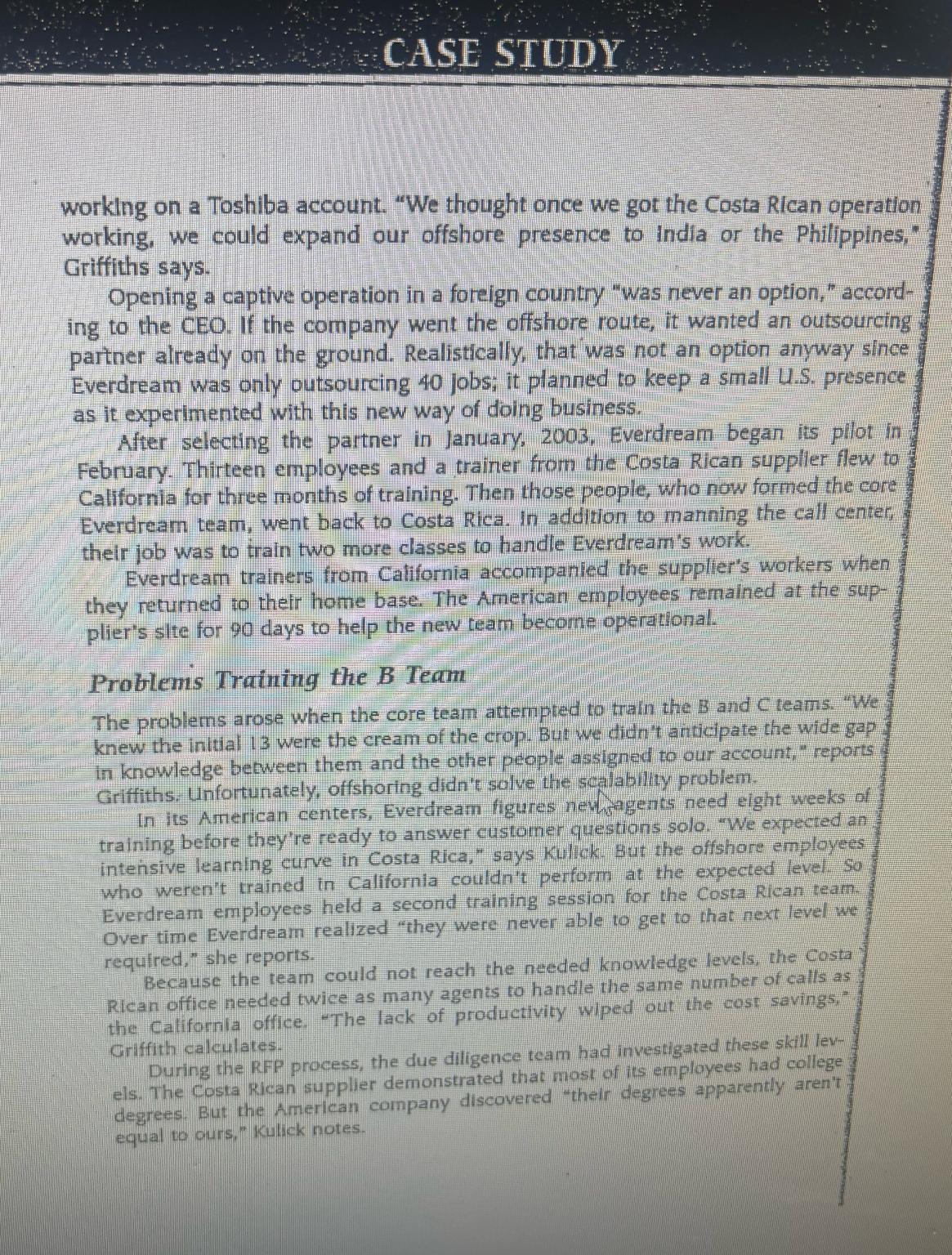
working on a Toshiba account. We thought once we got the Costa RIcan operation working, we could expand our offshore presence to India or the Philippines," Griffiths says.
Opening a captive operation in a foreign country "was never an option," according to the CEO. If the company went the offshore route, it wanted an outsourcing partner already on the ground. Realistically, that was not an option anyway since Everdream was only outsourcing jobs; it planned to keep a small US presence as it experimented with this new way of doing business.
After selecting the partner in January, Everdream began its pilot in February. Thirteen employees and a trainer from the Costa Rican supplier flew to California for three months of training. Then those people, who now formed the core Everdream team, went back to Costa Rica. in addition to manning the call center, their job was to train two more classes to handle Everdream's work.
Everdream trainers from California accompanied the supplier's workers when they returned to their home base. The American employees remained at the supplier's site for days to help the new team become operational.
Problemis Training the B Team
The problems arose when the core team attempted to train the B and C teams. We knew the initial were the cream of the crop. But we didn"t anticipate the wide gap in knowledge between them and the other people assigned to our account," reports Griffiths. Unfortunately, offshoring didn't solve the scalability problem.
In its American centers, Everdream figures newhagerts need eight weeks of training before they're ready to answer customer questions solo. We expected an intensive learning curve in Costa Rica," says Kulick. But the offshore employees who weren't trained in California couldn't perform at the expected level. So Everdream employees held a second training session for the Costa Rican team. Over time Everdream realized "they were never able to get to that next level w
Step by Step Solution
There are 3 Steps involved in it
1 Expert Approved Answer
Step: 1 Unlock

Question Has Been Solved by an Expert!
Get step-by-step solutions from verified subject matter experts
Step: 2 Unlock
Step: 3 Unlock
 Study Help