







Question: CASE STUDY ON IT PLEASE. It was Saturday, August 1, 2020 and Ricardo Estrada, the corporate purchasing and sustainability manager at the Plastilene Group, felt

CASE STUDY ON IT PLEASE.
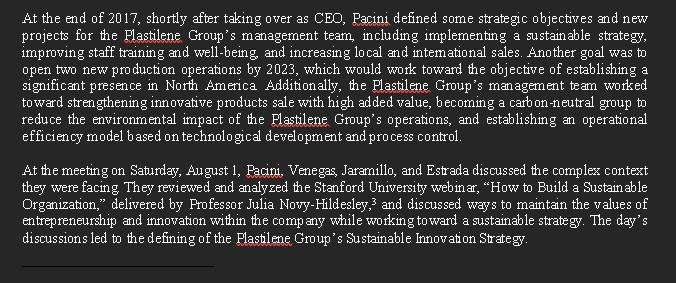
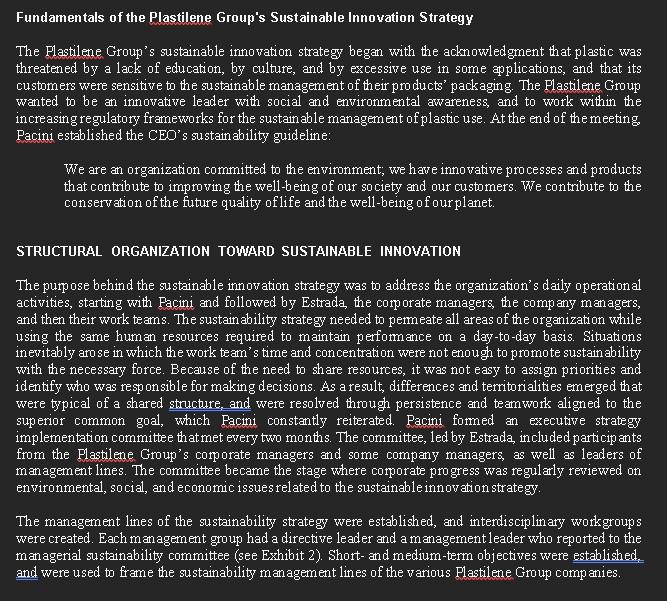
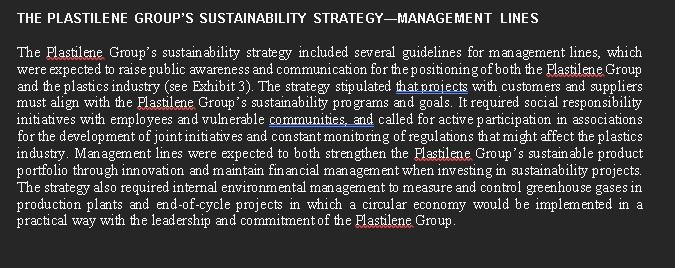
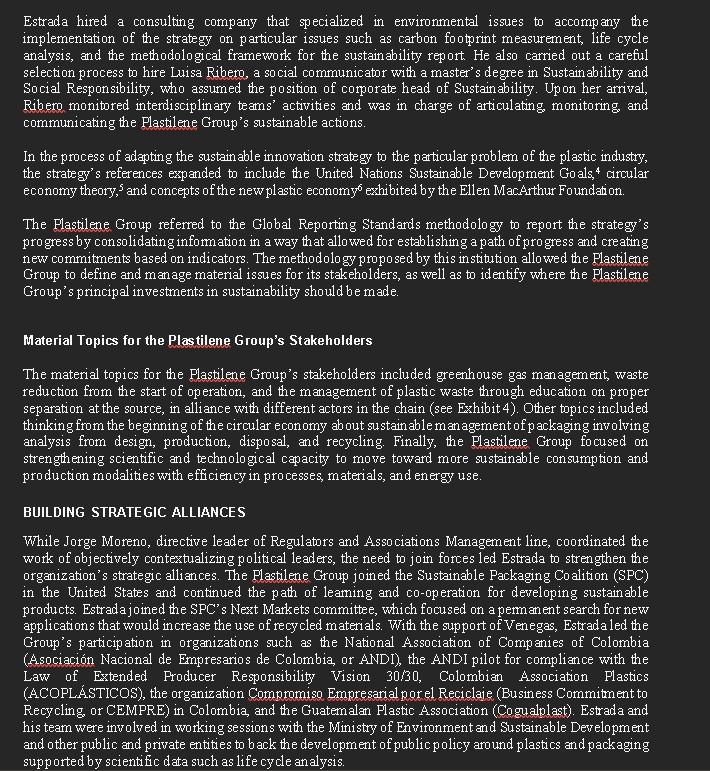
It was Saturday, August 1, 2020 and Ricardo Estrada, the corporate purchasing and sustainability manager at the Plastilene Group, felt various ideas stoming disorderly in his mind. He had left his house on the outskirts of Bogot, Colombia, in the city of Cajic shortly after 7 a.m., heading to northeast Bogot. He had araged a meeting with Stefano Pacini the Plastilene Group's chief executive officer (CEO), Fernando Venegas, a member of the Plastilene Group's shareholders' board; and Gabriel Jaramillo, vice-president of operations. The goal of the meeting was to define how to address the sustainability challenge that Pacini had entrusted to Estrada During his joumey, Estrada thought about how to face the situation in Colombia and the region. The media had demonized plastic due to the impact of its waste on marine ecosystems, while members of Colombia's Congress had proposed tightening and increasing prohibitions against plastic items. Meanwhile, the financial sector questioned companies' survival in the sector, and there was no clarity about a propriate technologies for plastic waste management. The Plastilene Group's large multinational petrochemical suppliers were stunned by the size of the threat against the industry. How could Estrada enhance sustainable innovation strategy within the Plastilene Group's structure? How could Pacini enhance corporate entrepreneurship and innovation at the Plastilene Group? A VOLATILE, UNCERTAIN, COMPLEX, AND AMBIGUOUS CONTEXT At the beginning of 2016, it was estimated that the equivalent of the contents of a plastic garbage truck were dumped into the world's rivers and ecosystems every minute, eventually ending up in the oceans. In the same year, during the World Economic Forum, the Ellen MacArthur Foundation declared that by 2050, the oceans would have more plastic than fish.2 Environmental organizations such as Greenpeace had long been promoting a battle against plastic items. In 2017, a significant proliferation of regulations occurred worldwide, with the main objective to reduce the consumption ofplastic bags, plates glasses, cutlery, straws, and other single-useplasticitems. Large mass- consumption multinationals such as Unilever, PepsiCo, Coca-Cola Company, and others ratified their commitments to reduce plastic consumption and use more environmentally friendly packaging wrappings and containers that were recyclable, compostable, reusable, or manufactured from recycled materials. Such events threatened the stability of global plastic item companies and their supply chains, the countries in which the Plastilene Group operated were not exempt from this reality. Estrada began working at the Plastilene Group at the beginning of 2010. Before his arrival, he had managed consulting projects with an intemational company within the Colombian Ministry of National Education Estrada had also worked as a business consultant, an independent entrepreneur, and an executive in private companies. He had served in various management positions as a collaborator of recognized trade, services, food, footwear, textiles, and clothing companies. By mid-2017, Estrada had been part of the Plastilene Group for seven and a half years, initially as a project consultant in the planning and production areas, then as an employee. He assumed the role of logistics manager, in which he had the opportunity to participate in the implementation of SAP enterprise resource planning software and lead the implementation of logistics co-operation agreements with strategic customers. Estrada had recently led the implementation of the Corporate Management of Purchasing and Materials Planning as a transversal area for all the Plastilene Group companies. The new corporate model made important impacts on cost reduction and the diversification of supply risks. It strengthened strategic relationships with global and local suppliers, and directly increased the company's profits by reducing the percentage cost of raw materials and more effectively negotiating trade agreements with strategic suppliers. In July 2017, Estrada spoke with the Plastilene Group's previous CEO and raised the possibility of working on sustainability in an orderly manner to respond to the general threat facing the plastics industry. However, with the appointment of Pacini as CEO, the Plastilene Group officially decided to face the growing threat against plastic materials through a sustainability strategy. Estrada was delegated to lead this task. THE PLASTILENE GROUP: 62 YEARS OF INNOVATION AND LEADERSHIP The Plastilene Group was part of the Pacini family's business group, which operated businesses in many sectors, including plastic, cardboard boxes, packaging, flower crops, granites, and marbles. As an organization, the Plastilene Group had 62 years of history. It operated production plants in Colombia, Ecuador, and Guatemala, and a US plant was in the preoperational stage. In 2017, its main products included flexible polyethylene packaging, polypropylene-laminated films, and polyethylene terephthalate (PET) sheets for food, beverage, and other industrial uses, and flexible films for floriculture. The Plastilene Group also produced post-industrial recycled composites and materials. The organization had served its markets for a long time, and they represented its primary income and sources of profit. The following companies comprised the Plastilee Group: Plastilene. Laninates, Khroma Novalene. Altalene, Reciclene, and Interplast in Colombia, Agroplsticos in Ecuador, Technofilms in Guatemala, and Plastilene NA in the United States (see Exhibit 1). The Plastilene Group had been vertically integrated since 2015, when it decided to organize itself in a matrix manner. It had corporate management positions to oversee the functional management in operations, logistics and systems, finance, human resources, purchasing, and sustainability. Additional company managers were primarily in charge of regional strategy, product commercialization, and fulfilling legal requirements in each company and region. Forty-two years earlier, the entrepreneurial, innovative, and continuous improvement awareness of its founder had led the Plastilene Group to manage plastic waste that resulted from its plant operations. The organization's interest had always been to optimize resources, be efficient in processes, and ensure that industrial waste could have a new life. This interest had led to Reciclene, a company that by 2018 had transfomed 3,000 tons of post-industrial plastic waste per year and converted it into new raw materials, resins, straps, and tubes. Reciclene marked a line of responsibility in the Plastilene Group. It paved the way so that 100 per cent of plastic waste from factories could be recovered. In the late 1990s, the Plastilene Group ventured into the manufacturing of PET sheets, a business that allowed it to establish a supply chain of 3,000 tons per year from beverage bottles' recycled material for the manufacture of agricultural, industrial, and food packaging. A New Leader, a Single Culture In November 2017, Pacini became CEO of the Plastilene Group. He was the son of the family business group's founder and had inherited his father's passions for sailing and operating industrial businesses. While the two interests may have seemed unrelated, Pacini's passion for navigation had led to his awareness of how waste negatively affected the oceans. On several occasions, while sailing the Atlantic, he had found fishing nets, bottles, bags, and other plastic items. Pacini had been involved with the Plastilene Group for many years, having served as a leader in relevant events and in negotiations with both clients and suppliers in significant multinational organizations. He had led the Plastilene Group's foray into the Central American market with the opening of Technofilms in 2000. In 2001, Pacini led a vital agreement with the multinational company DuPont de Nemours Inc. for the manufacture of flexible milk packaging for the Latin American region. Pacini led the Plastilene Group's technological transformation for which, among other actions, he developed agreements with the Geman fim W&H Group, one of the world's most recognized manufacturers of specialized machinery for the plastic film industry. Pacini had promoted the implementation of SAP enterprise resource planning software, which laid the foundations for a future digital transfomation within the Plastilene Group. Pacini was a member of the Plastilene Group's board of directors, and was involved in other businesses where the Pacini family was present. Pacini's vision closely aligned with his father's, which was always directed toward values, innovation entrepreneurship, and recognition of the human factor as pillars of the organization's growth. He held the conviction that the only way to do things was the right way. He conveyed this leadership style once he assumed the position ofCEO. At the end of 2017, shortly after taking over as CEO, Pacini defined some strategic objectives and new projects for the Plastilene Group's management team, including implementing a sustainable strategy, improving staff training and well-being, and increasing local and intem ational sales. Another goal was to open two new production operations by 2023, which would work toward the objective of establishing a significant presence in North America Additionally, the Plastilene Group's management tean worked toward strengthening innovative products sale with high added value, becoming a carbon-neutral group to reduce the environmental impact of the Plastilene Group's operations, and establishing an operational efficiency model based on technological development and process control. At the meeting on Saturday, August 1, Pacini, Venegas, Jaranillo, and Estrada discussed the complex context they were facing. They reviewed and analyzed the Stanford University webina, "How to Build a Sustainable Organization," delivered by Professor Julia Novy-Hildesley, and discussed ways to maintain the values of entrepreneurship and innovation within the company while working toward a sustainable strategy. The day's discussions led to the defining of the Plastilene Group's Sustainable Innovation Strategy a Fundamentals of the Plastilene Group's Sustainable Innovation Strategy The Plastilene Group's sustainable innovation strategy began with the acknowledgment that plastic was threatened by a lack of education, by culture, and by excessive use in some applications, and that its customers were sensitive to the sustainable management of their products' packaging. The Plastilene Group wanted to be an innovative leader with social and environmental awareness, and to work within the increasing regulatory frameworks for the sustainable management of plastic use. At the end of the meeting, Pacini established the CEO's sustainability guideline: We are an organization committed to the environment, we have innovative processes and products that contribute to improving the well-being of our society and our customers. We contribute to the conservation of the future quality oflife and the well-being of our planet. STRUCTURAL ORGANIZATION TOWARD SUSTAINABLE INNOVATION The purpose behind the sustainable innovation strategy was to address the organization's daily operational activities, starting with Pacini and followed by Estrada, the corporate managers, the company managers, and then their work teams. The sustain ability strategy needed to permeate all areas of the organization while using the same human resources required to maintain perfomance on a day-to-day basis. Situations inevitably arose in which the work tean's time and concentration were not enough to promote sustainability with the necessary force. Because of the need to share resources, it was not easy to assign priorities and identify who was responsible for making decisions. As a result, differences and territorialities emerged that were typical of a shared structure, and were resolved through persistence and teamwork aligned to the superior common goal, which Pacini constantly reiterated. Pacini fomed an executive strategy implementation committee that met every two months. The committee, led by Estrada, included participants from the Plastilene Group's corporate managers and some company managers, as well as leaders of management lines. The committee became the stage where corporate progress was regularly reviewed on environmental, social, and economic issues related to the sustainable innovation strategy. The management lines of the sustainability strategy were established, and interdisciplinary workgroups were created. Each management group had a directive leader and a management leader who reported to the managerial sustainability committee (see Exhibit 2). Short-and medium-term objectives were established and were used to frame the sustainability management lines of the various Plastilene Group companies. THE PLASTILENE GROUP'S SUSTAINABILITY STRATEGY-MANAGEMENT LINES The Plastilene Group's sustainability strategy included several guidelines for management lines, which were expected to raise public awareness and communication for the positioning of both the Plastilene Group and the plastics industry (see Exhibit 3). The strategy stipulated that projects with customers and suppliers must align with the Plastilene Group's sustainability programs and goals. It required social responsibility initiatives with employees and vulnerable communities, and called for active participation in associations for the development of joint initiatives and constant monitoring of regulations that might affect the plastics industry. Management lines were expected to both strengthen the Plastilene Group's sustainable product portfolio through innovation and maintain financial management when investing in sustainability projects. The strategy also required internal environmental management to measure and control greenhouse gases in production plants and end-of-cycle projects in which a circular economy would be implemented in a practical way with the leadership and commitment of the Plastilene Group. Estrada hired a consulting company that specialized in environmental issues to accompany the implementation of the strategy on particular issues such as carbon footprint measurement, life cycle analysis, and the methodological framework for the sustainability report. He also carried out a careful selection process to hire Luisa Ribero, a social communicator with a master's degree in Sustainability and Social Responsibility, who assumed the position of corporate head of Sustainability. Upon her arrival, Ribero monitored interdisciplinary teams' activities and was in charge of articulating monitoring and communicating the Plastilene Group's sustainable actions. In the process of adapting the sustainable innovation strategy to the particular problem of the plastic industry, the strategy's references expanded to include the United Nations Sustainable Development Goals, circular economy theory, and concepts of the new plastic economy exhibited by the Ellen MacArthur Foundation. The Plastilene Group referred to the Global Reporting Standards methodology to report the strategy's progress by consolidating infomation in a way that allowed for establishing a path of progress and creating new commitments based on indicators. The methodology proposed by this institution allowed the Plastilene Group to define and manage material issues for its stakeholders, as well as to identify where the Plastilene Group's principal investments in sustainability should be made. Material Topics for the Plastilene Group's Stakeholders The material topics for the Plastilene Group's stakeholders included greenhouse gas management, waste reduction from the start of operation, and the management of plastic waste through education on proper separation at the source, in alliance with different actors in the chain (see Exhibit 4). Other topics included thinking from the beginning of the circular economy about sustainable management of packaging involving analysis from design, production, disposal, and recycling. Finally, the Plastilene Group focused on strengthening scientific and technological capacity to move toward more sustainable consumption and production modalities with efficiency in processes, materials, and energy use. m BUILDING STRATEGIC ALLIANCES While Jorge Moreno, directive leader of Regulators and Associations Management line, coordinated the work of objectively contextualizing political leaders, the need to join forces led Estrada to strengthen the organization's strategic alliances. The Plastilene Group joined the Sustainable Packaging Coalition (SPC) in the United States and continued the path of leaming and co-operation for developing sustainable products. Estrada joined the SPC's Next Markets committee, which focused on a pemanent search for new applications that would increase the use of recycled materials. With the support of Venegas, Estrada led the Group's participation in organizations such as the National Association of Companies of Colombia (Asociacin Nacional de Empresarios de Colombia, or ANDI), the ANDI pilot for compliance with the Law of Extended Producer Responsibility Vision 30/30, Colombia Association Plastics (ACOPLSTICOS), the organization Compromiso Empresarial por el Reciclaje (Business Commitment to Recycling, or CEMPRE) in Colombia, and the Guatemalan Plastic Association (Cogualplast). Estrada and his team were involved in working sessions with the Ministry of Environment and Sustainable Development and other public and private entities to back the development of public policy around plastics and packaging supported by scientific data such as life cycle analysis. The development of strategic alliances to achieve goals led Estrada and his working group in purchasing and sustainability to establish collaborative partnerships with suppliers. The partners searched for sustainable raw materials, special materials to facilitate recycling, recycled raw materials for contact with food, and biodegradable resins, while developing supplier evaluation models that included sustainability criteria To strengthen the recycling chain and develop the line of social responsibility, the Plastilene Group fomed close relationships with different associations of recyclers. The Plastilene Group provided financial support and accompanied the recyclers in their operational and commercial development through training and purchase guarantees of their products at fair prices. The customer management line focused on communicating sustainability strategy to this stakeholder. The Plastilene Group became a pemanent customer advisor on sustainability issues, fulfilling its extended producer responsibility and the joint development of sustainable packaging Collaborative projects were generated with important beverage and cleaning products companies around strengthening the collection chain, the transformation of recycled materials and the circular economy as a way to comply with REP (Responsibilidad Extendida del Productor, or extended producer liability) legislation. New business models were developed in which the alliance with third parties to make up for a lack of proprietary technology became the first step in generating solutions to impact the circular economy. THE CHALLENGE OF TAKING ON THE CIRCULAR ECONOMY In 2018, the necessary studies were executed to carry out the compensation of greenhouse gases in the primary plants of the Plastilene Group, and a process for the compensation of carbon footprint was developed for the Plastilene and Novalene companies. These studies resulted in the foundations looking forward to being carbon- neutral in 2020 Sustainability became a fundamental part of developing the Plastilene Group's product portfolio. Eco- desigi became a protagonist for developing new products with reduced plastic consumption and new recyclable materials. The Plastilene Group incorporated products with a high content of raw materials that had been recycled by mechanical and chemical processes, and it was working on developing compostable products and bio-based products, among others. In April 2019, the Plastilene Group was a finalist in the SPC Sustainable Packaging Awards in the Sustainable Products and Processes category. The Plastilene Group presented an innovative lightweight technology that reduced up to 20 per cent of plastic consumption by decreasing film density. The Plastilene Group set out to find the best way to increase its direct offering to the circular economy, by avoiding the use of plastic in packaging so that plastic packaging would stop ending up in rivers, seas, and terrestrial ecosystems. Pacini, Jaramillo, Estrada, and the technical team of the Cycle Closure Management Line, led by Luis Ortegn and Fabin Forero, travelled to international fairs and visited research and development plants and laboratories in Europe, China, and the United States, where new recycling technologies were being consolidated. In October 2019, while they were at the K-Show, the plastic industry's most important technological event, they decided to invest in a mechanical recycling plant for plastic waste and agreed to build a production that would be operational in Colombia by the end of 2020. This technology would allow the recovery of aproximately 10,000 tons of post-consumer plastic waste per year, thus allowing the Plastilene Group to take the next step toward a circular economy. In November 2019, in a simple event in the city of Bogot and before a large audience, Pacini submitted the Plastilene Group's first sustainability report to the stakeholders. He communicated the Plastilene Group's three sustainable commitments facilitating its Colombian customers compliance with the regulations of REP: 1407/2018, offering a competitive portfolio of sustainable products under the principles of circula economy and eco-design, and becoming carbon neutral by 2020. The financial sector was pleasantly surprised by how the Plastilene Group was mitigating the company's risks. Other stakeholders such as customers, suppliers, and collaborators expressed their satisfaction with the way the Plastilene Group was implementing its sustainable innovation strategy. The preparation and delivery of the report consolidated the foundations of the sustainability communication strategy. With participation from Estrada, Ribero, and a communications specialist company, the Plastilene Group developed a communication strategy in social networks to tell its stakeholders about its vision and actions regarding sustainability and the role that each of society's actors must play to contribute to the circular economy and correct disposal of waste. All these actions allowed the Plastilene Group to fulfill its intemal goal of sustainability, which was to generate competitive advantages and promote growth in the Plastilene Group's sales through the sustainable products and actions of its companies. At the end of 2019, sustainability had become a benchmark for actions carried out by the Plastilene Group with its stakeholders. The sustainability strategy's achievements played an essential role in fulfilling the strategic objectives Pacini had set when he assumed the position as the Plastilene Group's CEO. Thus, within the line of environmental management, the leading companies of the Plastilene Group achieved carbon footprint compensation during 2019, and were on their way to obtaining carbon neutrality in 2020. At the beginning of 2020, a new plant was installed when the American market opening took place. The new plant played an important role in supporting sustainability and the sale of sustainable products. The Plastilene Group's sustainability strategy contributed to anticipating the start-up of two new production operations before 2023. The first would take place in the United States for product manufacturing with an emphasis on sustainability. The second would be built in Tocancip Colombia with the capacity to process 10,000 tons of post-consumer plastics recycling per year, thereby contributing to the circular economy. Sustainable product sales multiplied and contributed to the consolidation of customers' preferences while obtaining new sponsorships from suppliers and other financial partners to strengthen the circular economy and sustainability strategy. The Plastilee Group considered 2019 to have been its best historical year in tems of tons of product sold, economic income, EBITDA (eamings before interest, taxes, depreciation, and amortization), and other financial indicators. As of December 2019, the sustainable innovation strategy's exact financial results could not be quantified. Nonetheless, it was clear that the strategy offered support for the Plastilene Group's present and future, and that-together, with the motivation and leadership transmitted by Pacini the operational excellence of company managers and their work teans, and the contributions of technological innovationthis strategy contributed significantly to obtaining the desired results. In August 2020, Estrada continued to lead and advance the development of the Plastilene Group's sustainable innovation strategy, with the mission of incorporating sustainability into day-to-day operations. Despite the crisis caused by the COVID-19 pandemic, fundamental advances were expected for the year's end, including the development of a carbon-credit emission system as a result of the processing of recycled materials and the replacement ofvirgin raw materials. Additionally, the company's management anticipated 0 that the consolidation of products offered with recycled material content and the consolidation of a communications strategy to disseminate topics of sustainability would solidify the Plastilene Group's positioning as a sustainable company. THE CHALLENGE OF INTEGRATING AND COORDINATING INNOVATION AT THE COMPANY Throughout its history, the Plastilene Group's innovation policy had focused on product development. The innovation structure that managed the operation's vice-presidency was made up of different cells within each company. Since Pacini's arrival, the innovation concepthad taken on a new dimension and transcended the product and manufacturing processes. It contemplated sustainability, innovation in technology, administrative procedures, and the generation of new business models. Innovation at the Plastilene Group was headed by Pacini, who integrated different lines of innovation inside and outside the company. Pacini continued to reflect on the Plastilene Group's accomplishments and identify new ways to move forward in a conscious and orderly manner. However, Pacini was faced with several key questions to consider. How could the company keep innovation active and pemanently in operation within the Plastilene Group? Specifically, how could Estrada enhance the sustainable innovation strategy within the Plastilene Group's structure, while Pacini worked to enhance corporate entrepreneurship and innovation? . It was Saturday, August 1, 2020 and Ricardo Estrada, the corporate purchasing and sustainability manager at the Plastilene Group, felt various ideas stoming disorderly in his mind. He had left his house on the outskirts of Bogot, Colombia, in the city of Cajic shortly after 7 a.m., heading to northeast Bogot. He had araged a meeting with Stefano Pacini the Plastilene Group's chief executive officer (CEO), Fernando Venegas, a member of the Plastilene Group's shareholders' board; and Gabriel Jaramillo, vice-president of operations. The goal of the meeting was to define how to address the sustainability challenge that Pacini had entrusted to Estrada During his joumey, Estrada thought about how to face the situation in Colombia and the region. The media had demonized plastic due to the impact of its waste on marine ecosystems, while members of Colombia's Congress had proposed tightening and increasing prohibitions against plastic items. Meanwhile, the financial sector questioned companies' survival in the sector, and there was no clarity about a propriate technologies for plastic waste management. The Plastilene Group's large multinational petrochemical suppliers were stunned by the size of the threat against the industry. How could Estrada enhance sustainable innovation strategy within the Plastilene Group's structure? How could Pacini enhance corporate entrepreneurship and innovation at the Plastilene Group? A VOLATILE, UNCERTAIN, COMPLEX, AND AMBIGUOUS CONTEXT At the beginning of 2016, it was estimated that the equivalent of the contents of a plastic garbage truck were dumped into the world's rivers and ecosystems every minute, eventually ending up in the oceans. In the same year, during the World Economic Forum, the Ellen MacArthur Foundation declared that by 2050, the oceans would have more plastic than fish.2 Environmental organizations such as Greenpeace had long been promoting a battle against plastic items. In 2017, a significant proliferation of regulations occurred worldwide, with the main objective to reduce the consumption ofplastic bags, plates glasses, cutlery, straws, and other single-useplasticitems. Large mass- consumption multinationals such as Unilever, PepsiCo, Coca-Cola Company, and others ratified their commitments to reduce plastic consumption and use more environmentally friendly packaging wrappings and containers that were recyclable, compostable, reusable, or manufactured from recycled materials. Such events threatened the stability of global plastic item companies and their supply chains, the countries in which the Plastilene Group operated were not exempt from this reality. Estrada began working at the Plastilene Group at the beginning of 2010. Before his arrival, he had managed consulting projects with an intemational company within the Colombian Ministry of National Education Estrada had also worked as a business consultant, an independent entrepreneur, and an executive in private companies. He had served in various management positions as a collaborator of recognized trade, services, food, footwear, textiles, and clothing companies. By mid-2017, Estrada had been part of the Plastilene Group for seven and a half years, initially as a project consultant in the planning and production areas, then as an employee. He assumed the role of logistics manager, in which he had the opportunity to participate in the implementation of SAP enterprise resource planning software and lead the implementation of logistics co-operation agreements with strategic customers. Estrada had recently led the implementation of the Corporate Management of Purchasing and Materials Planning as a transversal area for all the Plastilene Group companies. The new corporate model made important impacts on cost reduction and the diversification of supply risks. It strengthened strategic relationships with global and local suppliers, and directly increased the company's profits by reducing the percentage cost of raw materials and more effectively negotiating trade agreements with strategic suppliers. In July 2017, Estrada spoke with the Plastilene Group's previous CEO and raised the possibility of working on sustainability in an orderly manner to respond to the general threat facing the plastics industry. However, with the appointment of Pacini as CEO, the Plastilene Group officially decided to face the growing threat against plastic materials through a sustainability strategy. Estrada was delegated to lead this task. THE PLASTILENE GROUP: 62 YEARS OF INNOVATION AND LEADERSHIP The Plastilene Group was part of the Pacini family's business group, which operated businesses in many sectors, including plastic, cardboard boxes, packaging, flower crops, granites, and marbles. As an organization, the Plastilene Group had 62 years of history. It operated production plants in Colombia, Ecuador, and Guatemala, and a US plant was in the preoperational stage. In 2017, its main products included flexible polyethylene packaging, polypropylene-laminated films, and polyethylene terephthalate (PET) sheets for food, beverage, and other industrial uses, and flexible films for floriculture. The Plastilene Group also produced post-industrial recycled composites and materials. The organization had served its markets for a long time, and they represented its primary income and sources of profit. The following companies comprised the Plastilee Group: Plastilene. Laninates, Khroma Novalene. Altalene, Reciclene, and Interplast in Colombia, Agroplsticos in Ecuador, Technofilms in Guatemala, and Plastilene NA in the United States (see Exhibit 1). The Plastilene Group had been vertically integrated since 2015, when it decided to organize itself in a matrix manner. It had corporate management positions to oversee the functional management in operations, logistics and systems, finance, human resources, purchasing, and sustainability. Additional company managers were primarily in charge of regional strategy, product commercialization, and fulfilling legal requirements in each company and region. Forty-two years earlier, the entrepreneurial, innovative, and continuous improvement awareness of its founder had led the Plastilene Group to manage plastic waste that resulted from its plant operations. The organization's interest had always been to optimize resources, be efficient in processes, and ensure that industrial waste could have a new life. This interest had led to Reciclene, a company that by 2018 had transfomed 3,000 tons of post-industrial plastic waste per year and converted it into new raw materials, resins, straps, and tubes. Reciclene marked a line of responsibility in the Plastilene Group. It paved the way so that 100 per cent of plastic waste from factories could be recovered. In the late 1990s, the Plastilene Group ventured into the manufacturing of PET sheets, a business that allowed it to establish a supply chain of 3,000 tons per year from beverage bottles' recycled material for the manufacture of agricultural, industrial, and food packaging. A New Leader, a Single Culture In November 2017, Pacini became CEO of the Plastilene Group. He was the son of the family business group's founder and had inherited his father's passions for sailing and operating industrial businesses. While the two interests may have seemed unrelated, Pacini's passion for navigation had led to his awareness of how waste negatively affected the oceans. On several occasions, while sailing the Atlantic, he had found fishing nets, bottles, bags, and other plastic items. Pacini had been involved with the Plastilene Group for many years, having served as a leader in relevant events and in negotiations with both clients and suppliers in significant multinational organizations. He had led the Plastilene Group's foray into the Central American market with the opening of Technofilms in 2000. In 2001, Pacini led a vital agreement with the multinational company DuPont de Nemours Inc. for the manufacture of flexible milk packaging for the Latin American region. Pacini led the Plastilene Group's technological transformation for which, among other actions, he developed agreements with the Geman fim W&H Group, one of the world's most recognized manufacturers of specialized machinery for the plastic film industry. Pacini had promoted the implementation of SAP enterprise resource planning software, which laid the foundations for a future digital transfomation within the Plastilene Group. Pacini was a member of the Plastilene Group's board of directors, and was involved in other businesses where the Pacini family was present. Pacini's vision closely aligned with his father's, which was always directed toward values, innovation entrepreneurship, and recognition of the human factor as pillars of the organization's growth. He held the conviction that the only way to do things was the right way. He conveyed this leadership style once he assumed the position ofCEO. At the end of 2017, shortly after taking over as CEO, Pacini defined some strategic objectives and new projects for the Plastilene Group's management team, including implementing a sustainable strategy, improving staff training and well-being, and increasing local and intem ational sales. Another goal was to open two new production operations by 2023, which would work toward the objective of establishing a significant presence in North America Additionally, the Plastilene Group's management tean worked toward strengthening innovative products sale with high added value, becoming a carbon-neutral group to reduce the environmental impact of the Plastilene Group's operations, and establishing an operational efficiency model based on technological development and process control. At the meeting on Saturday, August 1, Pacini, Venegas, Jaranillo, and Estrada discussed the complex context they were facing. They reviewed and analyzed the Stanford University webina, "How to Build a Sustainable Organization," delivered by Professor Julia Novy-Hildesley, and discussed ways to maintain the values of entrepreneurship and innovation within the company while working toward a sustainable strategy. The day's discussions led to the defining of the Plastilene Group's Sustainable Innovation Strategy a Fundamentals of the Plastilene Group's Sustainable Innovation Strategy The Plastilene Group's sustainable innovation strategy began with the acknowledgment that plastic was threatened by a lack of education, by culture, and by excessive use in some applications, and that its customers were sensitive to the sustainable management of their products' packaging. The Plastilene Group wanted to be an innovative leader with social and environmental awareness, and to work within the increasing regulatory frameworks for the sustainable management of plastic use. At the end of the meeting, Pacini established the CEO's sustainability guideline: We are an organization committed to the environment, we have innovative processes and products that contribute to improving the well-being of our society and our customers. We contribute to the conservation of the future quality oflife and the well-being of our planet. STRUCTURAL ORGANIZATION TOWARD SUSTAINABLE INNOVATION The purpose behind the sustainable innovation strategy was to address the organization's daily operational activities, starting with Pacini and followed by Estrada, the corporate managers, the company managers, and then their work teams. The sustain ability strategy needed to permeate all areas of the organization while using the same human resources required to maintain perfomance on a day-to-day basis. Situations inevitably arose in which the work tean's time and concentration were not enough to promote sustainability with the necessary force. Because of the need to share resources, it was not easy to assign priorities and identify who was responsible for making decisions. As a result, differences and territorialities emerged that were typical of a shared structure, and were resolved through persistence and teamwork aligned to the superior common goal, which Pacini constantly reiterated. Pacini fomed an executive strategy implementation committee that met every two months. The committee, led by Estrada, included participants from the Plastilene Group's corporate managers and some company managers, as well as leaders of management lines. The committee became the stage where corporate progress was regularly reviewed on environmental, social, and economic issues related to the sustainable innovation strategy. The management lines of the sustainability strategy were established, and interdisciplinary workgroups were created. Each management group had a directive leader and a management leader who reported to the managerial sustainability committee (see Exhibit 2). Short-and medium-term objectives were established and were used to frame the sustainability management lines of the various Plastilene Group companies. THE PLASTILENE GROUP'S SUSTAINABILITY STRATEGY-MANAGEMENT LINES The Plastilene Group's sustainability strategy included several guidelines for management lines, which were expected to raise public awareness and communication for the positioning of both the Plastilene Group and the plastics industry (see Exhibit 3). The strategy stipulated that projects with customers and suppliers must align with the Plastilene Group's sustainability programs and goals. It required social responsibility initiatives with employees and vulnerable communities, and called for active participation in associations for the development of joint initiatives and constant monitoring of regulations that might affect the plastics industry. Management lines were expected to both strengthen the Plastilene Group's sustainable product portfolio through innovation and maintain financial management when investing in sustainability projects. The strategy also required internal environmental management to measure and control greenhouse gases in production plants and end-of-cycle projects in which a circular economy would be implemented in a practical way with the leadership and commitment of the Plastilene Group. Estrada hired a consulting company that specialized in environmental issues to accompany the implementation of the strategy on particular issues such as carbon footprint measurement, life cycle analysis, and the methodological framework for the sustainability report. He also carried out a careful selection process to hire Luisa Ribero, a social communicator with a master's degree in Sustainability and Social Responsibility, who assumed the position of corporate head of Sustainability. Upon her arrival, Ribero monitored interdisciplinary teams' activities and was in charge of articulating monitoring and communicating the Plastilene Group's sustainable actions. In the process of adapting the sustainable innovation strategy to the particular problem of the plastic industry, the strategy's references expanded to include the United Nations Sustainable Development Goals, circular economy theory, and concepts of the new plastic economy exhibited by the Ellen MacArthur Foundation. The Plastilene Group referred to the Global Reporting Standards methodology to report the strategy's progress by consolidating infomation in a way that allowed for establishing a path of progress and creating new commitments based on indicators. The methodology proposed by this institution allowed the Plastilene Group to define and manage material issues for its stakeholders, as well as to identify where the Plastilene Group's principal investments in sustainability should be made. Material Topics for the Plastilene Group's Stakeholders The material topics for the Plastilene Group's stakeholders included greenhouse gas management, waste reduction from the start of operation, and the management of plastic waste through education on proper separation at the source, in alliance with different actors in the chain (see Exhibit 4). Other topics included thinking from the beginning of the circular economy about sustainable management of packaging involving analysis from design, production, disposal, and recycling. Finally, the Plastilene Group focused on strengthening scientific and technological capacity to move toward more sustainable consumption and production modalities with efficiency in processes, materials, and energy use. m BUILDING STRATEGIC ALLIANCES While Jorge Moreno, directive leader of Regulators and Associations Management line, coordinated the work of objectively contextualizing political leaders, the need to join forces led Estrada to strengthen the organization's strategic alliances. The Plastilene Group joined the Sustainable Packaging Coalition (SPC) in the United States and continued the path of leaming and co-operation for developing sustainable products. Estrada joined the SPC's Next Markets committee, which focused on a pemanent search for new applications that would increase the use of recycled materials. With the support of Venegas, Estrada led the Group's participation in organizations such as the National Association of Companies of Colombia (Asociacin Nacional de Empresarios de Colombia, or ANDI), the ANDI pilot for compliance with the Law of Extended Producer Responsibility Vision 30/30, Colombia Association Plastics (ACOPLSTICOS), the organization Compromiso Empresarial por el Reciclaje (Business Commitment to Recycling, or CEMPRE) in Colombia, and the Guatemalan Plastic Association (Cogualplast). Estrada and his team were involved in working sessions with the Ministry of Environment and Sustainable Development and other public and private entities to back the development of public policy around plastics and packaging supported by scientific data such as life cycle analysis. The development of strategic alliances to achieve goals led Estrada and his working group in purchasing and sustainability to establish collaborative partnerships with suppliers. The partners searched for sustainable raw materials, special materials to facilitate recycling, recycled raw materials for contact with food, and biodegradable resins, while developing supplier evaluation models that included sustainability criteria To strengthen the recycling chain and develop the line of social responsibility, the Plastilene Group fomed close relationships with different associations of recyclers. The Plastilene Group provided financial support and accompanied the recyclers in their operational and commercial development through training and purchase guarantees of their products at fair prices. The customer management line focused on communicating sustainability strategy to this stakeholder. The Plastilene Group became a pemanent customer advisor on sustainability issues, fulfilling its extended producer responsibility and the joint development of sustainable packaging Collaborative projects were generated with important beverage and cleaning products companies around strengthening the collection chain, the transformation of recycled materials and the circular economy as a way to comply with REP (Responsibilidad Extendida del Productor, or extended producer liability) legislation. New business models were developed in which the alliance with third parties to make up for a lack of proprietary technology became the first step in generating solutions to impact the circular economy. THE CHALLENGE OF TAKING ON THE CIRCULAR ECONOMY In 2018, the necessary studies were executed to carry out the compensation of greenhouse gases in the primary plants of the Plastilene Group, and a process for the compensation of carbon footprint was developed for the Plastilene and Novalene companies. These studies resulted in the foundations looking forward to being carbon- neutral in 2020 Sustainability became a fundamental part of developing the Plastilene Group's product portfolio. Eco- desigi became a protagonist for developing new products with reduced plastic consumption and new recyclable materials. The Plastilene Group incorporated products with a high content of raw materials that had been recycled by mechanical and chemical processes, and it was working on developing compostable products and bio-based products, among others. In April 2019, the Plastilene Group was a finalist in the SPC Sustainable Packaging Awards in the Sustainable Products and Processes category. The Plastilene Group presented an innovative lightweight technology that reduced up to 20 per cent of plastic consumption by decreasing film density. The Plastilene Group set out to find the best way to increase its direct offering to the circular economy, by avoiding the use of plastic in packaging so that plastic packaging would stop ending up in rivers, seas, and terrestrial ecosystems. Pacini, Jaramillo, Estrada, and the technical team of the Cycle Closure Management Line, led by Luis Ortegn and Fabin Forero, travelled to international fairs and visited research and development plants and laboratories in Europe, China, and the United States, where new recycling technologies were being consolidated. In October 2019, while they were at the K-Show, the plastic industry's most important technological event, they decided to invest in a mechanical recycling plant for plastic waste and agreed to build a production that would be operational in Colombia by the end of 2020. This technology would allow the recovery of aproximately 10,000 tons of post-consumer plastic waste per year, thus allowing the Plastilene Group to take the next step toward a circular economy. In November 2019, in a simple event in the city of Bogot and before a large audience, Pacini submitted the Plastilene Group's first sustainability report to the stakeholders. He communicated the Plastilene Group's three sustainable commitments facilitating its Colombian customers compliance with the regulations of REP: 1407/2018, offering a competitive portfolio of sustainable products under the principles of circula economy and eco-design, and becoming carbon neutral by 2020. The financial sector was pleasantly surprised by how the Plastilene Group was mitigating the company's risks. Other stakeholders such as customers, suppliers, and collaborators expressed their satisfaction with the way the Plastilene Group was implementing its sustainable innovation strategy. The preparation and delivery of the report consolidated the foundations of the sustainability communication strategy. With participation from Estrada, Ribero, and a communications specialist company, the Plastilene Group developed a communication strategy in social networks to tell its stakeholders about its vision and actions regarding sustainability and the role that each of society's actors must play to contribute to the circular economy and correct disposal of waste. All these actions allowed the Plastilene Group to fulfill its intemal goal of sustainability, which was to generate competitive advantages and promote growth in the Plastilene Group's sales through the sustainable products and actions of its companies. At the end of 2019, sustainability had become a benchmark for actions carried out by the Plastilene Group with its stakeholders. The sustainability strategy's achievements played an essential role in fulfilling the strategic objectives Pacini had set when he assumed the position as the Plastilene Group's CEO. Thus, within the line of environmental management, the leading companies of the Plastilene Group achieved carbon footprint compensation during 2019, and were on their way to obtaining carbon neutrality in 2020. At the beginning of 2020, a new plant was installed when the American market opening took place. The new plant played an important role in supporting sustainability and the sale of sustainable products. The Plastilene Group's sustainability strategy contributed to anticipating the start-up of two new production operations before 2023. The first would take place in the United States for product manufacturing with an emphasis on sustainability. The second would be built in Tocancip Colombia with the capacity to process 10,000 tons of post-consumer plastics recycling per year, thereby contributing to the circular economy. Sustainable product sales multiplied and contributed to the consolidation of customers' preferences while obtaining new sponsorships from suppliers and other financial partners to strengthen the circular economy and sustainability strategy. The Plastilee Group considered 2019 to have been its best historical year in tems of tons of product sold, economic income, EBITDA (eamings before interest, taxes, depreciation, and amortization), and other financial indicators. As of December 2019, the sustainable innovation strategy's exact financial results could not be quantified. Nonetheless, it was clear that the strategy offered support for the Plastilene Group's present and future, and that-together, with the motivation and leadership transmitted by Pacini the operational excellence of company managers and their work teans, and the contributions of technological innovationthis strategy contributed significantly to obtaining the desired results. In August 2020, Estrada continued to lead and advance the development of the Plastilene Group's sustainable innovation strategy, with the mission of incorporating sustainability into day-to-day operations. Despite the crisis caused by the COVID-19 pandemic, fundamental advances were expected for the year's end, including the development of a carbon-credit emission system as a result of the processing of recycled materials and the replacement ofvirgin raw materials. Additionally, the company's management anticipated 0 that the consolidation of products offered with recycled material content and the consolidation of a communications strategy to disseminate topics of sustainability would solidify the Plastilene Group's positioning as a sustainable company. THE CHALLENGE OF INTEGRATING AND COORDINATING INNOVATION AT THE COMPANY Throughout its history, the Plastilene Group's innovation policy had focused on product development. The innovation structure that managed the operation's vice-presidency was made up of different cells within each company. Since Pacini's arrival, the innovation concepthad taken on a new dimension and transcended the product and manufacturing processes. It contemplated sustainability, innovation in technology, administrative procedures, and the generation of new business models. Innovation at the Plastilene Group was headed by Pacini, who integrated different lines of innovation inside and outside the company. Pacini continued to reflect on the Plastilene Group's accomplishments and identify new ways to move forward in a conscious and orderly manner. However, Pacini was faced with several key questions to consider. How could the company keep innovation active and pemanently in operation within the Plastilene Group? Specifically, how could Estrada enhance the sustainable innovation strategy within the Plastilene Group's structure, while Pacini worked to enhance corporate entrepreneurship and innovationStep by Step Solution
There are 3 Steps involved in it
1 Expert Approved Answer
Step: 1 Unlock

Question Has Been Solved by an Expert!
Get step-by-step solutions from verified subject matter experts
Step: 2 Unlock
Step: 3 Unlock
 Study Help