



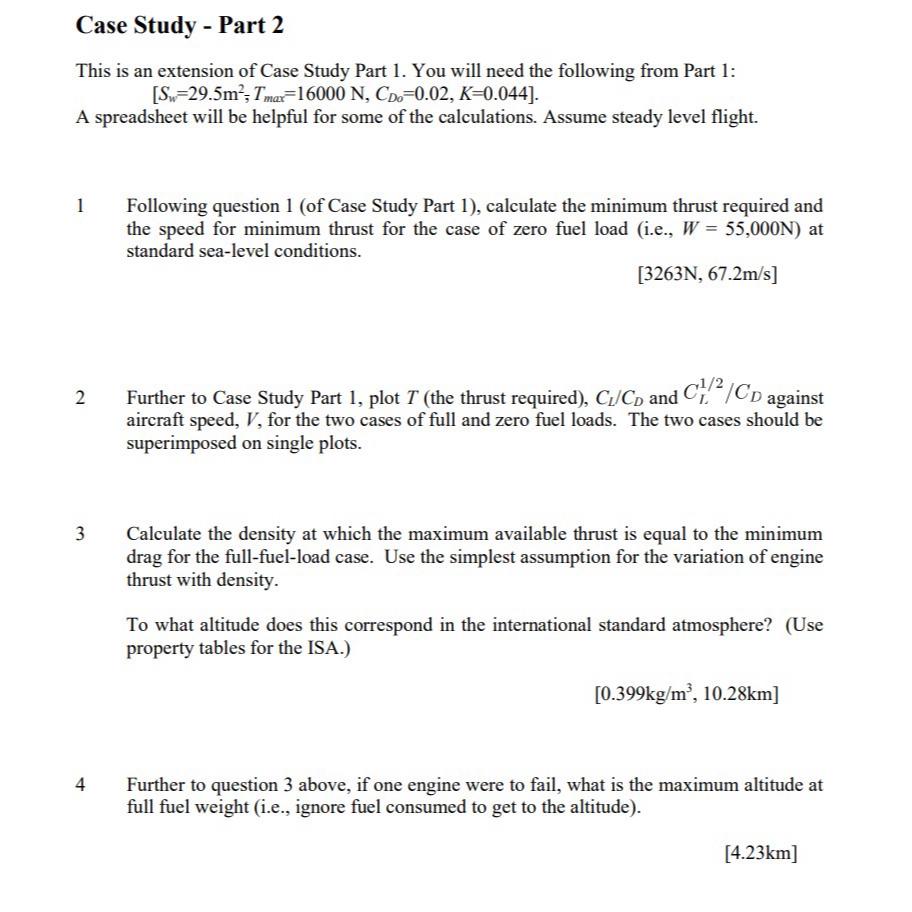
Question: Case Study - Part 2 This is an extension of Case Study Part 1 . You will need the following from Part 1 : S
Case Study Part
This is an extension of Case Study Part You will need the following from Part :
A spreadsheet will be helpful for some of the calculations. Assume steady level flight.
Following question of Case Study Part calculate the minimum thrust required and the speed for minimum thrust for the case of zero fuel load ie at standard sealevel conditions.
Further to Case Study Part plot the thrust required and against aircraft speed, for the two cases of full and zero fuel loads. The two cases should be superimposed on single plots.
Calculate the density at which the maximum available thrust is equal to the minimum drag for the fullfuelload case. Use the simplest assumption for the variation of engine thrust with density.
To what altitude does this correspond in the international standard atmosphere? Use property tables for the ISA.
Further to question above, if one engine were to fail, what is the maximum altitude at full fuel weight ie ignore fuel consumed to get to the altitude
km
Step by Step Solution
There are 3 Steps involved in it
1 Expert Approved Answer
Step: 1 Unlock

Question Has Been Solved by an Expert!
Get step-by-step solutions from verified subject matter experts
Step: 2 Unlock
Step: 3 Unlock