



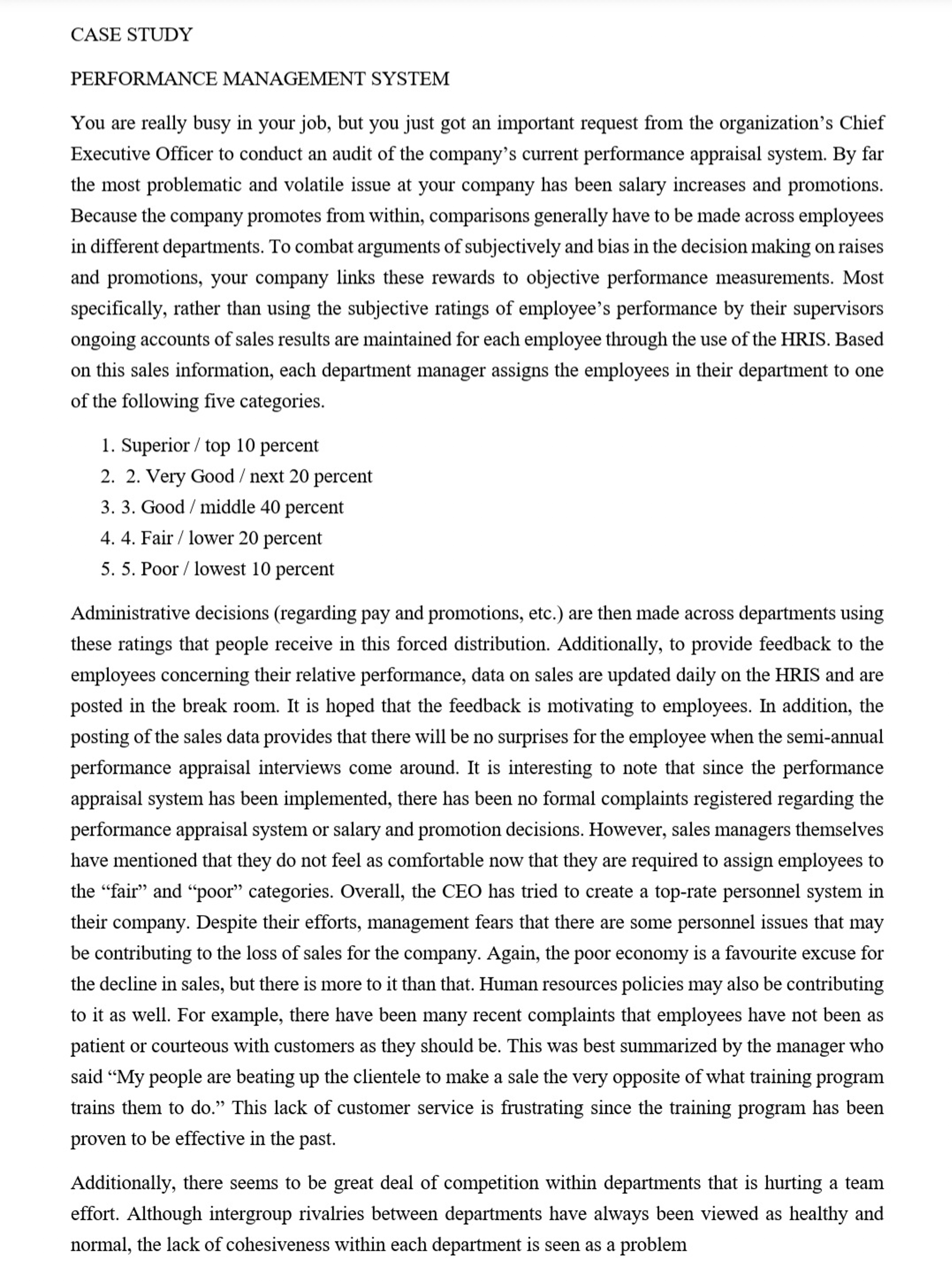
Question: CASE STUDY PERFORMANCE MANAGEMENT SYSTEM You are really busy in your job, but you just got an important request from the organization's Chief Executive Officer
CASE STUDY
PERFORMANCE MANAGEMENT SYSTEM
You are really busy in your job, but you just got an important request from the organization's Chief
Executive Officer to conduct an audit of the company's current performance appraisal system. By far
the most problematic and volatile issue at your company has been salary increases and promotions.
Because the company promotes from within, comparisons generally have to be made across employees
in different departments. To combat arguments of subjectively and bias in the decision making on raises
and promotions, your company links these rewards to objective performance measurements. Most
specifically, rather than using the subjective ratings of employee's performance by their supervisors
ongoing accounts of sales results are maintained for each employee through the use of the HRIS. Based
on this sales information, each department manager assigns the employees in their department to one
of the following five categories.
Superior top percent
Very Good next percent
Good middle percent
Fair lower percent
Poor lowest percent
Administrative decisions regarding pay and promotions, etc. are then made across departments using
these ratings that people receive in this forced distribution. Additionally, to provide feedback to the
employees concerning their relative performance, data on sales are updated daily on the HRIS and are
posted in the break room. It is hoped that the feedback is motivating to employees. In addition, the
posting of the sales data provides that there will be no surprises for the employee when the semiannual
performance appraisal interviews come around. It is interesting to note that since the performance
appraisal system has been implemented, there has been no formal complaints registered regarding the
performance appraisal system or salary and promotion decisions. However, sales managers themselves
have mentioned that they do not feel as comfortable now that they are required to assign employees to
the "fair" and "poor" categories. Overall, the CEO has tried to create a toprate personnel system in
their company. Despite their efforts, management fears that there are some personnel issues that may
be contributing to the loss of sales for the company. Again, the poor economy is a favourite excuse for
the decline in sales, but there is more to it than that. Human resources policies may also be contributing
to it as well. For example, there have been many recent complaints that employees have not been as
patient or courteous with customers as they should be This was best summarized by the manager who
said My people are beating up the clientele to make a sale the very opposite of what training program
trains them to do This lack of customer service is frustrating since the training program has been
proven to be effective in the past.
Additionally, there seems to be great deal of competition within departments that is hurting a team
effort. Although intergroup rivalries between departments have always been viewed as healthy and
normal, the lack of cohesiveness within each department is seen as a problem.
QIdentify and describe atleast three strenghts of the PMS Why are they strenght.
Q Identify three weekness of the PMS What are some of the consequences caused by these weeknesses.
Q What changes would you recommend for the appraisal system
Step by Step Solution
There are 3 Steps involved in it
1 Expert Approved Answer
Step: 1 Unlock

Question Has Been Solved by an Expert!
Get step-by-step solutions from verified subject matter experts
Step: 2 Unlock
Step: 3 Unlock