Question: Case Study: Please answer Q1 and Q3 only with around 50 words per each CLOSING CASE Coca-Cola's China strategy The Coca-Cola Company is the world's
Case Study: Please answer Q1 and Q3 only with around 50 words per each
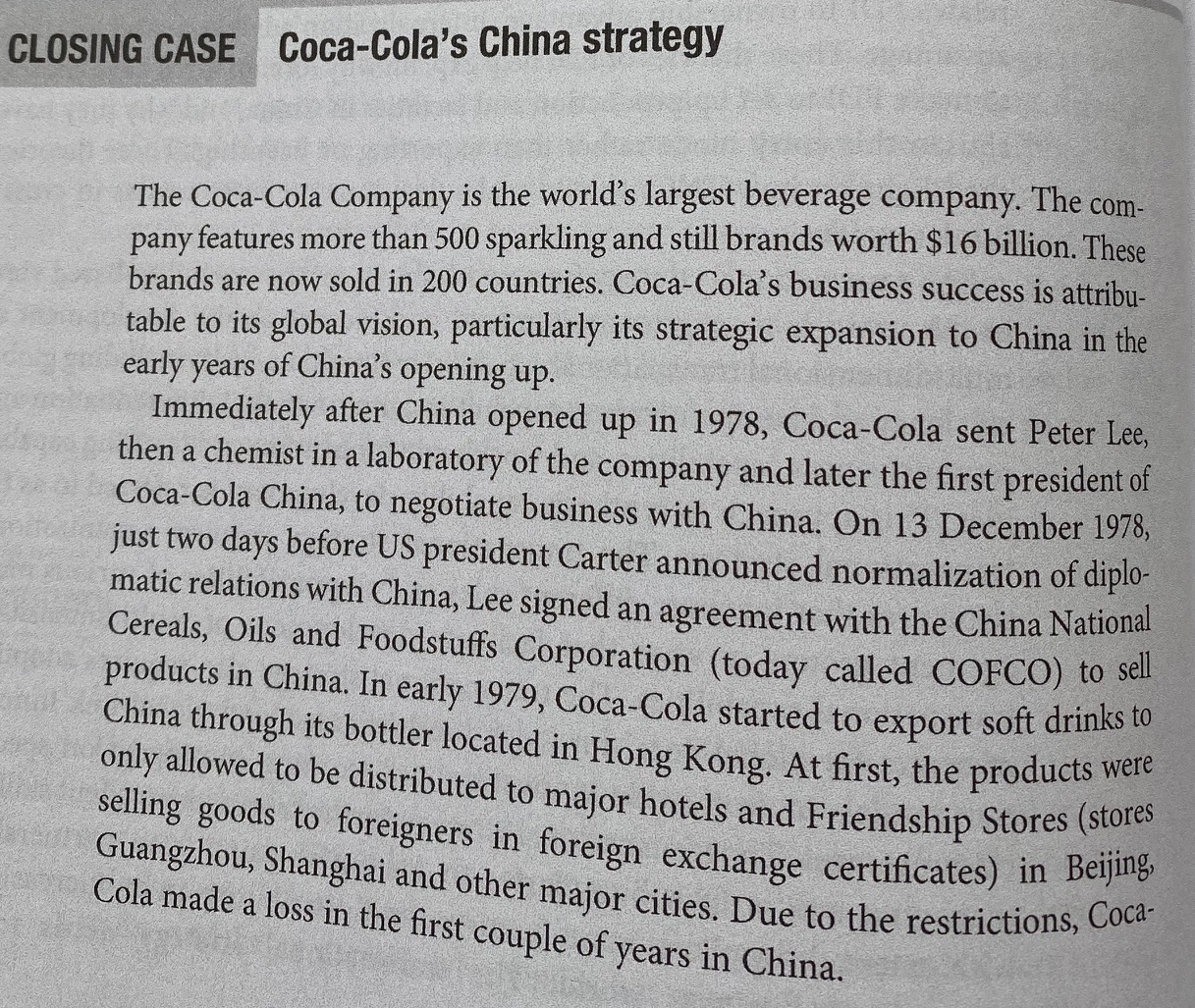
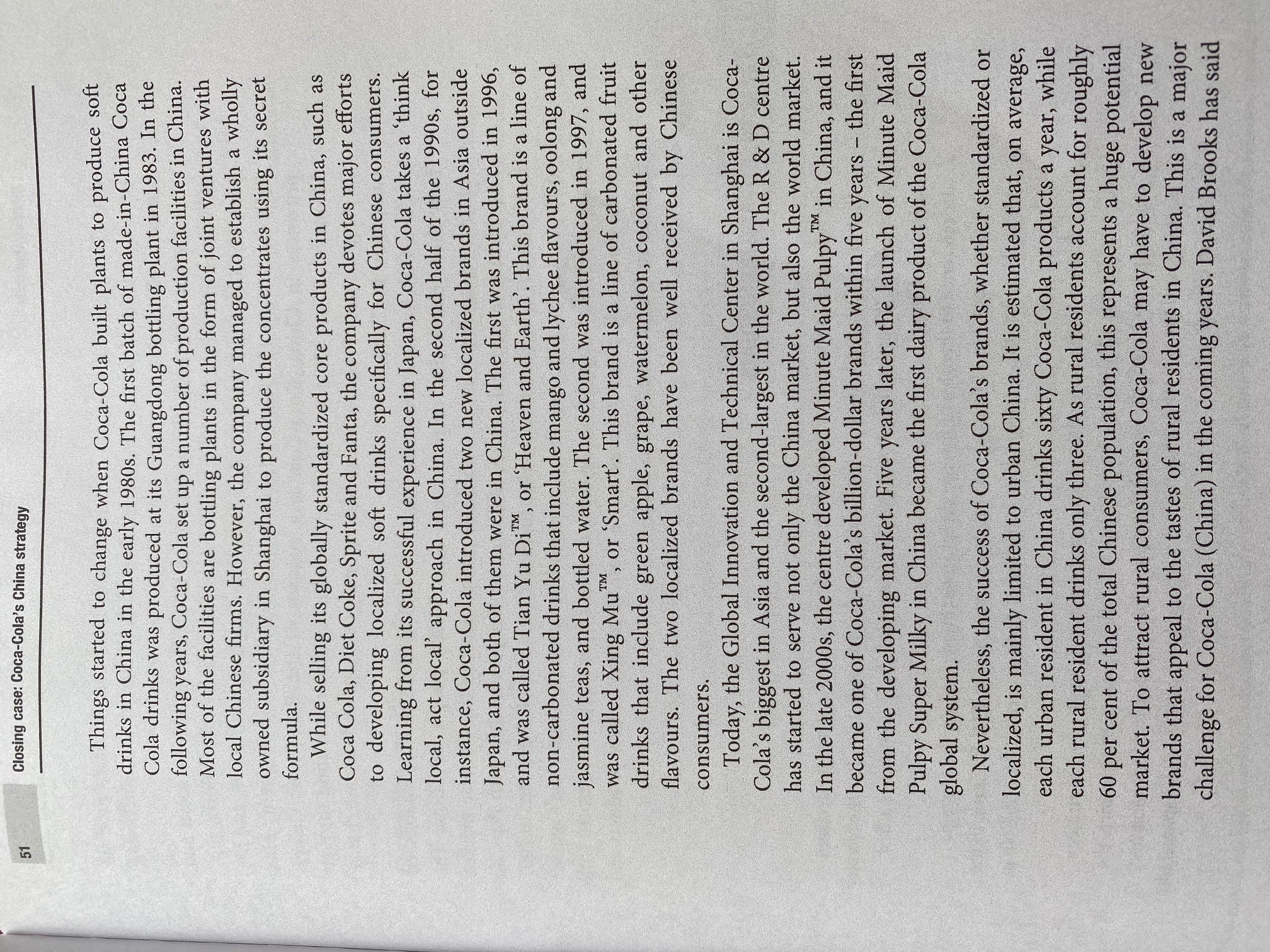
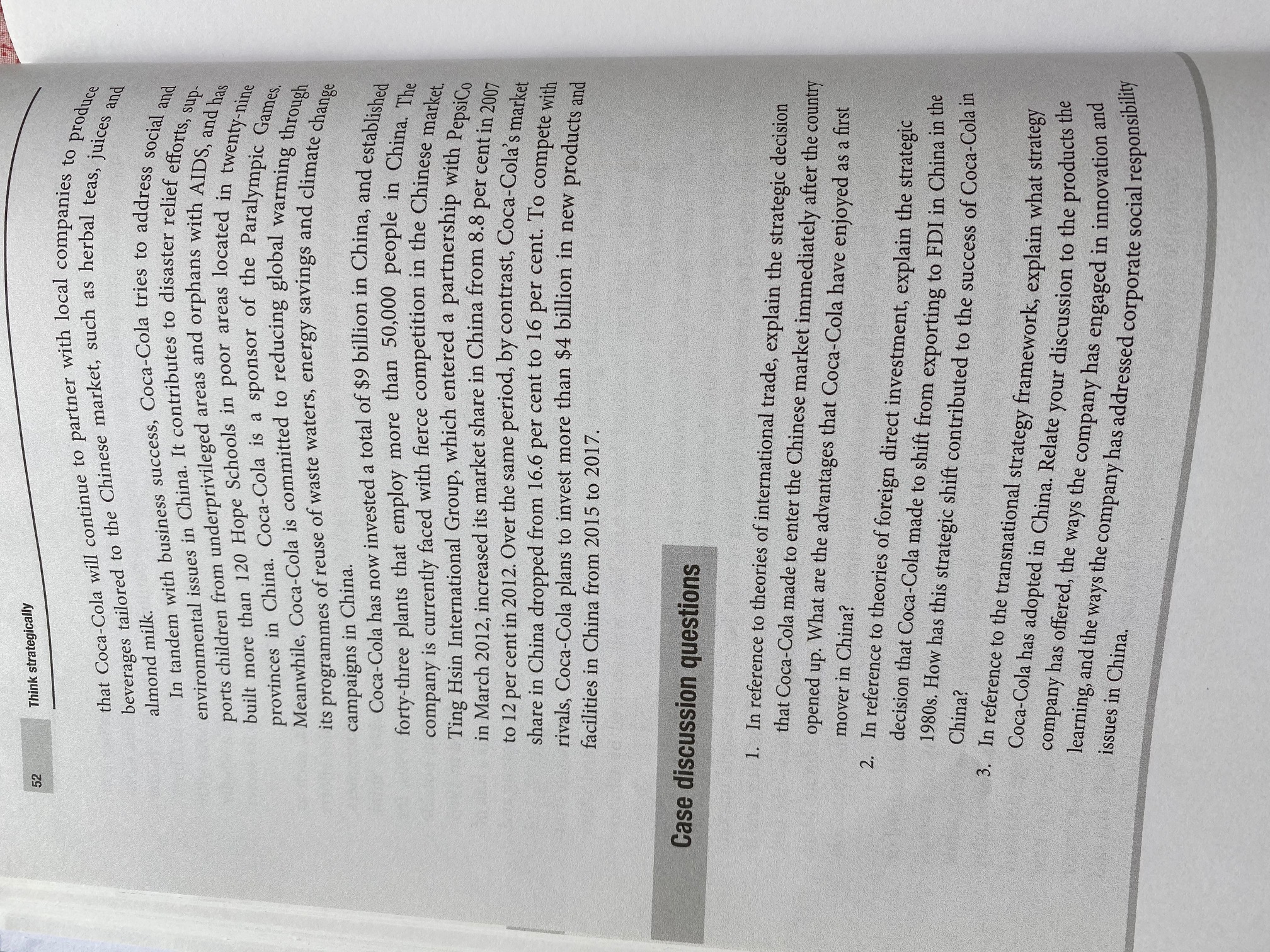
CLOSING CASE Coca-Cola's China strategy The Coca-Cola Company is the world's largest beverage company. The com- pany features more than 500 sparkling and still brands worth $16 billion. These brands are now sold in 200 countries. Coca-Cola's business success is attribu- table to its global vision, particularly its strategic expansion to China in the early years of China's opening up. Immediately after China opened up in 1978, Coca-Cola sent Peter Lee, then a chemist in a laboratory of the company and later the first president of Coca-Cola China, to negotiate business with China. On 13 December 1978, just two days before US president Carter announced normalization of diplo- matic relations with China, Lee signed an agreement with the China National Cereals, Oils and Foodstuffs Corporation (today called COFCO) to sell products in China. In early 1979, Coca-Cola started to export soft drinks to China through its bottler located in Hong Kong. At first, the products were only allowed to be distributed to major hotels and Friendship Stores (stores selling goods to foreigners in foreign exchange certificates) in Beijing, Guangzhou, Shanghai and other major cities. Due to the restrictions, Coca- Cola made a loss in the first couple of years in China. 51 Closing case: Coca-Cola's China strategy TM Things started to change when Coca-Cola built plants to produce soft drinks in China in the early 1980s. The first batch of made-in-China Coca Cola drinks was produced at its Guangdong bottling plant in 1983. In the following years, Coca-Cola set up a number of production facilities in China. Most of the facilities are bottling plants in the form of joint ventures with local Chinese firms. However, the company managed to establish a wholly owned subsidiary in Shanghai to produce the concentrates using its secret formula. While selling its globally standardized core products in China, such as Coca Cola, Diet Coke, Sprite and Fanta, the company devotes major efforts to developing localized soft drinks specifically for Chinese consumers. Learning from its successful experience in Japan, Coca-Cola takes a 'think local, act local approach in China. In the second half of the 1990s, for instance, Coca-Cola introduced two new localized brands in Asia outside Japan, and both of them were in China. The first was introduced in 1996, and was called Tian Yu Di , or Heaven and Earth'. This brand is a line of non-carbonated drinks that include mango and lychee flavours, oolong and jasmine teas, and bottled water. The second was introduced in 1997, and was called Xing MuTM, or Smart. This brand is a line of carbonated fruit drinks that include green apple, grape, watermelon, coconut and other flavours. The two localized brands have been well received by Chinese consumers. Today, the Global Innovation and Technical Center in Shanghai is Coca- Cola's biggest in Asia and the second-largest in the world. The R & D centre has started to serve not only the China market, but also the world market. In the late 2000s, the centre developed Minute Maid PulpyTM in China, and it became one of Coca-Cola's billion-dollar brands within five years the first from the developing market. Five years later, the launch of Minute Maid Pulpy Super Milky in China became the first dairy product of the Coca-Cola global system. Nevertheless, the success of Coca-Cola's brands, whether standardized or localized, is mainly limited to urban China. It is estimated that, on average, each urban resident in China drinks sixty Coca-Cola products a year, while each rural resident drinks only three. As rural residents account for roughly 60 per cent of the total Chinese population, this represents a huge potential market. To attract rural consumers, Coca-Cola may have to develop new brands that appeal to the tastes of rural residents in China. This is a major challenge for Coca-Cola (China) in the coming years. David Brooks has said Think strategically 52 almond milk. sup- that Coca-Cola will continue to partner with local companies to produce beverages tailored to the Chinese market, such as herbal teas, juices and environmental issues in China. It contributes to disaster relief efforts, In tandem with business success, Coca-Cola tries to address social and built more than 120 Hope Schools in poor areas located in twenty-nine ports children from underprivileged areas and orphans with AIDS, and has provinces in China. Coca-Cola is a sponsor of the Paralympic Games. Meanwhile, Coca-Cola is committed to reducing global warming through its programmes of reuse of waste waters, energy savings and climate change Coca-Cola has now invested a total of $9 billion in China, and established forty-three plants that employ more than 50,000 people in China. The company is currently faced with fierce competition in the Chinese market. Ting Hsin International Group, which entered a partnership with PepsiCo campaigns in China. in March 2012, increased its market share in China from 8.8 per cent in 2003 to 12 per cent in 2012. Over the same period, by contrast , Coca-Cola's market share in China dropped from 16.6 per cent to 16 per cent. To compete with rivals, Coca-Cola plans to invest more than $4 billion in new products and facilities in China from 2015 to 2017. Case discussion questions 1. In reference to theories of international trade, explain the strategic decision that Coca-Cola made to enter the Chinese market immediately after the country opened up. What are the advantages that Coca-Cola have enjoyed as a first mover in China? 2. In reference to theories of foreign direct investment, explain the strategic decision that Coca-Cola made to shift from exporting to FDI in China in the 1980s. How has this strategic shift contributed to the success of Coca-Cola in China? 3. In reference to the transnational strategy framework, explain what strategy Coca-Cola has adopted in China. Relate your discussion to the products the company has offered, the ways the company has engaged in innovation and issues in China. learning, and the ways the company has addressed corporate social responsibility









 Study Help