



Question: CASE STUDY QUESTIONS 1. What ethical issues did the product Ford Pinto Violated? Explain 2. Do you think Ford could have prevented the deaths and
CASE STUDY QUESTIONS
1. What ethical issues did the product Ford Pinto Violated? Explain
2. Do you think Ford could have prevented the deaths and damages Ford Pinto had caused? Discuss in details
3. Is it safe to say that Ford and general Motor are unethical companies with these cases of deaths and damages? Why ? Why not?
4. What you've learned from the case study? (5 sentences)
PLEASE ANSWER ALL THE QUESTIONS IN TYPING.. I WILL GIVE HELPFUL IMMEDIATELY .. JUST ANSWER IT CORRECTLY.
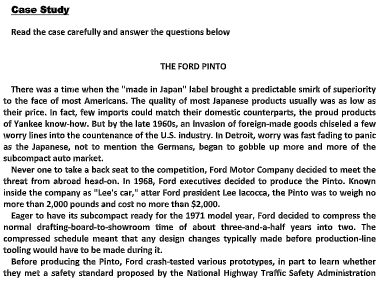
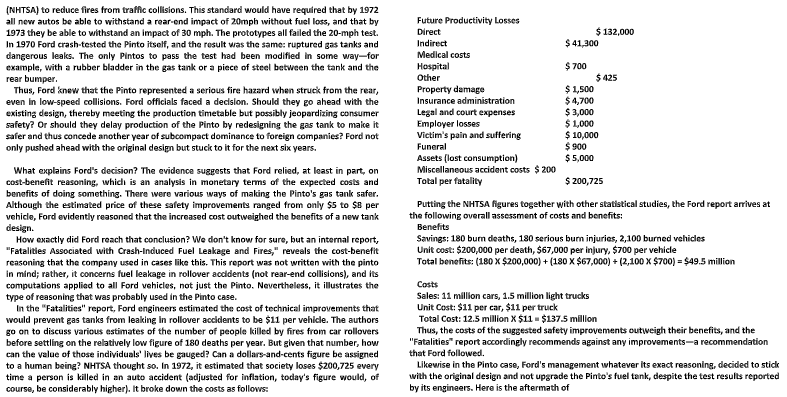
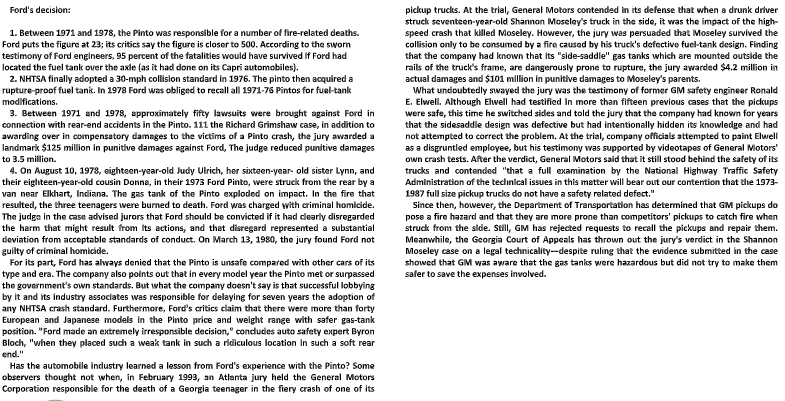
Case Study Read the case carefully and answer the questions below THE FORD PINTO There was a time when the "made in Japan" label brought a predictable smirk of superiority to the face of most Americans. The quality of most Japanese products usually was as low as their price. In fact, few imports could match their domestic counterparts, the proud products of Yankee know-how. But by the late 1960s, an Invasion of foreign-made goods chiseled a few worry lines into the countenance of the U.S. industry. In Detroit, worry was fast fading to panic as the Japanese, not to mention the Germans, began to gobble up more and more of the subcompact auto market. Never one to take a back seat to the competition, Ford Motor Company decided to meet the threat from abroad head-on. In 1968, Ford executives decided to produce the Pinto. Known inside the company as "Lee's car," atter Ford president Lee lacocca, the Pinto was to weigh no more than 2,000 pounds and cost no more than $2,000. Eager to have its subcompact ready for the 1971 model year, Ford decided to compress the normal drafting-board-to-showroom time of about three-and-a-half years into two. The compressed schedule meant that any design changes typically made before production-line tooling would have to be made during it. Before producing the Pinto, Ford crash-tested various prototypes, in part to learn whether they met a safety standard proposed by the National Highway Traffic Safety Administration Ford's decision: 1. Between 1971 and 1978, the Pinto was responsible for a number of fire-related deaths. Ford puts the figure at 23; its critics say the figure is closer to 500. According to the sworn testimony of Ford engineers, 95 percent of the fatalities would have survived If Ford had located the fuel tank over the axle (as it had done on its Capri automobiles). 2. NHTSA finally adopted a 30-mph collision standard in 1976. The pinto then acquired a rupture proof fuel tank. In 1978 Ford was obliged to recall all 1971-76 Pintos for fuel tank modifications. 3. Between 1971 and 1978, approximately fifty lawsuits were brought against Ford in connection with rear-end accidents in the Pinto 111 the Richard Grimshaw case, in addition to awarding over in compensatory damages to the victims of a Pinto crash, the jury awarded a landmark $125 million in punitive damages against Ford, The judge reduced punitive damages to 3.5 million. 4. On August 10, 1978, eighteen-year-old Judy Ulrich, her sixteen-year-old sister Lynn, and their eighteen-year-old cousin Donna, in their 1973 Ford Pinto, were struck from the rear by a van near Elkhart, Indiana. The gas tank of the Pinto exploded on impact. In the fire that resulted, the three teenagers were burned to death. Ford was charged with criminal homicide. The judge in the case advised jurors that Ford should be convicted if it had clearly disregarded the harm that might result from Its actions, and that disregard represented a substantial deviation from acceptable standards of conduct. On March 13, 1980, the jury found Ford not guilty of criminal homicide. For its part, Ford has always denied that the Pinto is unsafe compared with other cars of its type and era. The company also points out that in every model year the Pinto met or surpassed the government's own standards. But what the company doesn't say is that successful lobbying by it and its industry associates was responsible for delaying for seven years the adoption of any NHTSA crash standard. Furthermore, Ford's critics claim that there were more than forty European and Japanese models in the Pinto price and welght range with safer gas-tank position. "Ford made an extremely irresponsible decision, concludes auto safety expert Byron Bloch, "when they placed such a weak tank in such a ridiculous location In such a soft rear end." Has the automobile industry learned a lesson from Ford's experience with the Pinto? Some observers thought not when, in February 1993, an Atlanta jury held the General Motors Corporation responsible for the death of a Georgia teenager in the fiery crash of one of its pickup trucks. At the trial, General Motors contended in its defense that when a drunk driver struck seventeen-year-old Shannon Moseley's truck in the side, it was the impact of the high- speed crash that killed Moseley. However, the jury was persuaded that Moseley survived the collision only to be consumed by a fire caused by his truck's defectivo fuel-tank design. Finding that the company had known that its "side-saddle" gas tanks which are mounted outside the rails of the truck's frame, are dangerously prone to rupture, the jury awarded $4.2 million in actual damages and $101 million in punitive damages to Moseley's parents. What undoubtedly swayed the jury was the testimony of former GM safety engineer Ronald E. Elwell. Although Elwell had testified in more than fifteen previous cases that the pickups were safe, this time he switched sides and told the jury that the company had known for years that the sidesaddle design was defective but had intentionally hidden its inowledge and had not attempted to correct the problem. At the trial, company officials attempted to paint Elwell as a disgruntled employee, but his testimony was supported by videotapes of General Motors' own crash tests. After the verdict, General Motors said that it still stood behind the safety of its trucks and contended that a full examination by the National Highway Traffic Safety Administration of the technical issues in this matter will bear out our contention that the 1973- 1987 full size pickup trucks do not have a safety related defect." Since then, however, the Department of Transportation has determined that GM pickups do pose a fire hazard and that they are more prone than competitors' pickups to catch fire when struck from the side. Still, GM has rejected requests to recall the pickups and repair them. Meanwhile, the Georgia Court of Appeals has thrown out the jury's verdict in the Shannon Moseley case on a legal technicality-despite ruling that the evidence submitted in the case showed that GM was aware that the gas tanics were hazardous but did not try to make them safer to save the expenses involvedStep by Step Solution
There are 3 Steps involved in it
1 Expert Approved Answer
Step: 1 Unlock

Question Has Been Solved by an Expert!
Get step-by-step solutions from verified subject matter experts
Step: 2 Unlock
Step: 3 Unlock