







Question: Case study: Royal Dutch Shell PLC Total mark: 15 Royal Dutch Shell is one of the world's largest companies. It operates in 130 countries. Each
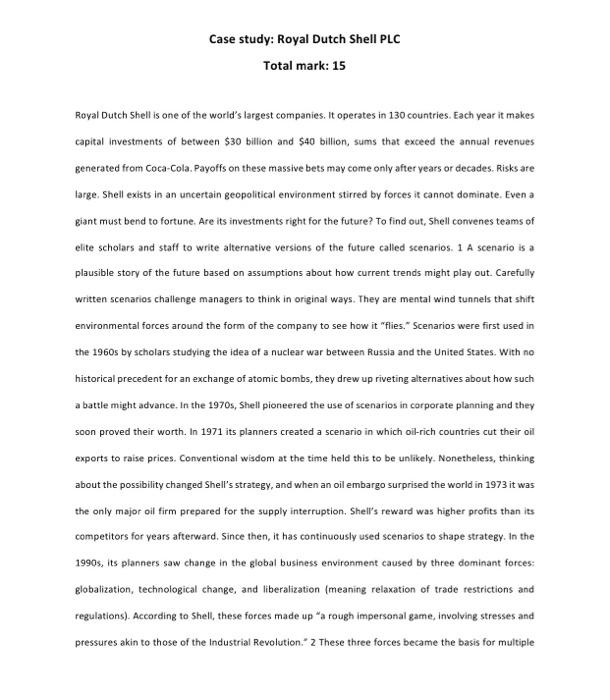
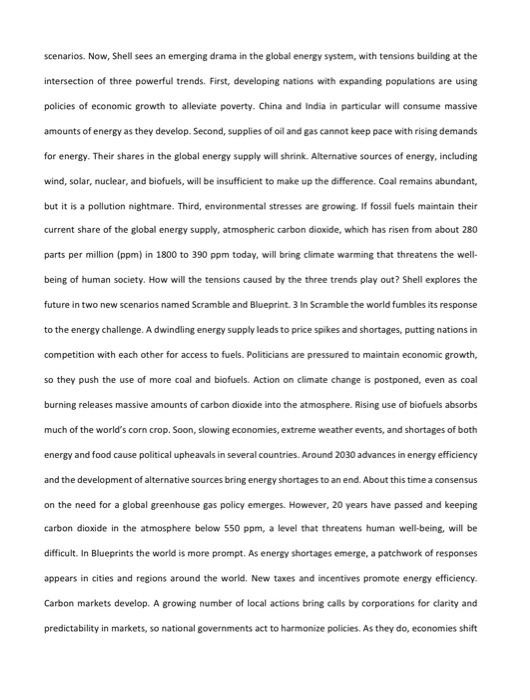
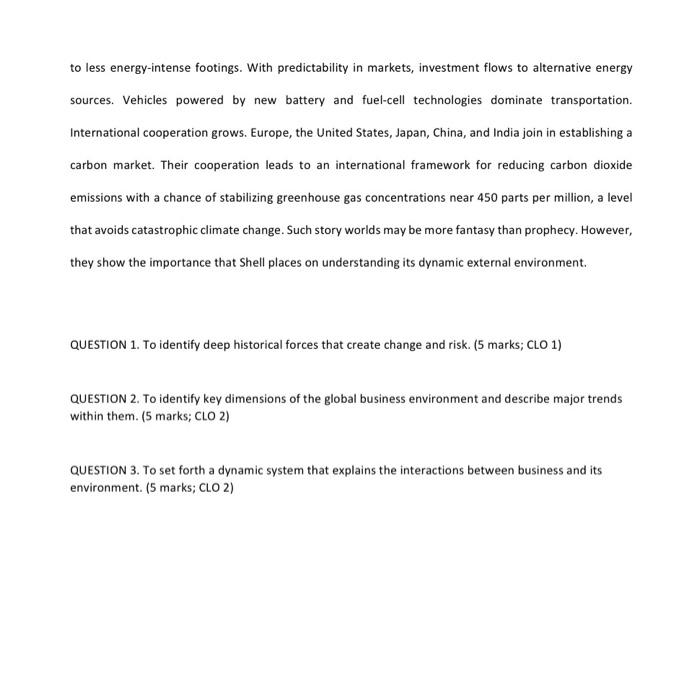
Case study: Royal Dutch Shell PLC Total mark: 15 Royal Dutch Shell is one of the world's largest companies. It operates in 130 countries. Each year it makes capital Investments of between $30 billion and $40 billion, sums that exceed the annual revenues generated from Coca-Cola. Payoffs on these massive bets may come only after years or decades. Risks are targe, Shell exists in an uncertain geopolitical environment stirred by forces it cannot dominate. Even a giant must bend to fortune. Are its investments right for the future? To find out, Shell convenes teams of elite scholars and staff to write alternative versions of the future called scenarios. 1 A scenario is a plausible story of the future based on assumptions about how current trends might play out. Carefully written scenarios challenge managers to think in original ways. They are mental wind tunnels that shift environmental forces around the form of the company to see how it "flies." Scenarios were first used in the 1960s by scholars studying the idea of a nuclear war between Russia and the United States. With no historical precedent for an exchange of atomic bombs, they drew up riveting alternatives about how such a battle might advance. In the 1970s, Shell pioneered the use of scenarios in corporate planning and they soon proved their worth. In 1971 its planners created a scenario in which oil-rich countries cut their oil exports to raise prices. Conventional wisdom at the time held this to be unlikely. Nonetheless, thinking about the possibility changed Shell's strategy, and when an oil embargo surprised the world in 1973 it was the only major oil firm prepared for the supply interruption. Shell's reward was higher profits than its competitors for years afterward. Since then, it has continuously used scenarios to shape strategy. In the 1990s, its planners saw change in the global business environment caused by three dominant forces: globalization, technological change, and liberalization (meaning relaxation of trade restrictions and regulations). According to Shell, these forces made up "a rough impersonal game involving stresses and pressures akin to those of the Industrial Revolution. These three forces became the basis for multiple scenarios. Now, Shell sees an emerging drama in the global energy system, with tensions building at the intersection of three powerful trends. First, developing nations with expanding populations are using policies of economic growth to alleviate poverty. China and India in particular will consume massive amounts of energy as they develop. Second, supplies of oil and gas cannot keep pace with rising demands for energy. Their shares in the global energy supply will shrink Alternative sources of energy, including wind, solar, nuclear, and biofuels, will be insufficient to make up the difference. Coal remains abundant, but it is a pollution nightmare. Third, environmental stresses are growing. If fossil fuels maintain their current share of the global energy supply, atmospheric carbon dioxide, which has risen from about 280 parts per million (ppm) in 1800 to 390 ppm today, will bring climate warming that threatens the well- being of human society. How will the tensions caused by the three trends play out? Shell explores the future in two new scenarios named Scramble and Blueprint 3 in Scramble the world fumbles its response to the energy challenge. A dwindling energy supply leads to price spikes and shortages, putting nations in competition with each other for access to fuels. Politicians are pressured to maintain economic growth, so they push the use of more coal and biofuels. Action on climate change is postponed, even as coal burning releases massive amounts of carbon dioxide into the atmosphere. Rising use of biofuels absorbs much of the world's corn crop. Soon, slowing economies, extreme weather events, and shortages of both energy and food cause political upheavals in several countries. Around 2030 advances in energy efficiency and the development of alternative sources bring energy shortages to an end. About this time a consensus on the need for a global greenhouse gas policy emerges. However, 20 years have passed and keeping carbon dioxide in the atmosphere below 550 ppm, a level that threatens human well-being, will be difficult. In Blueprints the world is more prompt. As energy shortages emerge, a patchwork of responses appears in cities and regions around the world. New taxes and incentives promote energy efficiency Carbon markets develop. A growing number of local actions bring calls by corporations for clarity and predictability in markets, so national governments act to harmonize policies. As they do, economies shift to less energy-intense footings. With predictability in markets, investment flows to alternative energy sources. Vehicles powered by new battery and fuel-cell technologies dominate transportation. International cooperation grows. Europe, the United States, Japan, China, and India join in establishing a carbon market. Their cooperation leads to an international framework for reducing carbon dioxide emissions with a chance of stabilizing greenhouse gas concentrations near 450 parts per million, a level that avoids catastrophic climate change. Such story worlds may be more fantasy than prophecy. However, they show the importance that Shell places on understanding its dynamic external environment. QUESTION 1. To identify deep historical forces that create change and risk. (5 marks; CLO 1) QUESTION 2. To identify key dimensions of the global business environment and describe major trends within them. (5 marks; CLO 2) QUESTION 3. To set forth a dynamic system that explains the interactions between business and its environment. (5 marks; CLO 2) Case study: Royal Dutch Shell PLC Total mark: 15 Royal Dutch Shell is one of the world's largest companies. It operates in 130 countries. Each year it makes capital Investments of between $30 billion and $40 billion, sums that exceed the annual revenues generated from Coca-Cola. Payoffs on these massive bets may come only after years or decades. Risks are targe, Shell exists in an uncertain geopolitical environment stirred by forces it cannot dominate. Even a giant must bend to fortune. Are its investments right for the future? To find out, Shell convenes teams of elite scholars and staff to write alternative versions of the future called scenarios. 1 A scenario is a plausible story of the future based on assumptions about how current trends might play out. Carefully written scenarios challenge managers to think in original ways. They are mental wind tunnels that shift environmental forces around the form of the company to see how it "flies." Scenarios were first used in the 1960s by scholars studying the idea of a nuclear war between Russia and the United States. With no historical precedent for an exchange of atomic bombs, they drew up riveting alternatives about how such a battle might advance. In the 1970s, Shell pioneered the use of scenarios in corporate planning and they soon proved their worth. In 1971 its planners created a scenario in which oil-rich countries cut their oil exports to raise prices. Conventional wisdom at the time held this to be unlikely. Nonetheless, thinking about the possibility changed Shell's strategy, and when an oil embargo surprised the world in 1973 it was the only major oil firm prepared for the supply interruption. Shell's reward was higher profits than its competitors for years afterward. Since then, it has continuously used scenarios to shape strategy. In the 1990s, its planners saw change in the global business environment caused by three dominant forces: globalization, technological change, and liberalization (meaning relaxation of trade restrictions and regulations). According to Shell, these forces made up "a rough impersonal game involving stresses and pressures akin to those of the Industrial Revolution. These three forces became the basis for multiple scenarios. Now, Shell sees an emerging drama in the global energy system, with tensions building at the intersection of three powerful trends. First, developing nations with expanding populations are using policies of economic growth to alleviate poverty. China and India in particular will consume massive amounts of energy as they develop. Second, supplies of oil and gas cannot keep pace with rising demands for energy. Their shares in the global energy supply will shrink Alternative sources of energy, including wind, solar, nuclear, and biofuels, will be insufficient to make up the difference. Coal remains abundant, but it is a pollution nightmare. Third, environmental stresses are growing. If fossil fuels maintain their current share of the global energy supply, atmospheric carbon dioxide, which has risen from about 280 parts per million (ppm) in 1800 to 390 ppm today, will bring climate warming that threatens the well- being of human society. How will the tensions caused by the three trends play out? Shell explores the future in two new scenarios named Scramble and Blueprint 3 in Scramble the world fumbles its response to the energy challenge. A dwindling energy supply leads to price spikes and shortages, putting nations in competition with each other for access to fuels. Politicians are pressured to maintain economic growth, so they push the use of more coal and biofuels. Action on climate change is postponed, even as coal burning releases massive amounts of carbon dioxide into the atmosphere. Rising use of biofuels absorbs much of the world's corn crop. Soon, slowing economies, extreme weather events, and shortages of both energy and food cause political upheavals in several countries. Around 2030 advances in energy efficiency and the development of alternative sources bring energy shortages to an end. About this time a consensus on the need for a global greenhouse gas policy emerges. However, 20 years have passed and keeping carbon dioxide in the atmosphere below 550 ppm, a level that threatens human well-being, will be difficult. In Blueprints the world is more prompt. As energy shortages emerge, a patchwork of responses appears in cities and regions around the world. New taxes and incentives promote energy efficiency Carbon markets develop. A growing number of local actions bring calls by corporations for clarity and predictability in markets, so national governments act to harmonize policies. As they do, economies shift to less energy-intense footings. With predictability in markets, investment flows to alternative energy sources. Vehicles powered by new battery and fuel-cell technologies dominate transportation. International cooperation grows. Europe, the United States, Japan, China, and India join in establishing a carbon market. Their cooperation leads to an international framework for reducing carbon dioxide emissions with a chance of stabilizing greenhouse gas concentrations near 450 parts per million, a level that avoids catastrophic climate change. Such story worlds may be more fantasy than prophecy. However, they show the importance that Shell places on understanding its dynamic external environment. QUESTION 1. To identify deep historical forces that create change and risk. (5 marks; CLO 1) QUESTION 2. To identify key dimensions of the global business environment and describe major trends within them. (5 marks; CLO 2) QUESTION 3. To set forth a dynamic system that explains the interactions between business and its environment. (5 marks; CLO 2)
Step by Step Solution
There are 3 Steps involved in it

Get step-by-step solutions from verified subject matter experts
 Study Help