





Question: Case Study Scenario 2 In 2004 Shell was facing an oil reserve crisis that hammered its share price. The situation was compounded by the abrupt
Case Study Scenario 2 In 2004 Shell was facing an

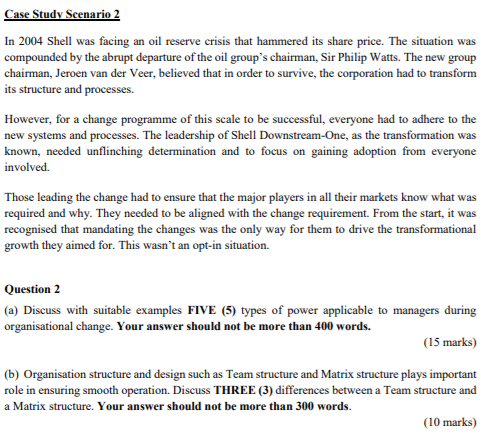
Case Study Scenario 2 In 2004 Shell was facing an oil reserve crisis that hammered its share price. The situation was compounded by the abrupt departure of the oil group's chairman, Sir Philip Watts. The new group chairman, Jeroen van der Veer, believed that in order to survive, the corporation had to transform its structure and processes. However, for a change programme of this scale to be successful, everyone had to adhere to the new systems and processes. The leadership of Shell Downstream-One, as the transformation was known, needed unflinching determination and to focus on gaining adoption from everyone involved. Those leading the change had to ensure that the major players in all their markets know what was required and why. They needed to be aligned with the change requirement. From the start, it was recognised that mandating the changes was the only way for them to drive the transformational growth they aimed for. This wasn't an opt-in situation. Question 2 (a) Discuss with suitable examples FIVE (5) types of power applicable to managers during organisational change. Your answer should not be more than 400 words. (15 marks) (b) Organisation structure and design such as Team structure and Matrix structure plays important role in ensuring smooth operation. Discuss THREE (3) differences between a Team structure and a Matrix structure. Your answer should not be more than 300 words. (10 marks)

Step by Step Solution

There are 3 Steps involved in it

1 Expert Approved Answer
Step: 1 Unlock blur-text-image

Question Has Been Solved by an Expert!

Get step-by-step solutions from verified subject matter experts

Step: 2 Unlock
Step: 3 Unlock

Students Have Also Explored These Related General Management Questions!