







Question: Case study. Segmentation at CleanCo. 1. CleanCo is a Polish manufacturer of cleaning products that serves the European grocery retailing market. CleanCo currently segments its
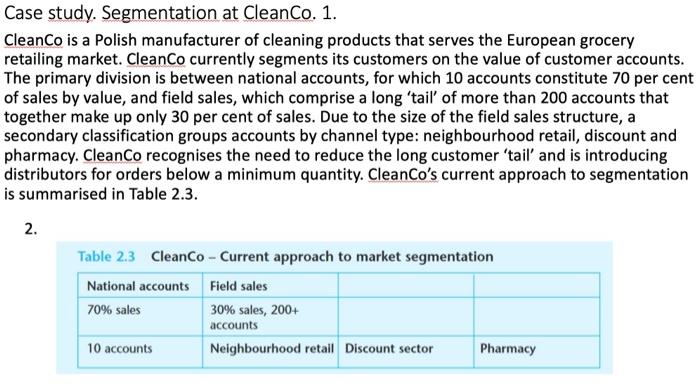
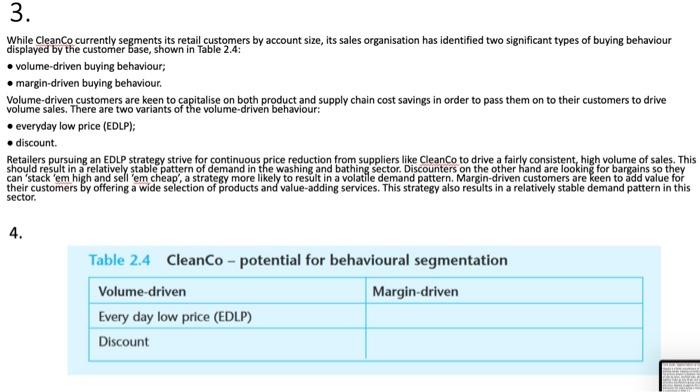
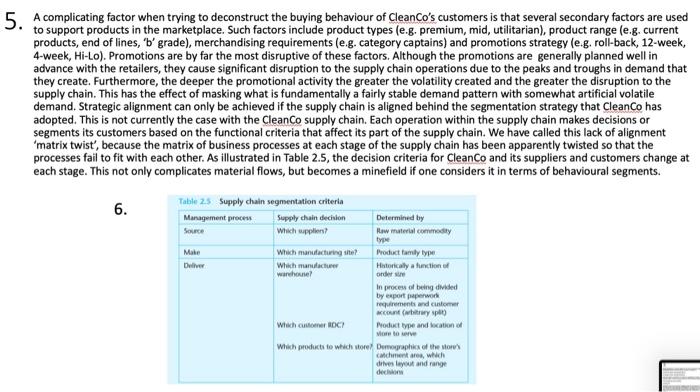
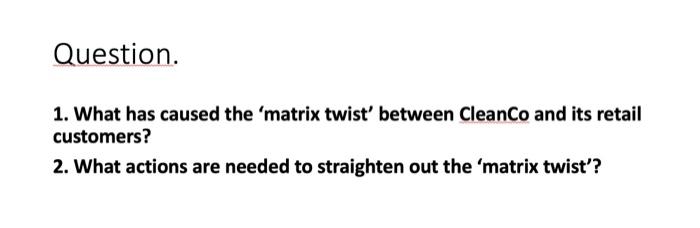
Case study. Segmentation at CleanCo. 1. CleanCo is a Polish manufacturer of cleaning products that serves the European grocery retailing market. CleanCo currently segments its customers on the value of customer accounts. The primary division is between national accounts, for which 10 accounts constitute 70 per cent of sales by value, and field sales, which comprise a long 'tail' of more than 200 accounts that together make up only 30 per cent of sales. Due to the size of the field sales structure, a secondary classification groups accounts by channel type: neighbourhood retail, discount and pharmacy. CleanCo recognises the need to reduce the long customer 'tail' and is introducing distributors for orders below a minimum quantity. CleanCo's current approach to segmentation is summarised in Table 2.3. While CleanCo currently segments its retail customers by account size, its sales organisation has identified two significant types of buying behaviour displayed by the customer base, shown in Table 2.4: - volume-driven buying behaviour; - margin-driven buying behaviour. Volume-driven customers are keen to capitalise on both product and supply chain cost savings in order to pass them on to their customers to drive volume sales. There are two variants of the volume-driven behaviour: - everyday low price (EDLP); - discount. Retailers pursuing an EDLP strategy strive for continuous price reduction from suppliers like CleanCo to drive a fairly consistent, high volume of sales. should result in a relatively stable pattern of demand in the washing and bathing sector. Discounters on the other hand are looking for bargains so they can 'stack 'em high and sell 'em cheap', a strategy more likely to result in a volatile demand pattern. Margin-driven customers are keen to add value for their customers by offering a wide selection of products and value-adding services. This strategy also results in a relatively stable demand pattern in thi sector. 4. Tahle 24 CleanCn-nntential for hehavioural sermentation A complicating factor when trying to deconstruct the buying behaviour of CleanCo's customers is that several secondary factors are used - to support products in the marketplace. Such factors include product types (e.g. premium, mid, utilitarian), product range (e.g. current products, end of lines, 'b' grade), merchandising requirements (e.g. category captains) and promotions strategy (e.g. roll-back, 12-week, 4-week, Hi-Lo). Promotions are by far the most disruptive of these factors. Although the promotions are generally planned well in advance with the retailers, they cause significant disruption to the supply chain operations due to the peaks and troughs in demand that they create. Furthermore, the deeper the promotional activity the greater the volatility created and the greater the disruption to the supply chain. This has the effect of masking what is fundamentally a fairly stable demand pattern with somewhat artificial volatile demand. Strategic alignment can only be achieved if the supply chain is aligned behind the segmentation strategy that CleanCo has adopted. This is not currently the case with the CleanCo supply chain. Each operation within the supply chain makes decisions or segments its customers based on the functional criteria that affect its part of the supply chain. We have called this lack of alignment 'matrix twist', because the matrix of business processes at each stage of the supply chain has been apparently twisted so that the processes fail to fit with each other. As illustrated in Table 2.5, the decision criteria for CleanCo and its suppliers and customers change at each stage. This not only complicates material flows, but becomes a minefield if one considers it in terms of behavioural segments. 1. What has caused the 'matrix twist' between CleanCo and its retail customers? 2. What actions are needed to straighten out the 'matrix twist
Step by Step Solution
There are 3 Steps involved in it

Get step-by-step solutions from verified subject matter experts
 Study Help