







Question: Case Study - Sign the New Ethics Code or Quit Barclay's PLC, the major U.K. bank, was fined 290 million by regulators in the United
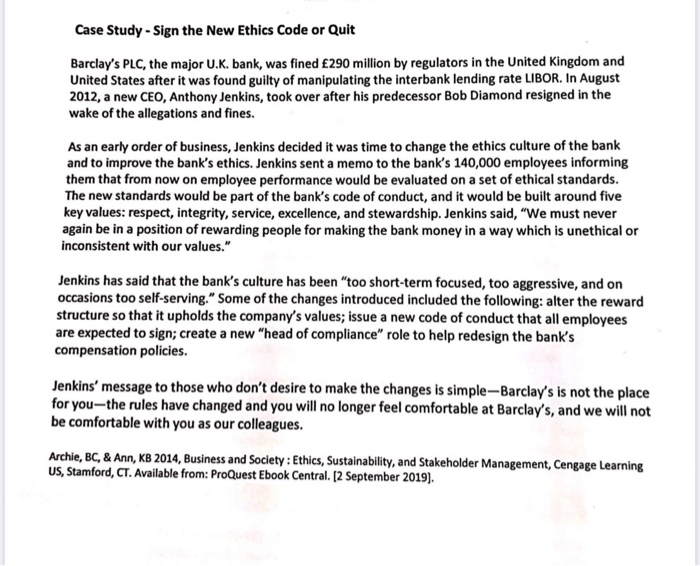
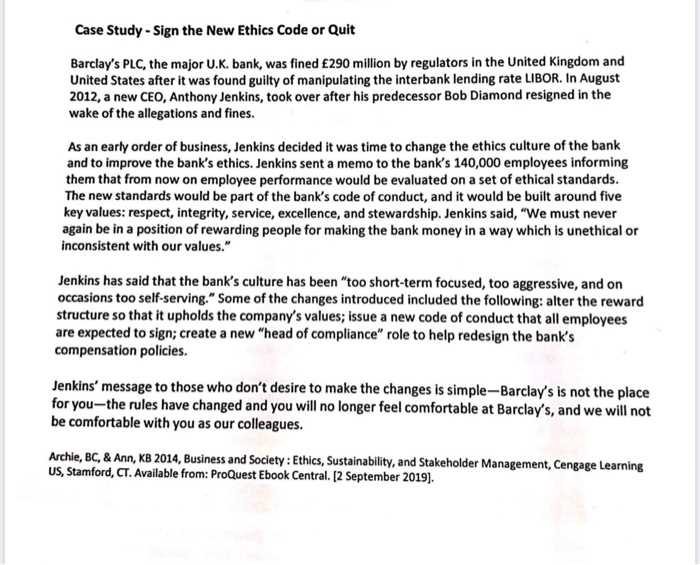
Case Study - Sign the New Ethics Code or Quit Barclay's PLC, the major U.K. bank, was fined 290 million by regulators in the United Kingdom and United States after it was found guilty of manipulating the interbank lending rate LIBOR. In August 2012, a new CEO, Anthony Jenkins, took over after his predecessor Bob Diamond resigned in the wake of the allegations and fines. As an early order of business, Jenkins decided it was time to change the ethics culture of the bank and to improve the bank's ethics. Jenkins sent a memo to the bank's 140,000 employees informing them that from now on employee performance would be evaluated on a set of ethical standards. The new standards would be part of the bank's code of conduct, and it would be built around five key values: respect, integrity, service, excellence, and stewardship. Jenkins said, "We must never again be in a position of rewarding people for making the bank money in a way which is unethical or inconsistent with our values." Jenkins has said that the bank's culture has been "too short-term focused, too aggressive, and on occasions too self-serving." Some of the changes introduced included the following: alter the reward structure so that it upholds the company's values; issue a new code of conduct that all employees are expected to sign; create a new "head of compliance" role to help redesign the bank's compensation policies. Jenkins' message to those who don't desire to make the changes is simple-Barclay's is not the place for you the rules have changed and you will no longer feel comfortable at Barclay's, and we will not be comfortable with you as our colleagues. Archie, BC, & Ann, KB 2014, Business and Society: Ethics, Sustainability, and Stakeholder Management, Cengage Learning US, Stamford, CT. Available from: ProQuest Ebook Central. (2 September 2019). Case Study - Sign the New Ethics Code or Quit Barclay's PLC, the major U.K. bank, was fined 290 million by regulators in the United Kingdom and United States after it was found guilty of manipulating the interbank lending rate LIBOR. In August 2012, a new CEO, Anthony Jenkins, took over after his predecessor Bob Diamond resigned in the wake of the allegations and fines. As an early order of business, Jenkins decided it was time to change the ethics culture of the bank and to improve the bank's ethics. Jenkins sent a memo to the bank's 140,000 employees informing them that from now on employee performance would be evaluated on a set of ethical standards. The new standards would be part of the bank's code of conduct, and it would be built around five key values: respect, integrity, service, excellence, and stewardship. Jenkins said, "We must never again be in a position of rewarding people for making the bank money in a way which is unethical or inconsistent with our values." Jenkins has said that the bank's culture has been "too short-term focused, too aggressive, and on occasions too self-serving." Some of the changes introduced included the following: alter the reward structure so that it upholds the company's values; issue a new code of conduct that all employees are expected to sign; create a new "head of compliance" role to help redesign the bank's compensation policies. Jenkins' message to those who don't desire to make the changes is simple-Barclay's is not the place for you the rules have changed and you will no longer feel comfortable at Barclay's, and we will not be comfortable with you as our colleagues. Archie, BC, & Ann, KB 2014, Business and Society: Ethics, Sustainability, and Stakeholder Management, Cengage Learning US, Stamford, CT. Available from: ProQuest Ebook Central. (2 September 2019). Case Study - Sign the New Ethics Code or Quit Barclay's PLC, the major U.K. bank, was fined 290 million by regulators in the United Kingdom and United States after it was found guilty of manipulating the interbank lending rate LIBOR. In August 2012, a new CEO, Anthony Jenkins, took over after his predecessor Bob Diamond resigned in the wake of the allegations and fines. As an early order of business, Jenkins decided it was time to change the ethics culture of the bank and to improve the bank's ethics. Jenkins sent a memo to the bank's 140,000 employees informing them that from now on employee performance would be evaluated on a set of ethical standards. The new standards would be part of the bank's code of conduct, and it would be built around five key values: respect, integrity, service, excellence, and stewardship. Jenkins said, "We must never again be in a position of rewarding people for making the bank money in a way which is unethical or inconsistent with our values." Jenkins has said that the bank's culture has been "too short-term focused, too aggressive, and on occasions too self-serving." Some of the changes introduced included the following: alter the reward structure so that it upholds the company's values; issue a new code of conduct that all employees are expected to sign; create a new "head of compliance" role to help redesign the bank's compensation policies. Jenkins' message to those who don't desire to make the changes is simple-Barclay's is not the place for you the rules have changed and you will no longer feel comfortable at Barclay's, and we will not be comfortable with you as our colleagues. Archie, BC, & Ann, KB 2014, Business and Society: Ethics, Sustainability, and Stakeholder Management, Cengage Learning US, Stamford, CT. Available from: ProQuest Ebook Central. (2 September 2019). Case Study - Sign the New Ethics Code or Quit Barclay's PLC, the major U.K. bank, was fined 290 million by regulators in the United Kingdom and United States after it was found guilty of manipulating the interbank lending rate LIBOR. In August 2012, a new CEO, Anthony Jenkins, took over after his predecessor Bob Diamond resigned in the wake of the allegations and fines. As an early order of business, Jenkins decided it was time to change the ethics culture of the bank and to improve the bank's ethics. Jenkins sent a memo to the bank's 140,000 employees informing them that from now on employee performance would be evaluated on a set of ethical standards. The new standards would be part of the bank's code of conduct, and it would be built around five key values: respect, integrity, service, excellence, and stewardship. Jenkins said, "We must never again be in a position of rewarding people for making the bank money in a way which is unethical or inconsistent with our values." Jenkins has said that the bank's culture has been "too short-term focused, too aggressive, and on occasions too self-serving." Some of the changes introduced included the following: alter the reward structure so that it upholds the company's values; issue a new code of conduct that all employees are expected to sign; create a new "head of compliance" role to help redesign the bank's compensation policies. Jenkins' message to those who don't desire to make the changes is simple-Barclay's is not the place for you the rules have changed and you will no longer feel comfortable at Barclay's, and we will not be comfortable with you as our colleagues. Archie, BC, & Ann, KB 2014, Business and Society: Ethics, Sustainability, and Stakeholder Management, Cengage Learning US, Stamford, CT. Available from: ProQuest Ebook Central. (2 September 2019)
Step by Step Solution
There are 3 Steps involved in it

Get step-by-step solutions from verified subject matter experts
 Study Help