


Question: CASE STUDY THE ALCOHOL/DRUG ABUSE PREVENTION PROGRAM (ADAPP) The North American Transportation Company (NATC) is a very large organiza- tion that provides continent-wide facilities for
CASE STUDY THE ALCOHOL/DRUG ABUSE PREVENTIONCASE STUDY THE ALCOHOL/DRUG ABUSE PREVENTION

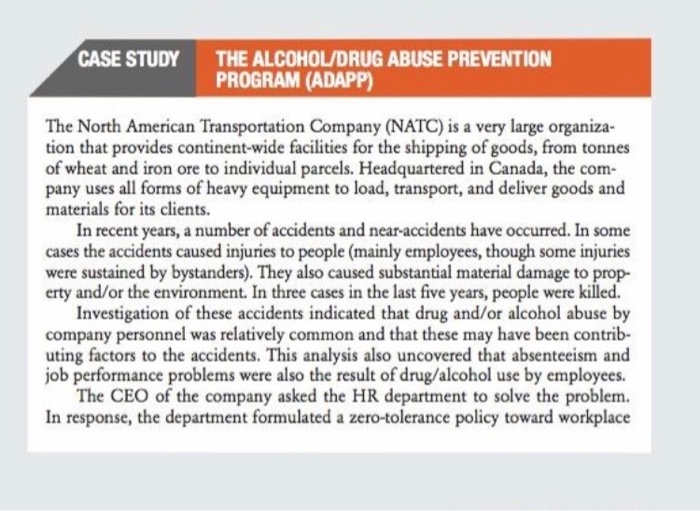
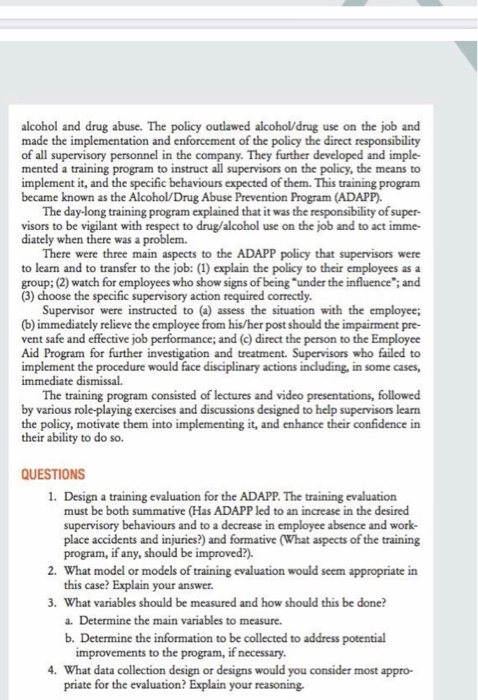
CASE STUDY THE ALCOHOL/DRUG ABUSE PREVENTION PROGRAM (ADAPP) The North American Transportation Company (NATC) is a very large organiza- tion that provides continent-wide facilities for the shipping of goods, from tonnes of wheat and iron ore to individual parcels. Headquartered in Canada, the com- pany uses all forms of heavy equipment to load, transport, and deliver goods and materials for its clients. In recent years, a number of accidents and near-accidents have occurred. In some cases the accidents caused injuries to people (mainly employees, though some injuries were sustained by bystanders). They also caused substantial material damage to prop- erty and/or the environment. In three cases in the last five years, people were killed. Investigation of these accidents indicated that drug and/or alcohol abuse by company personnel was relatively common and that these may have been contrib- uting factors to the accidents. This analysis also uncovered that absenteeism and job performance problems were also the result of drug/alcohol use by employees. The CEO of the company asked the HR department to solve the problem. In response, the department formulated a zero-tolerance policy toward workplace alcohol and drug abuse. The policy outlawed alcohol/drug use on the job and made the implementation and enforcement of the policy the direct responsibility of all supervisory personnel in the company. They further developed and imple- mented a training program to instruct all supervisors on the policy, the means to implement it, and the specific behaviours expected of them. This training program became known as the Alcohol/Drug Abuse Prevention Program (ADAPP). The day-long training program explained that it was the responsibility of super- visors to be vigilant with respect to drug/alcohol use on the job and to act imme- diately when there was a problem. There were three main aspects to the ADAPP policy that supervisors were to learn and to transfer to the job: (1) explain the policy to their employees as a group: (2) watch for employees who show signs of being under the influence"; and (3) choose the specific supervisory action required correctly. Supervisor were instructed to (a) assess the situation with the employee; (b) immediately relieve the employee from his/her post should the impairment pre- vent safe and effective job performance; and (c) direct the person to the Employee Aid Program for further investigation and treatment. Supervisors who failed to implement the procedure would face disciplinary actions including, in some cases, immediate dismissal. The training program consisted of lectures and video presentations, followed by various role-playing exercises and discussions designed to help supervisors learn the policy, motivate them into implementing it, and enhance their confidence in their ability to do so. QUESTIONS 1. Design a training evaluation for the ADAPP. The training evaluation must be both summative (Has ADAPP led to an increase in the desired supervisory behaviours and to a decrease in employee absence and work- place accidents and injuries?) and formative (What aspects of the training program, if any, should be improved?). 2. What model or models of training evaluation would seem appropriate in this case? Explain your answer. 3. What variables should be measured and how should this be done? a. Determine the main variables to measure. b. Determine the information to be collected to address potential improvements to the program, if necessary. 4. What data collection design or designs would you consider most appro- priate for the evaluation? Explain your reasoning

Step by Step Solution

There are 3 Steps involved in it

1 Expert Approved Answer
Step: 1 Unlock blur-text-image

Question Has Been Solved by an Expert!

Get step-by-step solutions from verified subject matter experts

Step: 2 Unlock
Step: 3 Unlock

Students Have Also Explored These Related General Management Questions!