







Question: Case study- The Auckland Energy Case Study-Electricity Bill Processing System 1. Auckland Energy is a new electricity company which has just begun to offer power
Case study- The Auckland Energy Case Study-Electricity Bill Processing System
1. Auckland Energy is a new electricity company which has just begun to offer power to the households
2. n West Auckland. It is expected that a large number of households will switch to use Auckland Energy
3. as their electricity supplier. The company is expanding its electricity infrastructure throughout the
4. Auckland Region. Currently, the customer bills are produced manually. The company produces
5. 4monthly customer electricity bills and parts of this process need to be automated. Due to a continuous
6. increase in their business activity, manually producing customer bills now impact their ability to deliver
7. customers their monthly electricity bills in a timely fashion. The company goal is to send the electricity
8. bill to all its customers by the end of the first working day in every month. Furthermore, Auckland
9. Energy has also discovered that due to work pressure, meter readers have incorrectly entered meter
10. data into the system. To successfully compete in the Auckland market, Auckland Energy knows that
11. they have to fix these two critical problems through automation. Auckland Energy has realised that a
12. services-based approach that incorporates smart meters is now needed to support their Electricity Bill
13. Processing System, which has to be developed and implemented at their Head Office in West
14. Auckland. The following is a brief description of their existing Electricity Bill Processing System
15. compiled based on interviews conducted with the Chief Executive of Auckland Energy.
15
17. When an existing household decides to switch to Auckland Energy or an owner of a brand-new
18. dwelling chooses Auckland Energy as their electricity supplier, a customer record is created by their
19. Accounts Clerk and kept in their customer file.The customer file contains records of all its current
20. customers. When a customer cancels his/her account with Auckland Energy, their record is removed
21. from the customer file by the Accounts Clerk and entered into in the past customerfile. When
22. marketing campaigns are run by Auckland Energy to attract new customers, this file is used to identify
23. and target their past customers as well. At the end of every month,customer records from the
24. customer file are used to create meter reading lists.
25
26. The meter readers visit households of current customers of Auckland Energy once every month to
27. read their electricity meters. Auckland Energy provides their meter readers with the meter reading
28. lists which identifies all their current customers on a particular street, in a suburb in Auckland. These
29. meter reading lists have customer details such as their customer number (assigned to each customer
30. by Auckland Energy), name, residential address, meter number, and a blank field for recording the
31. current meter reading.
32.
33. Every nine (9) months the management of Auckland Energy reviews and determines a new electricity
34. charge rate. It is the responsibility of their Revenue Manager to update the electricity charge rate in
35. their electricity charge rate file.
36.
37. When all the current readings have been recorded in a meter reading list for a particular street for the
38. current month, the meter readers bring the meter reading list into the Accounts Department at their
39. Head Office. The Accounts Clerk enters the current readings into a customer electricity meter
40. readings file which contains, for each customer, details of their previous readings.
41.
42. To produce current bills for customers, the system subtracts a customers previous meter reading
43. from their current reading,to find the total volume of electricity used for a period. This is multiplied
44. by the electricity charge rate which the accounts clerk finds in the electricity charge rate file. If this
45. is the first electricity bill for the customer, a charge for installation may be added, and sometimes
46. there is a maintenance charge.Installation and maintenance are done by Auckland Energys
47. Maintenance Department. These extra charges are supplied by the Maintenance Department, which
48. are included in the current bill together with any outstanding amount. The outstanding amount of a
49. customer is found in the outstanding bill file. All current electricity bills are kept in a current
50. customer bill file. The current bills are posted or emailed to their customers which shows their current
51. charge, extra charges (if any), and outstanding amount (if any). Their customers postal addresses are
52. kept in the customer file.
53.
54.Customers often prefer to pay by Internet banking or by direct debit. Auckland Energys customers
55. can also pay their electricity bill with their local banks. A list of deposits is returned by the banks. All
56. the customer payments are compared to the records in current bills file by the Accounts Clerk. The
57. customer bills which are paid in full are entered into in the paid bill file, and the current customer
58. bill and outstanding bill files are updated. Both these files are also updated with any partial
59. payments. The current electricity bills not paid by their due dates are transferred into theoutstanding
60. bill file.
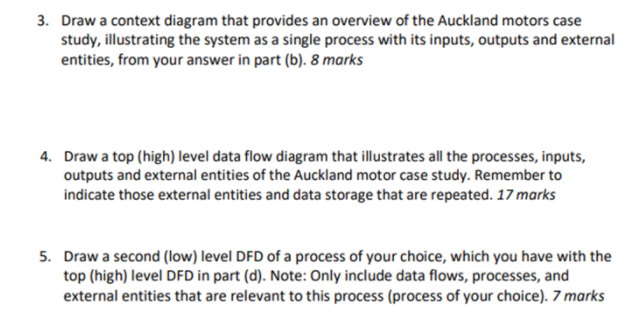
3. Draw a context diagram that provides an overview of the Auckland motors case study, illustrating the system as a single process with its inputs, outputs and external entities, from your answer in part (b). 8 marks 4. Draw a top (high) level data flow diagram that illustrates all the processes, inputs, outputs and external entities of the Auckland motor case study. Remember to indicate those external entities and data storage that are repeated. 17 marks 5. Draw a second (low) level DFD of a process of your choice, which you have with the top (high) level DFD in part (d). Note: Only include data flows, processes, and external entities that are relevant to this process (process of your choice). 7 marks
Step by Step Solution
There are 3 Steps involved in it

Get step-by-step solutions from verified subject matter experts
 Study Help