Question: case study this is a experiment q1- case study Objective....... Method......... Sample......... Result......... Discussion..... bq2- What does the results obtained from studies mean? q qq3-
case study this is a experiment
q1- case study
Objective.......
Method.........
Sample.........
Result.........
Discussion.....
bq2- What does the results obtained from studies mean?
q
qq3- How to explain these results?
case study this is a experiment
q1- case study
Objective.......
Method.........
Sample.........
Result.........
Discussion.....
q2- What does the results obtained from studies mean?
q
q3- How to explain these results?
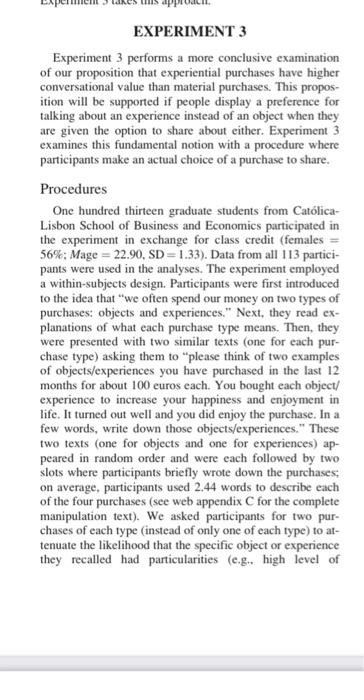
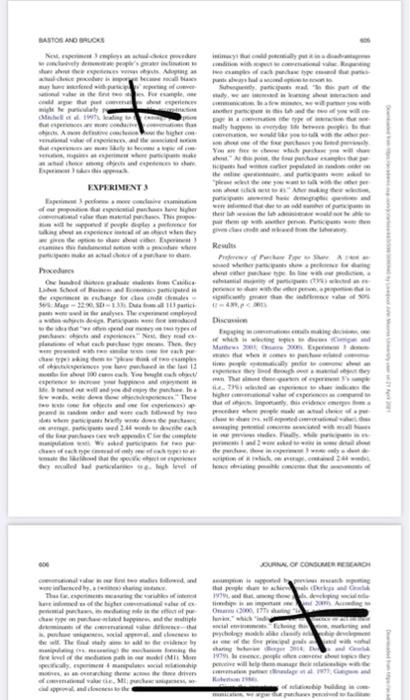
BASTOS AND RUCKS Narpanitaire war inaparapu yathal nam Step at - 1 gle, , . Porce - w EXPERIMENT parties are r The nians are the war Reus Purra - A - people pix Cr landai is tar Cutte state , m a hrs Plematism pantiment NA y hai Maman 2 sample when - un hari www.The them to DURA. OF COMMERCE 1 Tue ININL ly haalata * - pities | M thum M EXPERIMENT 3 Experiment 3 performs a more conclusive examination of our proposition that experiential purchases have higher conversational value than material purchases. This propos- ition will be supported if people display a preference for talking about an experience instead of an object when they are given the option to share about either. Experiment 3 examines this fundamental notion with a procedure where participants make an actual choice of a purchase to share. Procedures One hundred thirteen graduate students from Catlica- Lisbon School of Business and Economics participated in the experiment in exchange for class credit (females 56%; Mage = 22.90, SD=1.33). Data from all 113 partici- pants were used in the analyses. The experiment employed a within-subjects design. Participants were first introduced to the idea that we often spend our money on two types of purchases: objects and experiences." Next, they read ex- planations of what each purchase type means. Then, they were presented with two similar texts (one for each pur- chase type) asking them to "please think of two examples of objects/experiences you have purchased in the last 12 months for about 100 euros each. You bought each object/ experience to increase your happiness and enjoyment in life. It turned out well and you did enjoy the purchase. In a few words, write down those objects/experiences." These two texts (one for objects and one for experiences) ap- peared in random order and were each followed by two slots where participants briefly wrote down the purchases: on average, participants used 2.44 words to describe each of the four purchases (see web appendix C for the complete manipulation text). We asked participants for two pur- chases of each type (instead of only one of each type) to at- tenuate the likelihood that the specific object or experience they recalled had particularities (e.g. high level of intimacy) that could potentially put it in a disadvantageous condition with respect to conversational value. Requesting two examples of each purchase type ensured that partici- pants always had a second option to resort to Subsequently, participants read. "In this part of the study, we are interested in learning about interaction and communication. In a few minutes, we will partner you with another participant in this lab and the two of you will en gage in a conversation (the type of interaction that ner mally happens in everyday life between people). In that conversation, we would like you to talk with the other per- son about one of the four purchases you listed previously. You are free to choose which purchase you will share about." At this point, the four purchase examples that par ticipants had written earlier populated in random onder on the online questionnaire, and participants were asked to please select the one you want to talk with the other per- son about (click next to it." After making their selection, participants answered hasie demographic questions and were informed that due to an odd number of participants in their lab session the lab administrator would not be able to pair them up with another person. Participants were then given class credit and released from the laboratory Results Preference of Purchase Type o Share. A test >> Nessed whether participants show a preference for sharing about either purchase type. In line with our prediction, a substantial majority of participants (739) selected an er- perience to share with the other person, a proportion that is significantly greater than the indifference value of 50% 1: = 4.89.p<.001 discussion engaging in conversations entails making decisions one of which is sclecting topics to discuss and matthews omarzo experiment demon strates that when it comes purchase-related conversa tions people systematically prefer converse about an experience they lived through over a material object own. almost three-quarters sample selected share ficates the higher conversational value experiences as compared objects. importantly this evidence emerges from procedure where made actual choice pur- chase self-reported thus assuaging potential concerns associated with recall biases our previous studies. finally while participants ex- periments were asked write some detail purchase those wrote only short de scription on average contained words hence obviating possible assessments first two studies followed influenced by sharing instance. far experiments measuring variables interest have informed us periential purchases its mediating role effect type happiness multiple determinants differencethat uniqueness social approval closeness self. final study aims add manipulating mechanism forming level mediation path model more specifically manipulates relationship motives overarching theme across three drivers ml so- cial self>









 Study Help