







Question: Case Two ( Part 1 ) : Are Layoffs Unethical? Aaron Feuerstein and Malden Mills Fabric manufacturer Malden Mills of Lowell, Massachusetts, provided 3 ,
Case Two Part : Are Layoffs Unethical? Aaron Feuerstein and Malden Mills
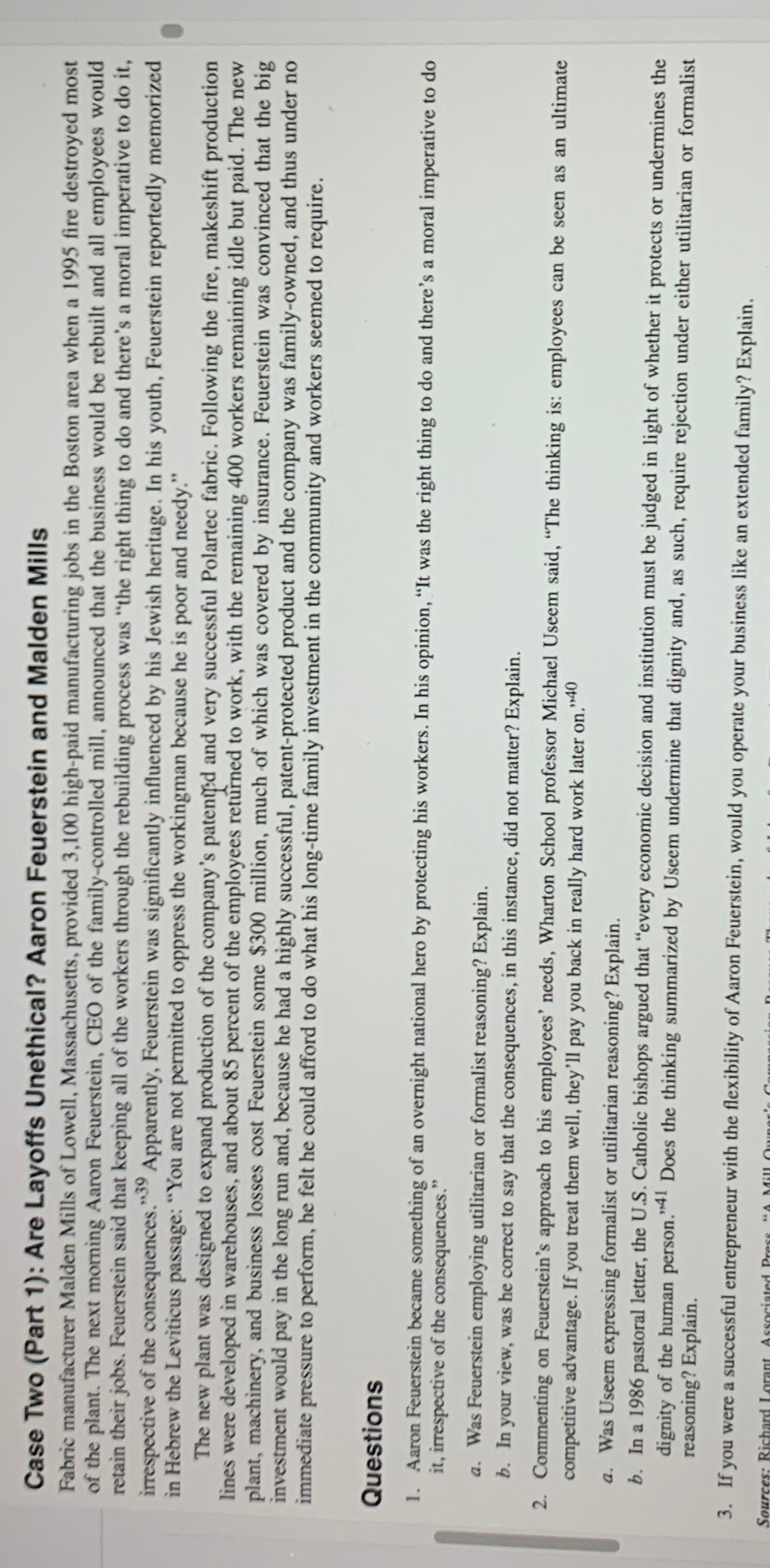
Fabric manufacturer Malden Mills of Lowell, Massachusetts, provided highpaid manufacturing jobs in the Boston area when a fire destroyed most of the plant. The next morning Aaron Feuerstein, CEO of the familycontrolled mill, announced that the business would be rebuilt and all employees would retain their jobs. Feuerstein said that keeping all of the workers through the rebuilding process was "the right thing to do and there's a moral imperative to do it irrespective of the consequences." Apparently, Feuerstein was significantly influenced by his Jewish heritage. In his youth, Feuerstein reportedly memorized in Hebrew the Leviticus passage: "You are not permitted to oppress the workingman because he is poor and needy."
The new plant was designed to expand production of the company's patenify and very successful Polartec fabric. Following the fire, makeshift production lines were developed in warehouses, and about percent of the employees returned to work, with the remaining workers remaining idle but paid. The new plant, machinery, and business losses cost Feuerstein some $ million, much of which was covered by insurance. Feuerstein was convinced that the big investment would pay in the long run and, because he had a highly successful, patentprotected product and the company was familyowned, and thus under no immediate pressure to perform, he felt he could afford to do what his longtime family investment in the community and workers seemed to require.
Questions
Aaron Feuerstein became something of an overnight national hero by protecting his workers. In his opinion, It was the right thing to do and there's a moral imperative to do it irrespective of the consequences."
a Was Feuerstein employing utilitarian or formalist reasoning? Explain.
b In your view, was he correct to say that the consequences, in this instance, did not matter? Explain.
Commenting on Feuerstein's approach to his employees' needs, Wharton School professor Michael Useem said, "The thinking is: employees can be seen as an ultimate competitive advantage. If you treat them well, they'll pay you back in really hard work later on
a Was Useem expressing formalist or utilitarian reasoning? Explain.
b In a pastoral letter, the US Catholic bishops argued that "every economic decision and institution must be judged in light of whether it protects or undermines the dignity of the human person." Does the thinking summarized by Useem undermine that dignity and, as such, require rejection under either utilitarian or formalist reasoning? Explain.
If you were a successful entrepreneur with the flexibility of Aaron Feuerstein, would you operate your business like an extended family? Explain.
Step by Step Solution
There are 3 Steps involved in it
1 Expert Approved Answer
Step: 1 Unlock

Question Has Been Solved by an Expert!
Get step-by-step solutions from verified subject matter experts
Step: 2 Unlock
Step: 3 Unlock
 Study Help