







Question: Case Two ( Part 2 ) : Are Layoffs Unethical? Aaron Feuerstein, Malden Mills, and Bankruptcy In November 2 0 0 1 , Malden Mills
Case Two Part : Are Layoffs Unethical? Aaron Feuerstein, Malden Mills, and Bankruptcy
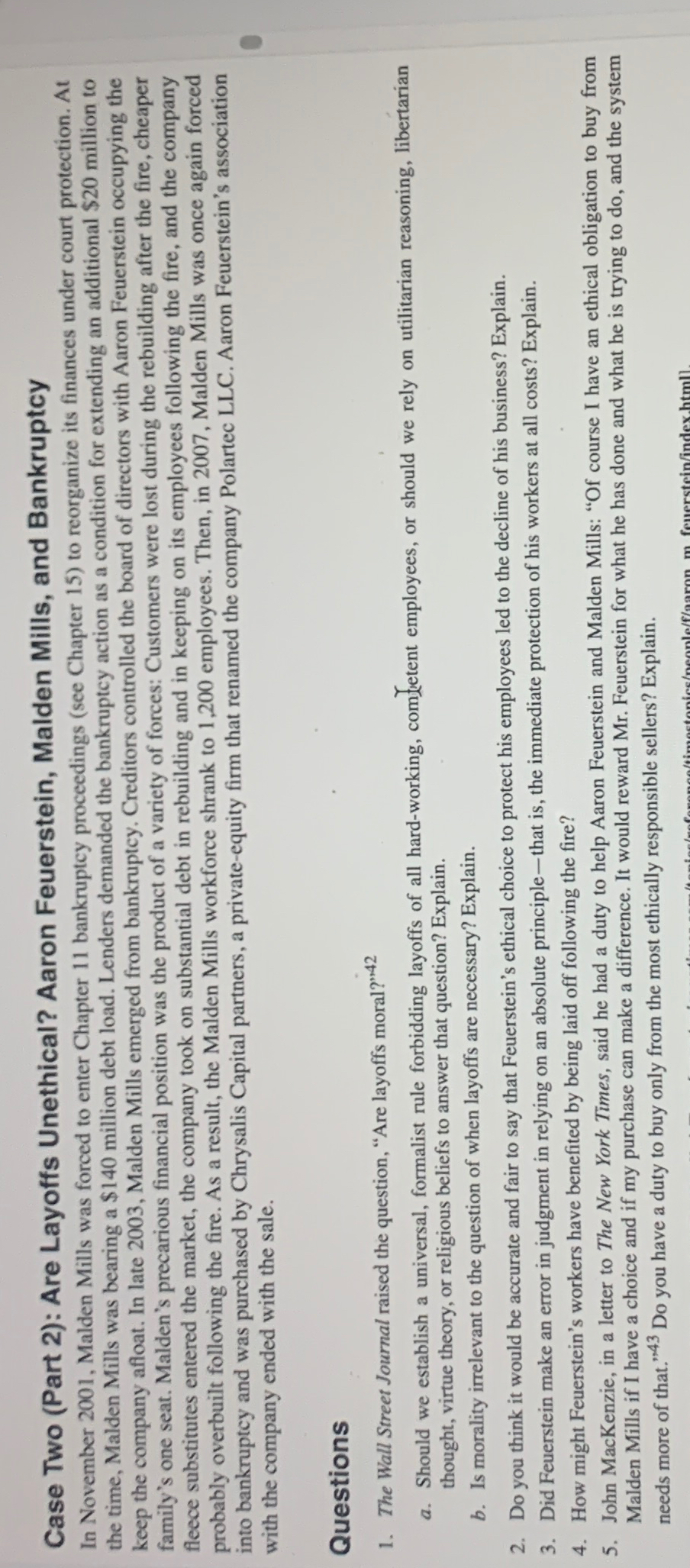
In November Malden Mills was forced to enter Chapter bankruptcy proceedings see Chapter to reorganize its finances under court protection. At the time, Malden Mills was bearing a $ million debt load. Lenders demanded the bankruptcy action as a condition for extending an additional $ million to keep the company afloat. In late Malden Mills emerged from bankruptcy. Creditors controlled the board of directors with Aaron Feuerstein occupying the family's one seat. Malden's precarious financial position was the product of a variety of forces: Customers were lost during the rebuilding after the fire, cheaper fleece substitutes entered the market, the company took on substantial debt in rebuilding and in keeping on its employees following the fire, and the company probably overbuilt following the fire. As a result, the Malden Mills workforce shrank to employees. Then, in Malden Mills was once again forced into bankruptcy and was purchased by Chrysalis Capital partners, a privateequity firm that renamed the company Polartec LLC Aaron Feuerstein's association with the company ended with the sale.
Questions
The Wall Street Journal raised the question, "Are layoffs moral?",
a Should we establish a universal, formalist rule forbidding layoffs of all hardworking, comfetent employees, or should we rely on utilitarian reasoning, libertarian thought, virtue theory, or religious beliefs to answer that question? Explain.
b Is morality irrelevant to the question of when layoffs are necessary? Explain.
Do you think it would be accurate and fair to say that Feuerstein's ethical choice to protect his employees led to the decline of his business? Explain.
Did Feuerstein make an error in judgment in relying on an absolute principle that is the immediate protection of his workers at all costs? Explain.
How might Feuerstein's workers have benefited by being laid off following the fire?
John MacKenzie, in a letter to The New York Times, said he had a duty to help Aaron Feuerstein and Malden Mills: Of course I have an ethical obligation to buy from Malden Mills if I have a choice and if my purchase can make a difference. It would reward Mr Feuerstein for what he has done and what he is trying to do and the system needs more of that, Do you have a duty to buy only from the most ethically responsible sellers? Explain.
Step by Step Solution
There are 3 Steps involved in it
1 Expert Approved Answer
Step: 1 Unlock

Question Has Been Solved by an Expert!
Get step-by-step solutions from verified subject matter experts
Step: 2 Unlock
Step: 3 Unlock
 Study Help