







Question: Cases: Case 1: A send message to D Case 2: B send message to A Questions: a) In the case 1; A sends a
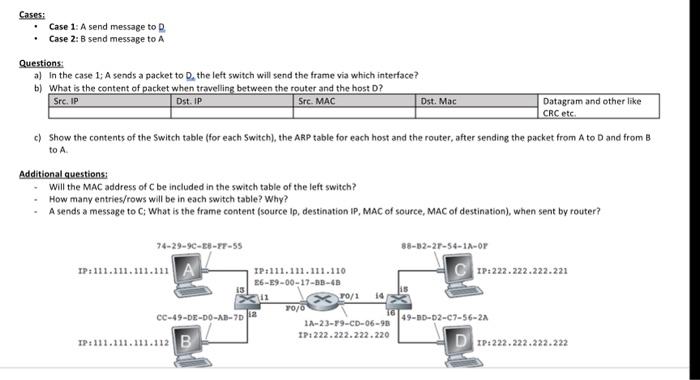
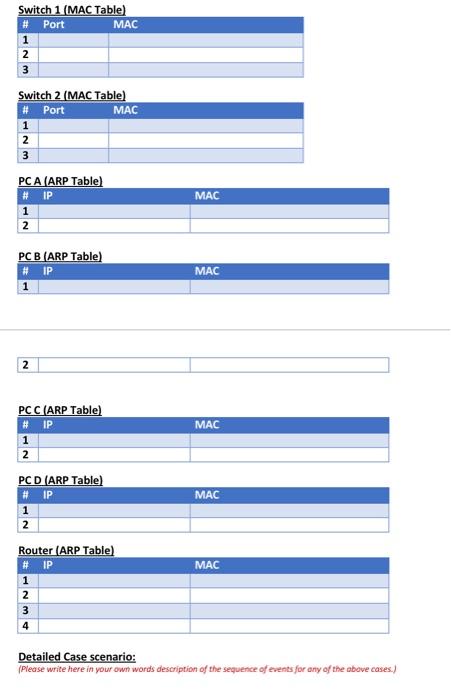
Cases: Case 1: A send message to D Case 2: B send message to A Questions: a) In the case 1; A sends a packet to D, the left switch will send the frame via which interface? b) What is the content of packet when travelling between the router and the host D? Src. IP Dst. IP Src. MAC c) Show the contents of the Switch table (for each Switch), the ARP table for each host and the router, after sending the packet from A to D and from B to A. 74-29-9C-E8-FF-55 Additional questions: Will the MAC address of C be included in the switch table of the left switch? How many entries/rows will be in each switch table? Why? A sends a message to C; What is the frame content (source Ip, destination IP, MAC of source, MAC of destination), when sent by router? IP: 111.111.111.111 13 CC-49-DE-DO-AB-7D IP:111.111.111.112 IP:111.111.111.110 26-29-00-17-BB-48 12 10/0 X PO/1 14 Dst. Mac 16 1A-23-F9-CD-06-9B IP: 222.222.222.220 Datagram and other like CRC etc. 88-B2-27-54-1A-OP IP: 222.222.222.221 49-BD-D2-C7-56-2A IP: 222.222.222.222 Switch 1 (MAC Table) # Port 1 123 2 Switch 2 (MAC Table) # Port 1 2 3 PC A (ARP Table) # IP 1 2 PC B (ARP Table) # IP 1 2 PC C (ARP Table) # IP 1 2 PC D (ARP Table) # IP 1 2 MAC 1234 MAC Router (ARP Table) # IP MAC MAC MAC MAC MAC Detailed Case scenario: (Please write here in your own words description of the sequence of events for any of the above cases.)
Step by Step Solution
3.48 Rating (151 Votes )
There are 3 Steps involved in it
a In the case 1 A sends a packet to D The left switch will send the frame via the interface connecte... View full answer

Get step-by-step solutions from verified subject matter experts
 Study Help