



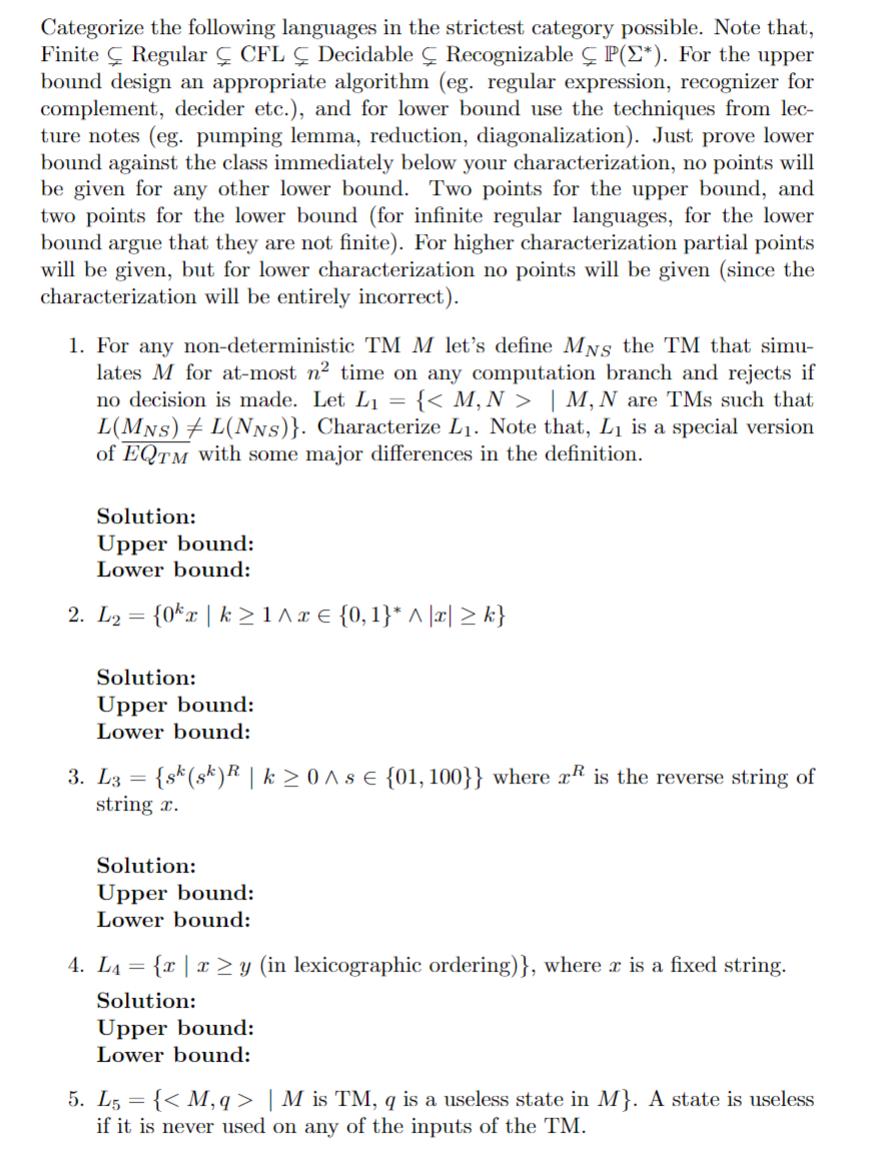
Question: Categorize the following languages in the strictest category possible. Note that, Finite Regular CFL Decidable Recognizable P ( * * ) . For the upper
Categorize the following languages in the strictest category possible. Note that,
Finite Regular CFL Decidable Recognizable For the upper
bound design an appropriate algorithm eg regular expression, recognizer for
complement, decider etc. and for lower bound use the techniques from lec
ture notes eg pumping lemma, reduction, diagonalization Just prove lower
bound against the class immediately below your characterization, no points will
be given for any other lower bound. Two points for the upper bound, and
two points for the lower bound for infinite regular languages, for the lower
bound argue that they are not finite For higher characterization partial points
will be given, but for lower characterization no points will be given since the
characterization will be entirely incorrect
For any nondeterministic TM let's define the TM that simu
lates for atmost time on any computation branch and rejects if
no decision is made. Let are TMs such that
: Characterize Note that, is a special version
of with some major differences in the definition.
Solution:
Upper bound:
Lower bound:
xin
Solution:
Upper bound:
Lower bound:
where is the reverse string of
string
Solution:
Upper bound:
Lower bound:
in lexicographic ordering
Step by Step Solution
There are 3 Steps involved in it
1 Expert Approved Answer
Step: 1 Unlock

Question Has Been Solved by an Expert!
Get step-by-step solutions from verified subject matter experts
Step: 2 Unlock
Step: 3 Unlock