Question: CBA Case Reading - Minimum Wage Introduction: Below, you'll find a summary of an actual grievance case that could not be decided by management and
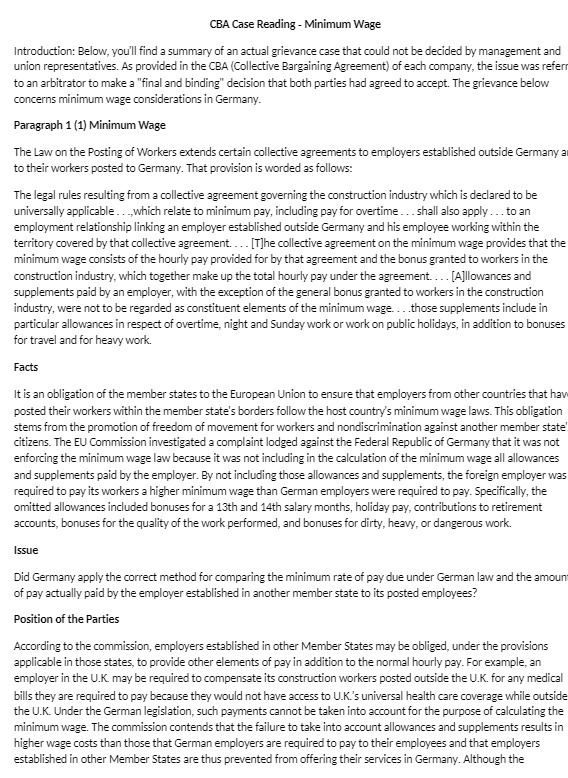
CBA Case Reading - Minimum Wage Introduction: Below, you'll find a summary of an actual grievance case that could not be decided by management and union representatives. As provided in the CBA (Collective Bargaining Agreement) of each company, the issue was refer to an arbitrator to make a "final and binding" decision that both parties had agreed to accept. The grievance below concerns minimum wage considerations in Germany. Paragraph 1 (1) Minimum Wage The Law on the Posting of Workers extends certain collective agreements to employers established outside Germany a to their workers posted to Germany. That provision is worded as follows: The legal rules resulting from a collective agreement governing the construction industry which is declared to be universally applicable . ..,which relate to minimum pay, including pay for overtime.. . shall also apply . . . to an employment relationship linking an employer established outside Germany and his employee working within the territory covered by that collective agreement. ... [The collective agreement on the minimum wage provides that the minimum wage consists of the hourly pay provided for by that agreement and the bonus granted to workers in the construction industry, which together make up the total hourly pay under the agreement. ... [Alllowances and supplements paid by an employer, with the exception of the general bonus granted to workers in the construction industry, were not to be regarded as constituent elements of the minimum wage. .. .those supplements include in particular allowances in respect of overtime, night and Sunday work or work on public holidays, in addition to bonuses for travel and for heavy work. Facts It is an obligation of the member states to the European Union to ensure that employers from other countries that hav posted their workers within the member state's borders follow the host country's minimum wage laws. This obligation stems from the promotion of freedom of movement for workers and nondiscrimination against another member state citizens. The EU Commission investigated a complaint lodged against the Federal Republic of Germany that it was not enforcing the minimum wage law because it was not including in the calculation of the minimum wage all allowances and supplements paid by the employer. By not including those allowances and supplements, the foreign employer was required to pay its workers a higher minimum wage than German employers were required to pay. Specifically, the omitted allowances included bonuses for a 13th and 14th salary months, holiday pay, contributions to retirement accounts, bonuses for the quality of the work performed, and bonuses for dirty, heavy, or dangerous work. Issue Did Germany apply the correct method for comparing the minimum rate of pay due under German law and the amoun of pay actually paid by the employer established in another member state to its posted employees? Position of the Parties According to the commission, employers established in other Member States may be obliged, under the provisions applicable in those states, to provide other elements of pay in addition to the normal hourly pay. For example, an employer in the U.K. may be required to compensate its construction workers posted outside the U.K. for any medica bills they are required to pay because they would not have access to U.K.'s universal health care coverage while outside the U.K. Under the German legislation, such payments cannot be taken into account for the purpose of calculating the minimum wage. The commission contends that the failure to take into account allowances and supplements results in higher wage costs than those that German employers are required to pay to their employees and that employers established in other Member States are thus prevented from offering their services in Germany. Although the









 Study Help