





Question: How can I solve this question? (linear algebra) Question 2a [8pts] Prove that (p(x), q(x)) = p(1)q(1) +p(2)q(2) +p(3)q(3) defines an inner product on P2

How can I solve this question? (linear algebra)
How can I solve this question? (linear algebra)
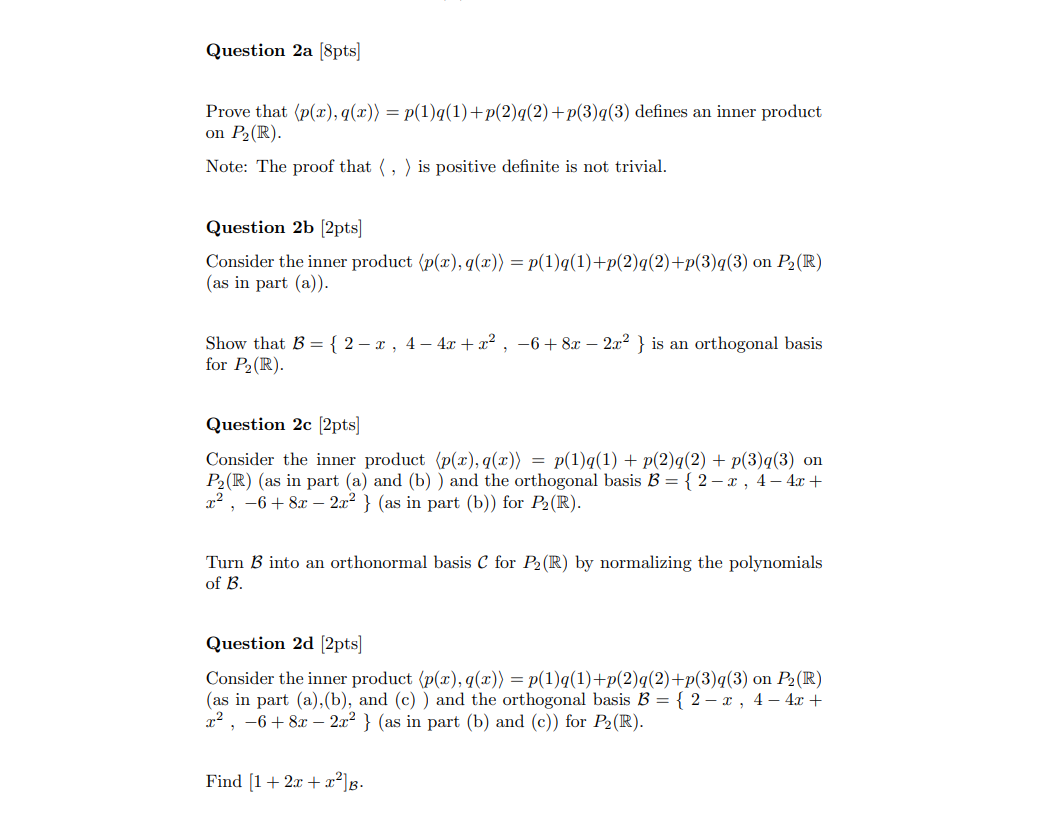
Question 2a [8pts] Prove that (p(x), q(x)) = p(1)q(1) +p(2)q(2) +p(3)q(3) defines an inner product on P2 (R). Note: The proof that ( , ) is positive definite is not trivial. Question 2b [2pts] Consider the inner product (p(x), q(x)) = p(1)q(1) +p(2)q(2) +p(3)q(3) on P2 (R) (as in part (a)). Show that B = { 2-x , 4-4x +x2 , -6+8x -2x } is an orthogonal basis for P2 (R). Question 2c [2pts] Consider the inner product (p(x), q(x)) = p(1)q(1) + p(2)q(2) + p(3)q(3) on P2 (R) (as in part (a) and (b) ) and the orthogonal basis B = { 2 -x , 4-4r + x2 , -6 + 8x - 2x } (as in part (b)) for P2 (R). Turn B into an orthonormal basis C for P2 (R) by normalizing the polynomials of B. Question 2d [2pts] Consider the inner product (p(x), q(x)) = p(1)q(1)+p(2)q(2) +p(3)q(3) on P2 (R) (as in part (a),(b), and (c) ) and the orthogonal basis B = { 2-x , 4-4x + x2 , -6+ 8x - 2x2 } (as in part (b) and (c)) for P2(R). Find [1 + 2x + x-]B

Step by Step Solution

There are 3 Steps involved in it

1 Expert Approved Answer
Step: 1 Unlock blur-text-image

Question Has Been Solved by an Expert!

Get step-by-step solutions from verified subject matter experts

Step: 2 Unlock
Step: 3 Unlock

Students Have Also Explored These Related Mathematics Questions!