







Question: Ch 05: End-of-Chapter Problems - Time Value of Money Click here to read the eBook: Semiannual and Other Compounding Periods Click here to read the
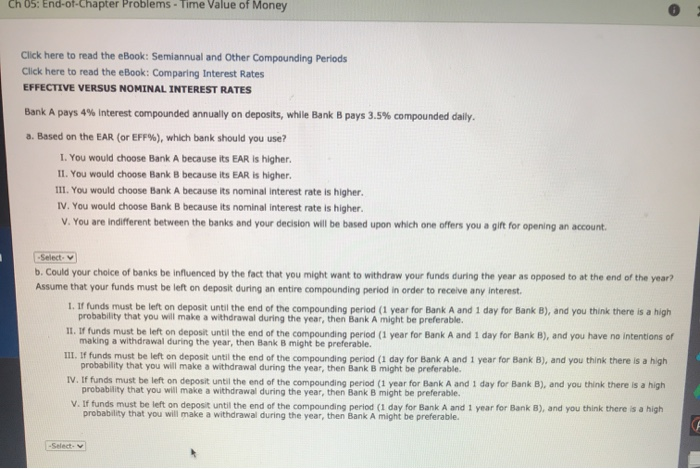
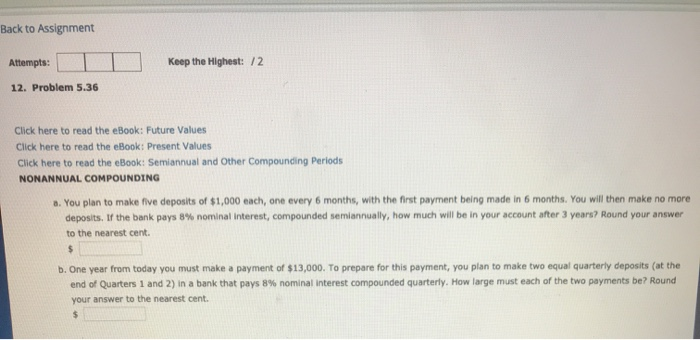
Ch 05: End-of-Chapter Problems - Time Value of Money Click here to read the eBook: Semiannual and Other Compounding Periods Click here to read the eBook: Comparing Interest Rates EFFECTIVE VERSUS NOMINAL INTEREST RATES Bank A pays 4% Interest compounded annually on deposits, while Bank B pays 3.5% compounded daily. a. Based on the EAR (or EFF%), which bank should you use? 1. You would choose Bank A because its EAR is higher 11. You would choose Bank B because its EAR is higher. III. You would choose Bank A because its nominal Interest rate is higher. IV. You would choose Bank B because its nominal Interest rate is higher V. You are indifferent between the banks and your decision will be based upon which one offers you a gift for opening an account Select b. Could your choice of banks be influenced by the fact that you might want to withdraw your funds during the year as opposed to at the end of the year? Assume that your funds must be left on deposit during an entire compounding period in order to receive any interest 1. If funds must be left on deposit until the end of the compounding period (1 year for Bank A and 1 day for Bank B), and you think there is a high probability that you will make a withdrawal during the year, then Bank A might be preferable. 11. If funds must be left on deposit until the end of the compounding period (1 year for Bank A and 1 day for Bank B), and you have no intentions of making a withdrawal during the year, then Bank B might be preferable. III. If funds must be left on deposit until the end of the compounding period (1 day for Bank A and 1 year for Bank B), and you think there is a high probability that you will make a withdrawal during the year, then Bank B might be preferable. IV. If funds must be left on deposit until the end of the compounding period (1 year for Bank A and 1 day for Bank B), and you think there is a high probability that you will make a withdrawal during the year, then Bank B might be preferable. V. If funds must be left on deposit until the end of the compounding period (1 day for Bank A and 1 year for Bank B), and you think there is a high probability that you will make a withdrawal during the year, then Bank A might be preferable. -Select- Back to Assignment Attempts: Keep the Highest: /2 12. Problem 5.36 Click here to read the eBook: Future Values Click here to read the eBook: Present Values Click here to read the eBook: Semiannual and Other Compounding Periods NONANNUAL COMPOUNDING a. You plan to make five deposits of $1,000 each, one every 6 months, with the first payment being made in 6 months. You will then make no more deposits. If the bank pays 8% nominal Interest, compounded semiannually, how much will be in your account after 3 years? Round your answer to the nearest cent. $ b. One year from today you must make a payment of $13,000. To prepare for this payment, you plan to make two equal quarterly deposits (at the end of Quarters 1 and 2) in a bank that pays 8% nominal Interest compounded quarterly. How large must each of the two payments be? Round your answer to the nearest cent. $
Step by Step Solution
There are 3 Steps involved in it

Get step-by-step solutions from verified subject matter experts
 Study Help