



Question: Ch 05- End-of-Chapter Problems - Time Value of Money Jan sold her house on December 31 and took a $15,000 mortgage as part of the
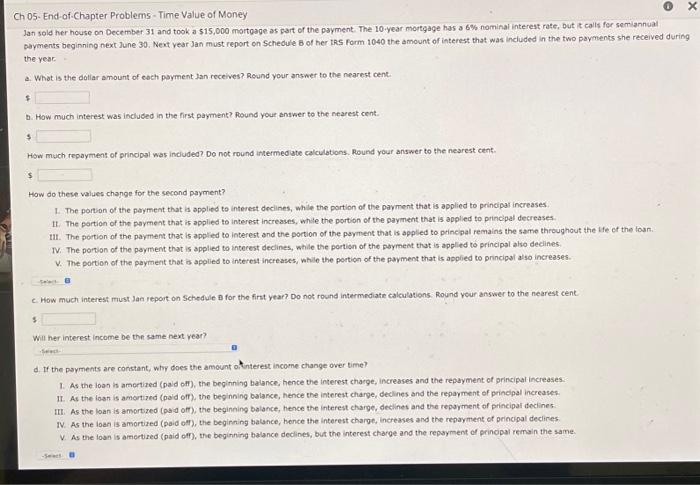
Ch 05- End-af-Chapter Problems - Time Value of Money Jan sold her house on December 31 and took a 515,000 mortgage as part of the payment. The 10 -year mortgage has a 6% nominal interest rate, but it cals for semiannual payments beginning next June 30. Next vear Jan must report on Schedule 6 of her tRS form 1040 the amount of interest that was included in the two payments she received during the vear a. What is the dotlar amount of each payment lan receives? Round your answer to the nearest cent. \& b. How much interest was included in the first payment? Pound your answer to the nearest cent. 5 How much repayment of principal was included? De not round ithermedate calculations. Round your answer to the nearest cent. s How do these values change for the second payment? 1. The portion of the payment that is applied to interest decines, while the portion of the payment that is applied to principar increases. 11. The portion of the poyment that is applied to interest increases, while the portion of the payment that is appled to principal decreases. 11. The portion of the payment that is appled to interest and the portion of the payment that is appled to princpal remains the same throughout the ife of the loan. IV. The portion of the payment that is applied to interest decines, while the portion of the poyment that is applited to principal also decines. V. The portion of the payment that is applied to inserest increases, while the porticn of the payment that is applied to principal also increases. C. How much interest must Jac report on Schedule D for the first year? Do not round intermediate calculations. Round your answer to the nearest cent. 5 Will her interest income be the same next vear? d. If the payments are constant, why does the amount of thterest income change over time? 1. As the loan is amortized (paid off), the beginning balance, hence the interest charge, increases and the repayment of principal increases: II. As the losn is amortized (pad off), the beginning balanse, hence the interest charpe, dedines and the repayment of principal increases. III. As the loan is amortized (paj om), the beginning balance, hence the interest charge, declines and the repayment of principar declines: IV. As the loan is amortized (paid om), the beginning baunce, hence the interest charge, increases and the repayment of principal declines. . As the loon is amortized (paid off), the beginning balance declines, but the interest charge and the repayment of prinopal remain the same
Step by Step Solution
There are 3 Steps involved in it

Get step-by-step solutions from verified subject matter experts