







Question: Ch . 5 Problems: 1 , 2 , 3 , 4 , 5 , 6 , 1 0 , 1 1 , 1 2 ,
Ch Problems: pg
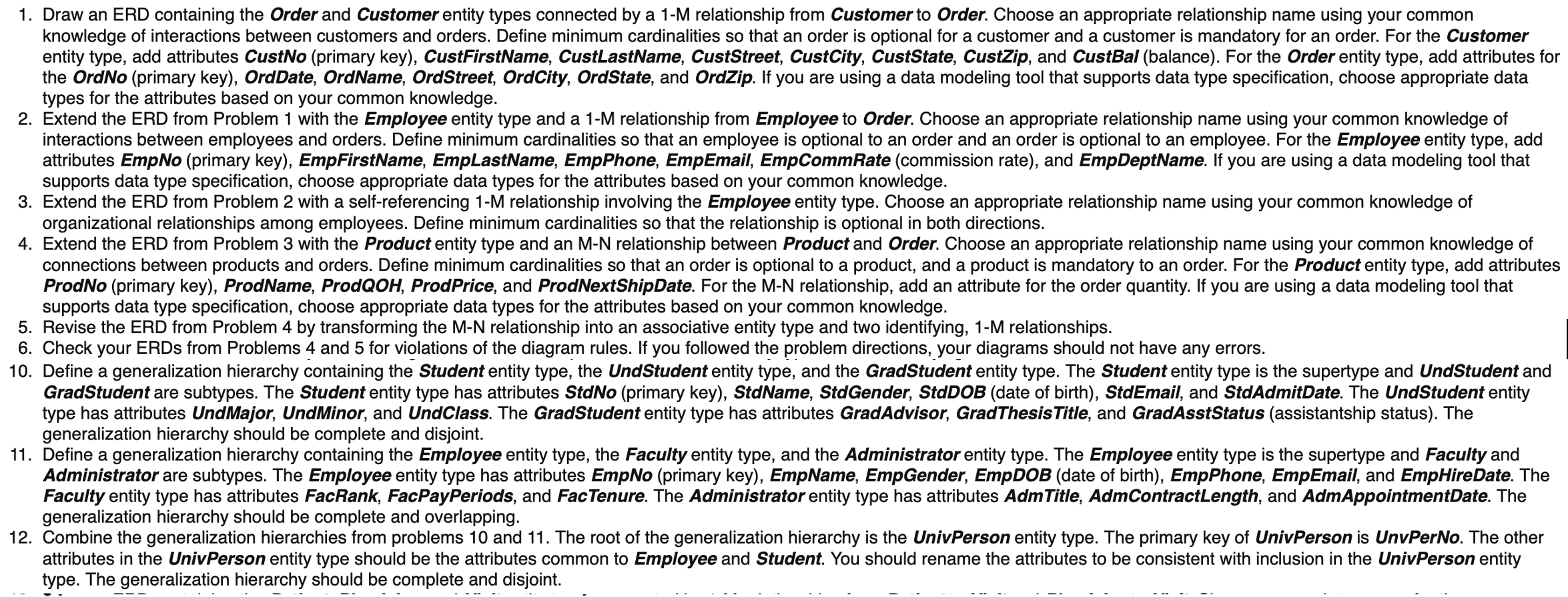
CopyPaste the ERD for each problem from your drawing application to a Word document and clearly label each problem. Submit the Word document at the class Canvas site. Draw an ERD containing the Order and Customer entity types connected by a M relationship from Customer to Order. Choose an appropriate relationship name using your common knowledge of interactions between customers and orders. Define minimum cardinalities so that an order is optional for a customer and a customer is mandatory for an order. For the Customer entity type, add attributes CustNo primary key CustFirstName, CustLastName, CustStreet, CustCity, CustState, CustZip, and CustBal balance For the Order entity type, add attributes for the OrdNo primary key OrdDate, OrdName, OrdStreet, OrdCity, OrdState, and OrdZip. If you are using a data modeling tool that supports data type specification, choose appropriate data types for the attributes based on your common knowledge.
Extend the ERD from Problem with the Employee entity type and a M relationship from Employee to Order. Choose an appropriate relationship name using your common knowledge of interactions between employees and orders. Define minimum cardinalities so that an employee is optional to an order and an order is optional to an employee. For the Employee entity type, add attributes EmpNo primary key EmpFirstName, EmpLastName, EmpPhone, EmpEmail, EmpCommRate commission rate and EmpDeptName. If you are using a data modeling tool that supports data type specification, choose appropriate data types for the attributes based on your common knowledge.
Extend the ERD from Problem with a selfreferencing M relationship involving the Employee entity type. Choose an appropriate relationship name using your common knowledge of organizational relationships among employees. Define minimum cardinalities so that the relationship is optional in both directions.
Extend the ERD from Problem with the Product entity type and an MN relationship between Product and Order. Choose an appropriate relationship name using your common knowledge of connections between products and orders. Define minimum cardinalities so that an order is optional to a product, and a product is mandatory to an order. For the Product entity type, add attributes ProdNo primary key ProdName, ProdQOH, ProdPrice, and ProdNextShipDate. For the MN relationship, add an attribute for the order quantity. If you are using a data modeling tool that supports data type specification, choose appropriate data types for the attributes based on your common knowledge.
Revise the ERD from Problem by transforming the MN relationship into an associative entity type and two identifying, M relationships.
Check your ERDs from Problems and for violations of the diagram rules. If you followed the problem directions, your diagrams should not have any errors.
Define a generalization hierarchy containing the Student entity type, the UndStudent entity type, and the GradStudent entity type. The Student entity type is the supertype and UndStudent and GradStudent are subtypes. The Student entity type has attributes StdNo primary key StdName, StdGender, StdDOB date of birth StdEmail, and StdAdmitDate. The UndStudent entity type has attributes UndMajor, UndMinor, and UndClass. The GradStudent entity type has attributes GradAdvisor, GradThesisTitle, and GradAsstStatus assistantship status The generalization hierarchy should be complete and disjoint.
Define a generalization hierarchy containing the Employee entity type, the Faculty entity type, and the Administrator entity type. The Employee entity type is the supertype and Faculty and Administrator are subtypes. The Employee entity type has attributes EmpNo primary key EmpName, EmpGender, EmpDOB date of birth EmpPhone, EmpEmail, and EmpHireDate. The Faculty entity type has attributes FacRank, FacPayPeriods, and FacTenure. The Administrator entity type has attributes AdmTitle, AdmContractLength, and AdmAppointmentDate. The generalization hierarchy should be complete and overlapping.
Combine the generalization hierarchies from problems and The root of the generalization hierarchy is the UnivPerson entity type. The primary key of UnivPerson is UnvPerNo. The other attributes in the UnivPerson entity type should be the attributes common to Employee and Student. You should rename the attributes to be consistent with inclusion in the UnivPerson entity type. The generalization hierarchy should be complete and disjoint.
Step by Step Solution
There are 3 Steps involved in it
1 Expert Approved Answer
Step: 1 Unlock

Question Has Been Solved by an Expert!
Get step-by-step solutions from verified subject matter experts
Step: 2 Unlock
Step: 3 Unlock
 Study Help