







Question: change. if we change a single bit in the input (plaintext) then half of the digits in the output (ciphertext) should a.Confusion b. Substitution c.Diffusion
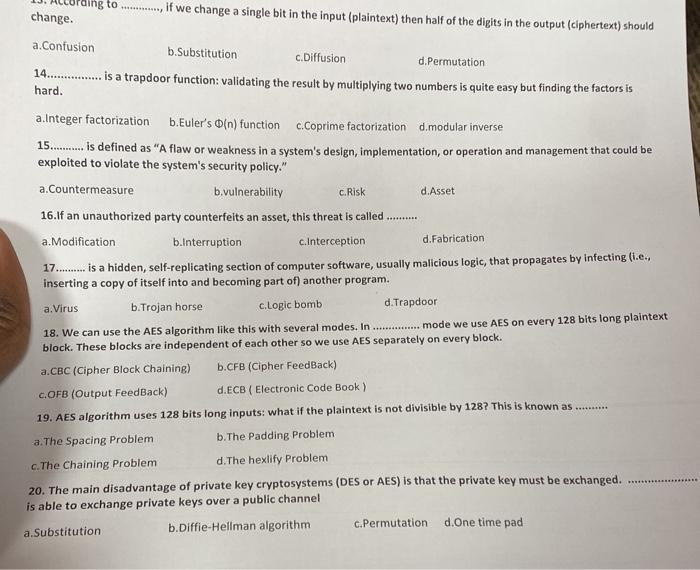
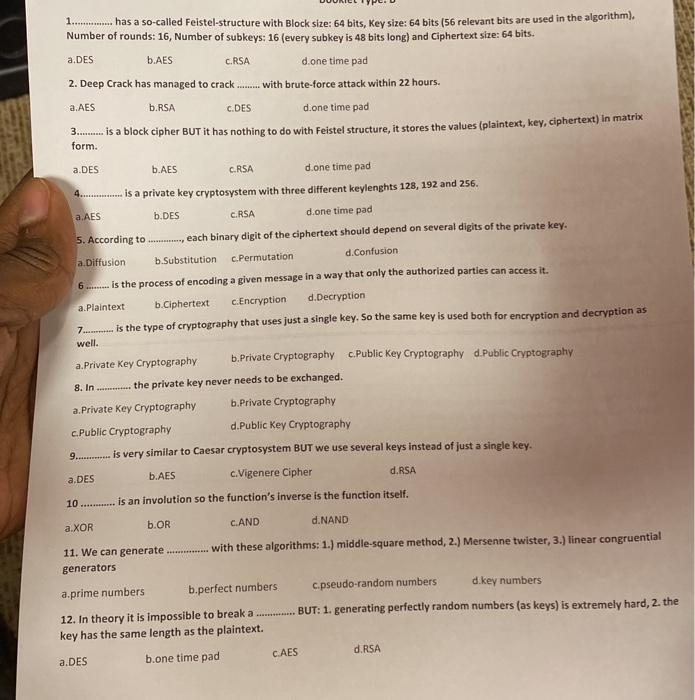
change. if we change a single bit in the input (plaintext) then half of the digits in the output (ciphertext) should a.Confusion b. Substitution c.Diffusion d.Permutation 14. is a trapdoor function: validating the result by multiplying two numbers is quite easy but finding the factors is hard. a.Integer factorization b.Euler's (n) function c.Coprime factorization d.modular inverse 15. is defined as "A flaw or weakness in a system's design, implementation, or operation and management that could be exploited to violate the system's security policy." a.Countermeasure b.vulnerability c.Risk d.Asset 16. If an unauthorized party counterfeits an asset, this threat is called a.Modification b.interruption c.Interception d. Fabrication 17......... is a hidden, self-replicating section of computer software, usually malicious logic, that propagates by infecting (i.e., inserting a copy of itself into and becoming part of) another program. a.Virus b.Trojan horse c.Logic bomb d.Trapdoor 18. We can use the AES algorithm like this with several modes. In mode we use AES on every 128 bits long plaintext block. These blocks are independent of each other so we use AES separately on every block. a.CBC (Cipher Block Chaining) b.CFB (Cipher FeedBack) c.OFB (Output FeedBack) d.ECB ( Electronic Code Book) 19. AES algorithm uses 128 bits long inputs: what if the plaintext is not divisible by 128 ? This is known as a. The Spacing Problem b. The Padding Problem c. The Chaining Problem d.The hexlify Problem 20. The main disadvantage of private key cryptosystems (DES or AES) is that the private key must be exchanged. is able to exchange private keys over a public channel a. Substitution b.Diffie-Hellman algorithm c.Permutation d.One time pad 1. has a so-called Feistel-structure with Block size: 64 bits, Key size: 64 bits (56 relevant bits are used in the algorithm), Number of rounds: 16, Number of subkeys: 16 (every subkey is 48 bits long) and Ciphertext size: 64 bits. a,DES b. AES c. RSA d.one time pad 2. Deep Crack has managed to crack with brute-force attack within 22 hours. a.AES b.RSA C.DES d.one time pad 3. is a block cipher BUT it has nothing to do with Feistel structure, it stores the values (plaintext, key, ciphertext) in matrix form. a.DES b.AES C.RSA d.one time pad A. is a private key cryptosystem with three different keylenghts 128,192 and 256. a. AES b.DES c. RSA dione time pad 5. According to each binary digit of the ciphertext should depend on several digits of the private key. a. Diffusion b. Substitution c.Permutation d.Confusion 6 is the process of encoding a given message in a way that only the authorized parties can access it. a.Plaintext- b.Ciphertext ciEncryption d.Decryption 7......... is the type of cryptography that uses just a single key. So the same key is used both for encryption and decryption as well. a.Private Key Cryptography b.Private Cryptography c.Public Key Cryptography d.Public Cryptography 8. In the private key never needs to be exchanged. a. Private Key Cryptography b. Private Cryptography c.Public Cryptography d.Public Key Cryptography 9. is very similar to Caesar cryptosystem BUT we use several keys instead of just a single key. a.DES b.AES c. Vigenere Cipher d, RSA 10 is an involution so the function's inverse is the function itself. a.XOR b. OR C.AND d. NAND 11. We can generate with these algorithms: 1.) middle-square method, 2.) Mersenne twister, 3.) linear congruential generators a.prime numbers b.perfect numbers c.pseudo-random numbers d.key numbers 12. In theory it is impossible to break a BUT: 1. generating perfectly random numbers (as keys) is extremely hard, 2. the key has the same length as the plaintext. a.DES b.one time pad C.AES d.RSA
Step by Step Solution
There are 3 Steps involved in it

Get step-by-step solutions from verified subject matter experts
 Study Help