Question: each student is required to read the given article and elaborate a short report about his/her point of view and what he/she learned from the
each student is required to read the given article and elaborate a short report about his/her point of view and what he/she learned from the artical
the subject is orgazational development (managment)
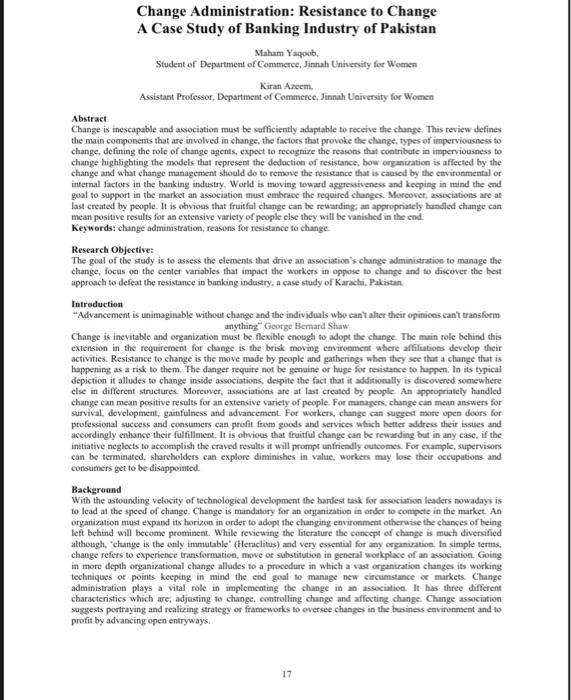
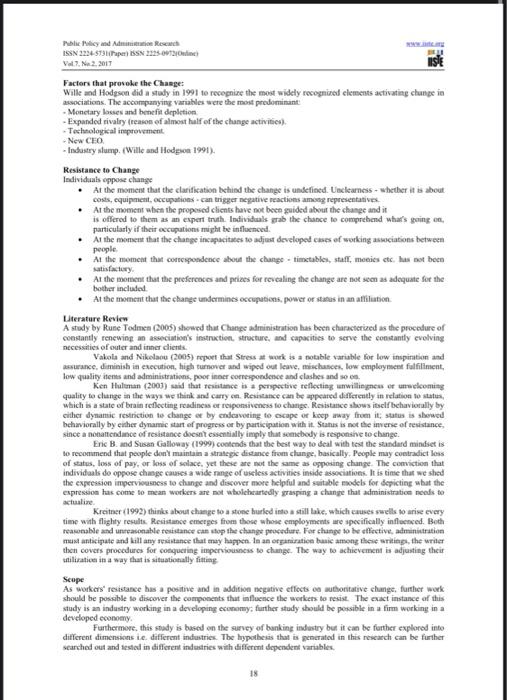
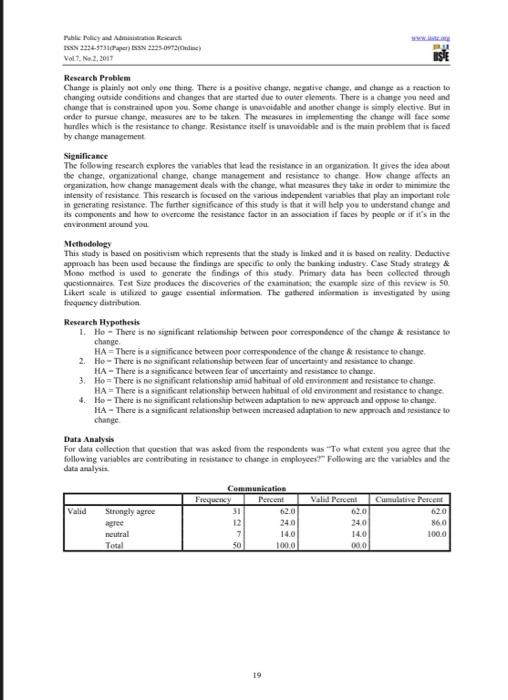
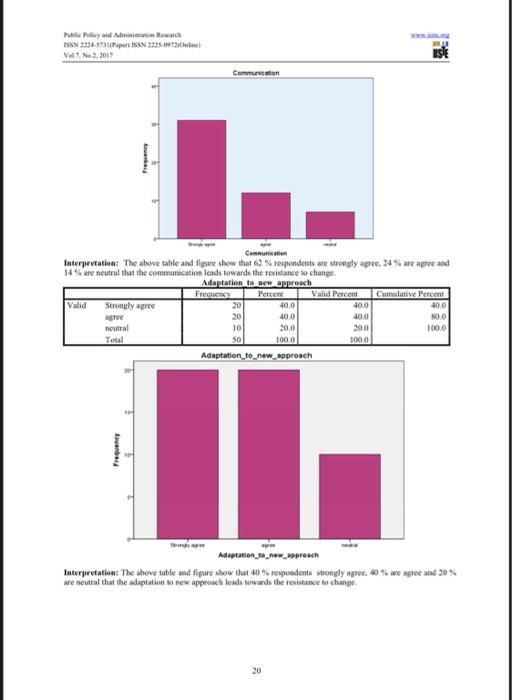
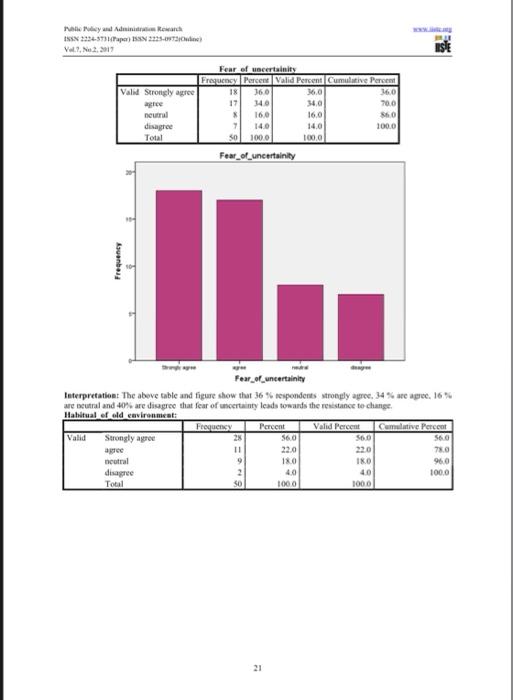
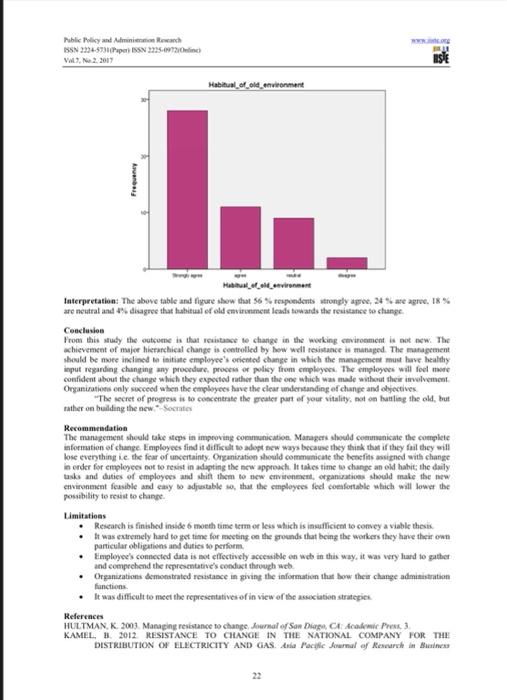
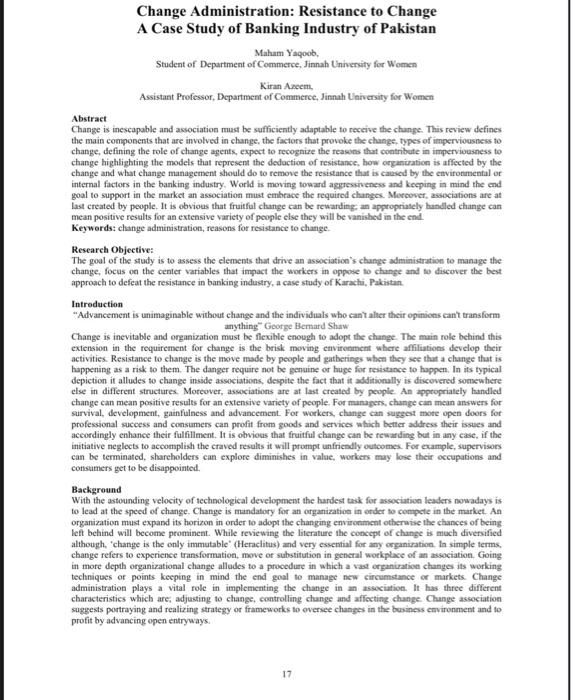
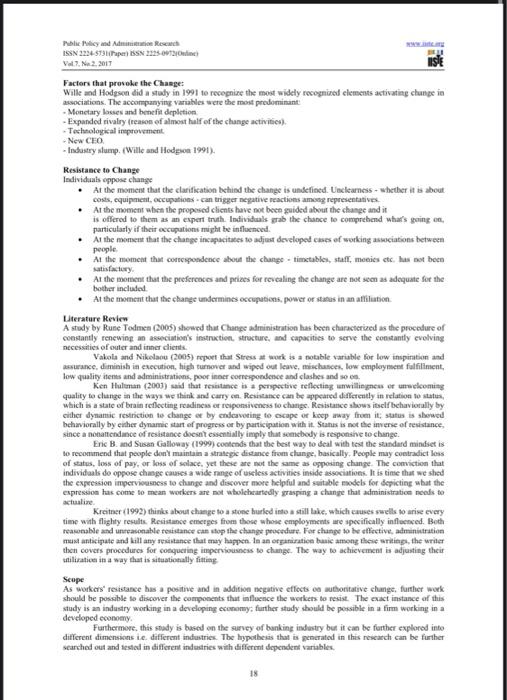
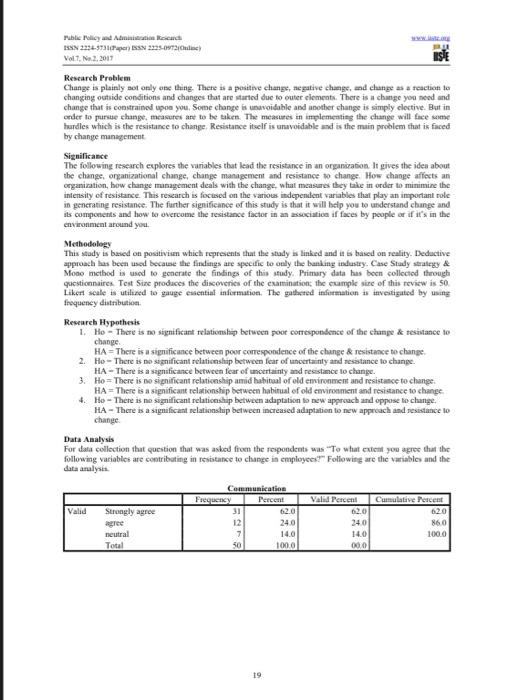
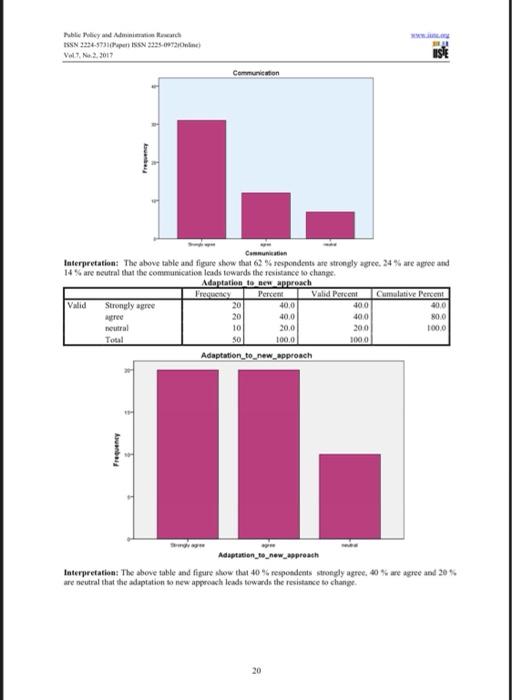
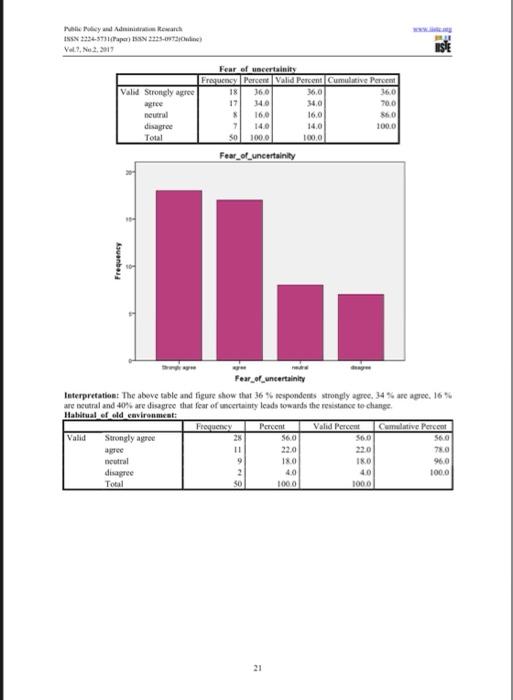
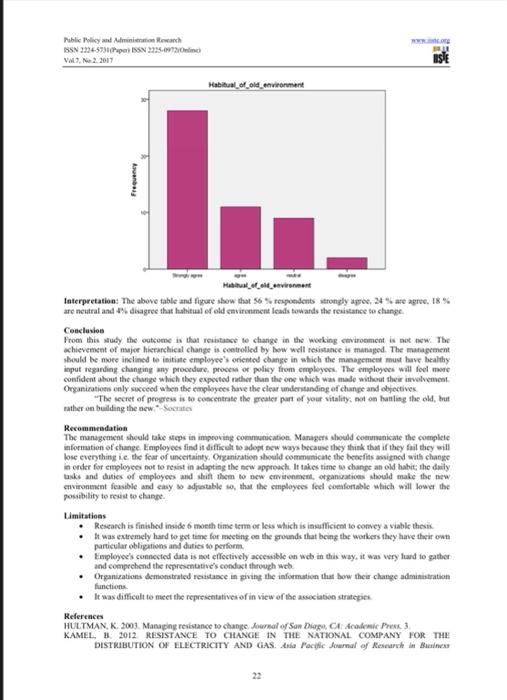
Change Administration: Resistance to Change A Case Study of Banking Industry of Pakistan Mahum Yaqoob, Student of Department of Commerce, Jinnah University for Women Kiran Azeem, Assistant Professor, Department of Commerce, Jinnah University for Women Abstract Change is inescapable and association must be sufficiently adaptable to receive the change. This review defines the main components that are involved in change, the factors that provoke the change, types of imperviousness to change, defining the role of change agents, expect to recognize the reasons that contribute in imperviousness to change highlighting the models that represent the deduction of resistance, how organization is affected by the change and what change management should do to remove the resistance that is caused by the environmental or internal factors in the banking industry. World is moving toward aggressiveness and keeping in mind the end goal to support in the market an association must embrace the required changes. Moreover, associations are at last created by people. It is obvious that fruitful change can be rewarding an appropriately handled change can mean positive results for an extensive variety of people else they will be vanished in the end Keywords: change administration, reasons for resistance to change. Research Objective: The goal of the study is to assess the elements that drive an association's change administration to manage the change, focus on the center variables that impact the workers in oppose to change and to discover the best approach to defeat the resistance in banking industry, a case study of Karachi, Pakistan Introduction **Advancement is unimaginable without change and the individuals who can't alter their opinions can't transform anything" George Bemard Shaw Change is inevitable and organization must be flexible enough to adopt the change. The main role behind this extension in the requirement for change is the brisk moving environment where affiliations develop their activities. Resistance to change is the move made by people and gatherings when they see that a change that is happening as a risk to them. The danger require not be genuine or huge for resistance to happen. In its typical depiction it alludes to change inside associations, despite the fact that it additionally is discovered somewhere else in different structures. Moreover, associations are at last created by people. An appropriately handled change can mean positive results for an extensive variety of people. For managers, change can mean answers for survival, development, gainfulness and advancement For workers, change can suggest more open doors for professional success and consumers can profit from goods and services which better address their issues and accordingly enhance their fulfillment. It is obvious that fruitful change can be rewarding but in any case, if the initiative neglects to accomplish the craved results it will prompt unfriendly outcomes. For example, supervisors can be terminated, shareholders can explore diminishes in value workers may lose their occupations and consumers get to be disappointed. Background With the astounding velocity of technological development the hardest task for association leaders nowadays is to lead at the speed of change. Change is mandatory for an organization in order to compete in the market. An Organization must expand its horizon in order to adopt the changing environment otherwise the chances of being left behind will become prominent. While reviewing the literature the concept of change is much diversified although. change is the only immutable" (Heraclitus) and very essential for any seganization. In simple terms. change refers to experience transformation, move or substitution in general workplace of an association. Going in more depth organizational change alludes to a procedure in which a vast organization changes its working techniques or points keeping in mind the end goal to manage new circumstance or markets. Change administration plays a vital role in implementing the change in an association. It has three different characteristics which are, adjusting to change, controlling change and affecting change. Change association suggests portraying and realizing strategy or frameworks to oversee changes in the business environment and to profit by advancing open entryways. 17 Publicacy and Admin Research ISSN 2234 13ape SSN 232-line Vol.7.2.2017 Factors that provoke the Change Wille and Hodgson did a study in 1991 to recognize the most widely recognized clements activating chunpe in associations. The accompanying variables were the most predominant - Monetary losses and benefit depletion Expanded rivalry reason of almost half of the change activities) Technological improvement New CEO - Industry slump. (Wille and Hodgson 1991), Resistance to Change Individuals oppose change At the moment that the clarification behind the change is undefined. Unclearness - whether it is about costs, equipment, occupations can trigger negative reactions among representatives . At the moment when the proposed clients have not been guided about the change and it is offered to them as an expert truth. Individuals prab the chance to comprehend what's going on, particularly if their occupations mught be influenced At the moment that the change incapacitate to adjust developed cases of working associations between people At the moment that correspondence about the change timetables, staff, mories etc. has not been satisfactory At the moment that the preferences and prices for revealing the change are not seen as adequate for the bother included At the moment that the change undermines occupations, power or states in an attilation Literature Review A study by Rune Todmen (2005) showed that Change administration has been characterized as the procedure of constantly renewing an association's instruction, structure, and capacities to serve the constantly evolving necessities of outer and inner clients Vakola and Nikolaou (2005) report that Stress at work is a notable variable for low inspiration and Assurance, diminish in execution high tumover and wiped out leave, michance, low employment fulfillment, low quality items and administrations, poor inner correspondence and clashes and so Ken Hulman (2001) said that resistance is perspective reflecting unwillingness or unwelcoming quality to change in the ways we think and carry on. Resistance can be appeared differently in relation to status, which is a state of brain reflecting readiness or responsiveness to change Resistance shows itself behaviotally by either dynamic restriction to change or by endeavoting to escape or keep away from it, status is showed behaviorally by either dynamic start of progress or by participation with it. Status is not the inverse of resistance since a nonattendance of resistance doesn't essentially imply that somebody is responsive to change. Eric B. and Susan Galloway (1999) contends that the best way to deal with test the standard mindset is to recommend that people don't maintain a strategie distance from chunge, basically, People may contradict loss of status, loss of pay, or loss of solace, yet these are not the same as opposing change. The conviction that individual do oppose change causes a wide range of useless activities inside associations. It is time that we shed the expression imperviousness to change and discover more helpful and suitable models for depicting what the expression has come to mean workers are not wholeheartedly grasping a change that administration needs to actualize Kreitner (1992) think about change to a stone hurled into a still lake, which causes swells to arise every time with flighty results. Resistance emerges from those whose employments are specifically influenced. Both reasonable and unreasonable resistance can stop the change procedure. For change to be effective, administration must anticipate and kill any resistance that may happen. In an organiration buic among these writing, the writer then covers procedures for conquering imperviousness to change. The way to achievement is adjusting their utilization in a way that is situationally fitting Scope As Workers' resistance has a positive and in addition negative effects on authoritative change further work should be possible to discover the components that influence the workers to resist. The exact instance of this study is an industry working in a developing economy, further study should be possible in a fimm working in a developed economy Furthermore, this study is based on the survey of banking industry but it can be further explored into different dimensions ie different industries. The hypothesis that is generated in this research can be further searched out and tested in different industries with different dependent variables 18 Public Policy and Amstech IN 2234-531) SN 2335-072) Vol. No.2.2017 ISE Research Problem Chunge is plainly not only one thing. There is a positive change, negative change, and change as a reaction to changing outside conditions and changes that are started due to outer elements. There is a change you need and change that is constrained upon you. Some change is avoidable and another change is simply clective. But in order to pursue change, measures are to be taken. The measures in implementing the change will face some hurdles which is the resistance to change Resistance itself is unavoidable and is the main problem that is faced by change management Significance The following research explores the variables that lead the resistance in an organization. It gives the idea about the change, organizational change, change management and resistance to change. How change affects an organization, how change management deals with the change, what measures they take it order to minimize the intensity of resistance. This research is focused on the various independent variables that play an important role in generating resistance. The further significance of this study is that it will belp you to understand change and its components and how to overcome the resistance factor in an association of faces by people or if it's in the environment around you Methodology This study is based on positivisan which represents that the study is linked and it is based on reality. Deductive approach has been used because the findings are specific to only the banking industry. Case Study strategy & Mono method is used to generate the findings of this study. Primary data has been collected through questionnaires Test Sire produces the discoveries of the examination the cumple sire of this review is 50 Likert scale is utilized to gauge essential information. The gathered information is investigated by using Frequency distribution Research Hypothesis 1. Ho - There is no significant relationship between por correspondence of the change & resistance to change HA=There is a significance between poor correspondence of the change & resistance to change 2. Ho - There is no sagnificant relationship between fear of uncertainty and resistance to change. HA- There is a significance between fear of uncertainty and resistance to change. 3. Ho=There is no significant relationship amid habitual of old environment and resistance to change HA=There is a significant relationship between habitual of old environment and resistance to change 4. Ho - There is no significant relationship between adaptation to sew approach and oppose to change HA - There is a significant relationstup between increased adaptation to new approach and sesistance to change Data Analysis For data collection that question that was asked from the respondents was "To what extent you agree that the following variables are contributing in resistance to change in employees?" Following are the variables and the data analysis Communication Frequency Percent Valid Percent Cumulative Percent Valid Strongly agree 31 62.0 02.0 agree 12 24.0 24.0 86.0 neutral 7 14.0 14.0 1000 Total 50 1000 000 19 Mobile Ach ISSN 2224.373 ISSN 1235 0720 V N2017 Communication Communication Interpretation: The above table and figure show that 62% respondents are strongly agree. 24% are apee and 14 are neutral that the communication leads towards the resistance to change Adaptation to sew approach Freguetsy Percent Valid Percent Cumulative Percent Valid Strongly agree 20 40,0 400 400 re 20 400 400 800 neutral 10 20,0 200 1000 Total 50 1000 1000 Adaptation to new approach Kuba Adaptation_to_new_proach Interpretation: The above table and figure show that 40% respondents strongly agree. 40% we agree and 20% are neutral that the adaptation to new approach leads towards the resistance to change 20 Maya Adiwand IS2334-ST3T) ISSN 2225.00 Vol.2.2017 Valid Strongly agree Fear of uncertainty Frequency Percent Valid Percent Cumulative Perset 18 360 36.0 160 17 40 340 700 * 16.01 16.0 360 7 140 14.0 100.0 50 100.01 100.0 neutral disagree Total Fear_ol_uncertainty Frequency Fear_of_uncertainty laterpretation: The above table and figure show that 36% respondents strongly agree. 34% se agree. 16% we neutral and 40% are disagree that fear of uncertainty leads towards the resistance to change, Habitual of old vironment Fregues Percent Valid Percent Cumulative. Perecat Valid Strongly agree 28 560 560 560 agree 11 22.0 220 7.0 neutral 9 180 180 960 disagree 2 4.0 40 100.0 Total SO 1000 1000 21 CE Public Policy and Admin Reach ISSN 23345731 2235-0020 VLT. N.2.2017 Habitual of old environment Frequency Habillement Interpretation: The above table and figure show that 56% respondents strongly agree, 24% are agree. 18 % are neutral and disagree that habitual of old environment leads towards the resistance to change Conclusion From this way the outcome is that resistance to change in the working environment is not new. The achievement of major hierarchical change is controlled by how well resistance is managed. The management should be more inclined to initiate employee's oriented change in which the management must have healthy input regarding changing any procedure process of policy from employees. The employees will feel more confident about the change which they expected rather than the one which was made without the involvement Organizations only succeed when the employees have the clear understanding of change and objectives "The secret of progress is to concentrate the greater part of your vitality, not on battling the old, but rather on building the new Socrates Recommendation The management should take steps in improving communication Managers should communicate the complete information of change. Employees find it difficult to adopt new ways because they think that if they fail they will lose everything ie the fear of uncertainty. Organization should communicate the benefits assigned with change in order for employees not to resist in adapting the new approach. It takes time to change an old habit: the daily tasks and duties of employees and built them to new environment organisations should make the new environment feasible and cry to adjustable so that the employees feel comfortable which will lower the possibility to resist to change. Limitations Research is finished inside 6 month time term or less which is insufficient to convey a viable thesis . It was extremely hard to get time for meeting on the grounds that being the workers they have their own particular obligations and duties to perform . Employee's connected data is not effectively accessible on web in this way, it was very hard to gather and comprehend the representative's conduct through web Organizations demonstrated resistance in giving the information that how their change administration functions . It was difficult to meet the representatives of in view of the association strategies References HULTMAN, K. 2003. Managing resistance to change Journal of San Diape. Academic Press. 3. KAMEL 2012 RESISTANCE TO CHANGE IN THE NATIONAL COMPANY FOR THE DISTRIBUTION OF ELECTRICITY AND GAS Asia Pacific Journal of Research in Business Public Policy and Rech ISSN 22205732225-30 V. N.2.2017 Moram TODNEM BY. R. 2005. Organisational change management: A critical review. Journal of change management 5,369-380 VAKOLAM & NIKOLAOU. 1. 2005. Atitudes towards organisational change. What is the role of employees stress and commitment Empiyee relations, 27, 160-174 WILLE, E & HODGSON. P. 1991. aking chan wark, Mercury KREITNER, R. 1992. Management, Boston: Houghton Mifflin DENT, E B & GOLDBERG, SG 199. Challenging resistance to change" The Journal of Applied Behaal Science 35, 25-41 23 Change Administration: Resistance to Change A Case Study of Banking Industry of Pakistan Mahum Yaqoob, Student of Department of Commerce, Jinnah University for Women Kiran Azeem, Assistant Professor, Department of Commerce, Jinnah University for Women Abstract Change is inescapable and association must be sufficiently adaptable to receive the change. This review defines the main components that are involved in change, the factors that provoke the change, types of imperviousness to change, defining the role of change agents, expect to recognize the reasons that contribute in imperviousness to change highlighting the models that represent the deduction of resistance, how organization is affected by the change and what change management should do to remove the resistance that is caused by the environmental or internal factors in the banking industry. World is moving toward aggressiveness and keeping in mind the end goal to support in the market an association must embrace the required changes. Moreover, associations are at last created by people. It is obvious that fruitful change can be rewarding an appropriately handled change can mean positive results for an extensive variety of people else they will be vanished in the end Keywords: change administration, reasons for resistance to change. Research Objective: The goal of the study is to assess the elements that drive an association's change administration to manage the change, focus on the center variables that impact the workers in oppose to change and to discover the best approach to defeat the resistance in banking industry, a case study of Karachi, Pakistan Introduction **Advancement is unimaginable without change and the individuals who can't alter their opinions can't transform anything" George Bemard Shaw Change is inevitable and organization must be flexible enough to adopt the change. The main role behind this extension in the requirement for change is the brisk moving environment where affiliations develop their activities. Resistance to change is the move made by people and gatherings when they see that a change that is happening as a risk to them. The danger require not be genuine or huge for resistance to happen. In its typical depiction it alludes to change inside associations, despite the fact that it additionally is discovered somewhere else in different structures. Moreover, associations are at last created by people. An appropriately handled change can mean positive results for an extensive variety of people. For managers, change can mean answers for survival, development, gainfulness and advancement For workers, change can suggest more open doors for professional success and consumers can profit from goods and services which better address their issues and accordingly enhance their fulfillment. It is obvious that fruitful change can be rewarding but in any case, if the initiative neglects to accomplish the craved results it will prompt unfriendly outcomes. For example, supervisors can be terminated, shareholders can explore diminishes in value workers may lose their occupations and consumers get to be disappointed. Background With the astounding velocity of technological development the hardest task for association leaders nowadays is to lead at the speed of change. Change is mandatory for an organization in order to compete in the market. An Organization must expand its horizon in order to adopt the changing environment otherwise the chances of being left behind will become prominent. While reviewing the literature the concept of change is much diversified although. change is the only immutable" (Heraclitus) and very essential for any seganization. In simple terms. change refers to experience transformation, move or substitution in general workplace of an association. Going in more depth organizational change alludes to a procedure in which a vast organization changes its working techniques or points keeping in mind the end goal to manage new circumstance or markets. Change administration plays a vital role in implementing the change in an association. It has three different characteristics which are, adjusting to change, controlling change and affecting change. Change association suggests portraying and realizing strategy or frameworks to oversee changes in the business environment and to profit by advancing open entryways. 17 Publicacy and Admin Research ISSN 2234 13ape SSN 232-line Vol.7.2.2017 Factors that provoke the Change Wille and Hodgson did a study in 1991 to recognize the most widely recognized clements activating chunpe in associations. The accompanying variables were the most predominant - Monetary losses and benefit depletion Expanded rivalry reason of almost half of the change activities) Technological improvement New CEO - Industry slump. (Wille and Hodgson 1991), Resistance to Change Individuals oppose change At the moment that the clarification behind the change is undefined. Unclearness - whether it is about costs, equipment, occupations can trigger negative reactions among representatives . At the moment when the proposed clients have not been guided about the change and it is offered to them as an expert truth. Individuals prab the chance to comprehend what's going on, particularly if their occupations mught be influenced At the moment that the change incapacitate to adjust developed cases of working associations between people At the moment that correspondence about the change timetables, staff, mories etc. has not been satisfactory At the moment that the preferences and prices for revealing the change are not seen as adequate for the bother included At the moment that the change undermines occupations, power or states in an attilation Literature Review A study by Rune Todmen (2005) showed that Change administration has been characterized as the procedure of constantly renewing an association's instruction, structure, and capacities to serve the constantly evolving necessities of outer and inner clients Vakola and Nikolaou (2005) report that Stress at work is a notable variable for low inspiration and Assurance, diminish in execution high tumover and wiped out leave, michance, low employment fulfillment, low quality items and administrations, poor inner correspondence and clashes and so Ken Hulman (2001) said that resistance is perspective reflecting unwillingness or unwelcoming quality to change in the ways we think and carry on. Resistance can be appeared differently in relation to status, which is a state of brain reflecting readiness or responsiveness to change Resistance shows itself behaviotally by either dynamic restriction to change or by endeavoting to escape or keep away from it, status is showed behaviorally by either dynamic start of progress or by participation with it. Status is not the inverse of resistance since a nonattendance of resistance doesn't essentially imply that somebody is responsive to change. Eric B. and Susan Galloway (1999) contends that the best way to deal with test the standard mindset is to recommend that people don't maintain a strategie distance from chunge, basically, People may contradict loss of status, loss of pay, or loss of solace, yet these are not the same as opposing change. The conviction that individual do oppose change causes a wide range of useless activities inside associations. It is time that we shed the expression imperviousness to change and discover more helpful and suitable models for depicting what the expression has come to mean workers are not wholeheartedly grasping a change that administration needs to actualize Kreitner (1992) think about change to a stone hurled into a still lake, which causes swells to arise every time with flighty results. Resistance emerges from those whose employments are specifically influenced. Both reasonable and unreasonable resistance can stop the change procedure. For change to be effective, administration must anticipate and kill any resistance that may happen. In an organiration buic among these writing, the writer then covers procedures for conquering imperviousness to change. The way to achievement is adjusting their utilization in a way that is situationally fitting Scope As Workers' resistance has a positive and in addition negative effects on authoritative change further work should be possible to discover the components that influence the workers to resist. The exact instance of this study is an industry working in a developing economy, further study should be possible in a fimm working in a developed economy Furthermore, this study is based on the survey of banking industry but it can be further explored into different dimensions ie different industries. The hypothesis that is generated in this research can be further searched out and tested in different industries with different dependent variables 18 Public Policy and Amstech IN 2234-531) SN 2335-072) Vol. No.2.2017 ISE Research Problem Chunge is plainly not only one thing. There is a positive change, negative change, and change as a reaction to changing outside conditions and changes that are started due to outer elements. There is a change you need and change that is constrained upon you. Some change is avoidable and another change is simply clective. But in order to pursue change, measures are to be taken. The measures in implementing the change will face some hurdles which is the resistance to change Resistance itself is unavoidable and is the main problem that is faced by change management Significance The following research explores the variables that lead the resistance in an organization. It gives the idea about the change, organizational change, change management and resistance to change. How change affects an organization, how change management deals with the change, what measures they take it order to minimize the intensity of resistance. This research is focused on the various independent variables that play an important role in generating resistance. The further significance of this study is that it will belp you to understand change and its components and how to overcome the resistance factor in an association of faces by people or if it's in the environment around you Methodology This study is based on positivisan which represents that the study is linked and it is based on reality. Deductive approach has been used because the findings are specific to only the banking industry. Case Study strategy & Mono method is used to generate the findings of this study. Primary data has been collected through questionnaires Test Sire produces the discoveries of the examination the cumple sire of this review is 50 Likert scale is utilized to gauge essential information. The gathered information is investigated by using Frequency distribution Research Hypothesis 1. Ho - There is no significant relationship between por correspondence of the change & resistance to change HA=There is a significance between poor correspondence of the change & resistance to change 2. Ho - There is no sagnificant relationship between fear of uncertainty and resistance to change. HA- There is a significance between fear of uncertainty and resistance to change. 3. Ho=There is no significant relationship amid habitual of old environment and resistance to change HA=There is a significant relationship between habitual of old environment and resistance to change 4. Ho - There is no significant relationship between adaptation to sew approach and oppose to change HA - There is a significant relationstup between increased adaptation to new approach and sesistance to change Data Analysis For data collection that question that was asked from the respondents was "To what extent you agree that the following variables are contributing in resistance to change in employees?" Following are the variables and the data analysis Communication Frequency Percent Valid Percent Cumulative Percent Valid Strongly agree 31 62.0 02.0 agree 12 24.0 24.0 86.0 neutral 7 14.0 14.0 1000 Total 50 1000 000 19 Mobile Ach ISSN 2224.373 ISSN 1235 0720 V N2017 Communication Communication Interpretation: The above table and figure show that 62% respondents are strongly agree. 24% are apee and 14 are neutral that the communication leads towards the resistance to change Adaptation to sew approach Freguetsy Percent Valid Percent Cumulative Percent Valid Strongly agree 20 40,0 400 400 re 20 400 400 800 neutral 10 20,0 200 1000 Total 50 1000 1000 Adaptation to new approach Kuba Adaptation_to_new_proach Interpretation: The above table and figure show that 40% respondents strongly agree. 40% we agree and 20% are neutral that the adaptation to new approach leads towards the resistance to change 20 Maya Adiwand IS2334-ST3T) ISSN 2225.00 Vol.2.2017 Valid Strongly agree Fear of uncertainty Frequency Percent Valid Percent Cumulative Perset 18 360 36.0 160 17 40 340 700 * 16.01 16.0 360 7 140 14.0 100.0 50 100.01 100.0 neutral disagree Total Fear_ol_uncertainty Frequency Fear_of_uncertainty laterpretation: The above table and figure show that 36% respondents strongly agree. 34% se agree. 16% we neutral and 40% are disagree that fear of uncertainty leads towards the resistance to change, Habitual of old vironment Fregues Percent Valid Percent Cumulative. Perecat Valid Strongly agree 28 560 560 560 agree 11 22.0 220 7.0 neutral 9 180 180 960 disagree 2 4.0 40 100.0 Total SO 1000 1000 21 CE Public Policy and Admin Reach ISSN 23345731 2235-0020 VLT. N.2.2017 Habitual of old environment Frequency Habillement Interpretation: The above table and figure show that 56% respondents strongly agree, 24% are agree. 18 % are neutral and disagree that habitual of old environment leads towards the resistance to change Conclusion From this way the outcome is that resistance to change in the working environment is not new. The achievement of major hierarchical change is controlled by how well resistance is managed. The management should be more inclined to initiate employee's oriented change in which the management must have healthy input regarding changing any procedure process of policy from employees. The employees will feel more confident about the change which they expected rather than the one which was made without the involvement Organizations only succeed when the employees have the clear understanding of change and objectives "The secret of progress is to concentrate the greater part of your vitality, not on battling the old, but rather on building the new Socrates Recommendation The management should take steps in improving communication Managers should communicate the complete information of change. Employees find it difficult to adopt new ways because they think that if they fail they will lose everything ie the fear of uncertainty. Organization should communicate the benefits assigned with change in order for employees not to resist in adapting the new approach. It takes time to change an old habit: the daily tasks and duties of employees and built them to new environment organisations should make the new environment feasible and cry to adjustable so that the employees feel comfortable which will lower the possibility to resist to change. Limitations Research is finished inside 6 month time term or less which is insufficient to convey a viable thesis . It was extremely hard to get time for meeting on the grounds that being the workers they have their own particular obligations and duties to perform . Employee's connected data is not effectively accessible on web in this way, it was very hard to gather and comprehend the representative's conduct through web Organizations demonstrated resistance in giving the information that how their change administration functions . It was difficult to meet the representatives of in view of the association strategies References HULTMAN, K. 2003. Managing resistance to change Journal of San Diape. Academic Press. 3. KAMEL 2012 RESISTANCE TO CHANGE IN THE NATIONAL COMPANY FOR THE DISTRIBUTION OF ELECTRICITY AND GAS Asia Pacific Journal of Research in Business Public Policy and Rech ISSN 22205732225-30 V. N.2.2017 Moram TODNEM BY. R. 2005. Organisational change management: A critical review. Journal of change management 5,369-380 VAKOLAM & NIKOLAOU. 1. 2005. Atitudes towards organisational change. What is the role of employees stress and commitment Empiyee relations, 27, 160-174 WILLE, E & HODGSON. P. 1991. aking chan wark, Mercury KREITNER, R. 1992. Management, Boston: Houghton Mifflin DENT, E B & GOLDBERG, SG 199. Challenging resistance to change" The Journal of Applied Behaal Science 35, 25-41 23 Change Administration: Resistance to Change A Case Study of Banking Industry of Pakistan Mahum Yaqoob, Student of Department of Commerce, Jinnah University for Women Kiran Azeem, Assistant Professor, Department of Commerce, Jinnah University for Women Abstract Change is inescapable and association must be sufficiently adaptable to receive the change. This review defines the main components that are involved in change, the factors that provoke the change, types of imperviousness to change, defining the role of change agents, expect to recognize the reasons that contribute in imperviousness to change highlighting the models that represent the deduction of resistance, how organization is affected by the change and what change management should do to remove the resistance that is caused by the environmental or internal factors in the banking industry. World is moving toward aggressiveness and keeping in mind the end goal to support in the market an association must embrace the required changes. Moreover, associations are at last created by people. It is obvious that fruitful change can be rewarding an appropriately handled change can mean positive results for an extensive variety of people else they will be vanished in the end Keywords: change administration, reasons for resistance to change. Research Objective: The goal of the study is to assess the elements that drive an association's change administration to manage the change, focus on the center variables that impact the workers in oppose to change and to discover the best approach to defeat the resistance in banking industry, a case study of Karachi, Pakistan Introduction **Advancement is unimaginable without change and the individuals who can't alter their opinions can't transform anything" George Bemard Shaw Change is inevitable and organization must be flexible enough to adopt the change. The main role behind this extension in the requirement for change is the brisk moving environment where affiliations develop their activities. Resistance to change is the move made by people and gatherings when they see that a change that is happening as a risk to them. The danger require not be genuine or huge for resistance to happen. In its typical depiction it alludes to change inside associations, despite the fact that it additionally is discovered somewhere else in different structures. Moreover, associations are at last created by people. An appropriately handled change can mean positive results for an extensive variety of people. For managers, change can mean answers for survival, development, gainfulness and advancement For workers, change can suggest more open doors for professional success and consumers can profit from goods and services which better address their issues and accordingly enhance their fulfillment. It is obvious that fruitful change can be rewarding but in any case, if the initiative neglects to accomplish the craved results it will prompt unfriendly outcomes. For example, supervisors can be terminated, shareholders can explore diminishes in value workers may lose their occupations and consumers get to be disappointed. Background With the astounding velocity of technological development the hardest task for association leaders nowadays is to lead at the speed of change. Change is mandatory for an organization in order to compete in the market. An Organization must expand its horizon in order to adopt the changing environment otherwise the chances of being left behind will become prominent. While reviewing the literature the concept of change is much diversified although. change is the only immutable" (Heraclitus) and very essential for any seganization. In simple terms. change refers to experience transformation, move or substitution in general workplace of an association. Going in more depth organizational change alludes to a procedure in which a vast organization changes its working techniques or points keeping in mind the end goal to manage new circumstance or markets. Change administration plays a vital role in implementing the change in an association. It has three different characteristics which are, adjusting to change, controlling change and affecting change. Change association suggests portraying and realizing strategy or frameworks to oversee changes in the business environment and to profit by advancing open entryways. 17 Publicacy and Admin Research ISSN 2234 13ape SSN 232-line Vol.7.2.2017 Factors that provoke the Change Wille and Hodgson did a study in 1991 to recognize the most widely recognized clements activating chunpe in associations. The accompanying variables were the most predominant - Monetary losses and benefit depletion Expanded rivalry reason of almost half of the change activities) Technological improvement New CEO - Industry slump. (Wille and Hodgson 1991), Resistance to Change Individuals oppose change At the moment that the clarification behind the change is undefined. Unclearness - whether it is about costs, equipment, occupations can trigger negative reactions among representatives . At the moment when the proposed clients have not been guided about the change and it is offered to them as an expert truth. Individuals prab the chance to comprehend what's going on, particularly if their occupations mught be influenced At the moment that the change incapacitate to adjust developed cases of working associations between people At the moment that correspondence about the change timetables, staff, mories etc. has not been satisfactory At the moment that the preferences and prices for revealing the change are not seen as adequate for the bother included At the moment that the change undermines occupations, power or states in an attilation Literature Review A study by Rune Todmen (2005) showed that Change administration has been characterized as the procedure of constantly renewing an association's instruction, structure, and capacities to serve the constantly evolving necessities of outer and inner clients Vakola and Nikolaou (2005) report that Stress at work is a notable variable for low inspiration and Assurance, diminish in execution high tumover and wiped out leave, michance, low employment fulfillment, low quality items and administrations, poor inner correspondence and clashes and so Ken Hulman (2001) said that resistance is perspective reflecting unwillingness or unwelcoming quality to change in the ways we think and carry on. Resistance can be appeared differently in relation to status, which is a state of brain reflecting readiness or responsiveness to change Resistance shows itself behaviotally by either dynamic restriction to change or by endeavoting to escape or keep away from it, status is showed behaviorally by either dynamic start of progress or by participation with it. Status is not the inverse of resistance since a nonattendance of resistance doesn't essentially imply that somebody is responsive to change. Eric B. and Susan Galloway (1999) contends that the best way to deal with test the standard mindset is to recommend that people don't maintain a strategie distance from chunge, basically, People may contradict loss of status, loss of pay, or loss of solace, yet these are not the same as opposing change. The conviction that individual do oppose change causes a wide range of useless activities inside associations. It is time that we shed the expression imperviousness to change and discover more helpful and suitable models for depicting what the expression has come to mean workers are not wholeheartedly grasping a change that administration needs to actualize Kreitner (1992) think about change to a stone hurled into a still lake, which causes swells to arise every time with flighty results. Resistance emerges from those whose employments are specifically influenced. Both reasonable and unreasonable resistance can stop the change procedure. For change to be effective, administration must anticipate and kill any resistance that may happen. In an organiration buic among these writing, the writer then covers procedures for conquering imperviousness to change. The way to achievement is adjusting their utilization in a way that is situationally fitting Scope As Workers' resistance has a positive and in addition negative effects on authoritative change further work should be possible to discover the components that influence the workers to resist. The exact instance of this study is an industry working in a developing economy, further study should be possible in a fimm working in a developed economy Furthermore, this study is based on the survey of banking industry but it can be further explored into different dimensions ie different industries. The hypothesis that is generated in this research can be further searched out and tested in different industries with different dependent variables 18 Public Policy and Amstech IN 2234-531) SN 2335-072) Vol. No.2.2017 ISE Research Problem Chunge is plainly not only one thing. There is a positive change, negative change, and change as a reaction to changing outside conditions and changes that are started due to outer elements. There is a change you need and change that is constrained upon you. Some change is avoidable and another change is simply clective. But in order to pursue change, measures are to be taken. The measures in implementing the change will face some hurdles which is the resistance to change Resistance itself is unavoidable and is the main problem that is faced by change management Significance The following research explores the variables that lead the resistance in an organization. It gives the idea about the change, organizational change, change management and resistance to change. How change affects an organization, how change management deals with the change, what measures they take it order to minimize the intensity of resistance. This research is focused on the various independent variables that play an important role in generating resistance. The further significance of this study is that it will belp you to understand change and its components and how to overcome the resistance factor in an association of faces by people or if it's in the environment around you Methodology This study is based on positivisan which represents that the study is linked and it is based on reality. Deductive approach has been used because the findings are specific to only the banking industry. Case Study strategy & Mono method is used to generate the findings of this study. Primary data has been collected through questionnaires Test Sire produces the discoveries of the examination the cumple sire of this review is 50 Likert scale is utilized to gauge essential information. The gathered information is investigated by using Frequency distribution Research Hypothesis 1. Ho - There is no significant relationship between por correspondence of the change & resistance to change HA=There is a significance between poor correspondence of the change & resistance to change 2. Ho - There is no sagnificant relationship between fear of uncertainty and resistance to change. HA- There is a significance between fear of uncertainty and resistance to change. 3. Ho=There is no significant relationship amid habitual of old environment and resistance to change HA=There is a significant relationship between habitual of old environment and resistance to change 4. Ho - There is no significant relationship between adaptation to sew approach and oppose to change HA - There is a significant relationstup between increased adaptation to new approach and sesistance to change Data Analysis For data collection that question that was asked from the respondents was "To what extent you agree that the following variables are contributing in resistance to change in employees?" Following are the variables and the data analysis Communication Frequency Percent Valid Percent Cumulative Percent Valid Strongly agree 31 62.0 02.0 agree 12 24.0 24.0 86.0 neutral 7 14.0 14.0 1000 Total 50 1000 000 19 Mobile Ach ISSN 2224.373 ISSN 1235 0720 V N2017 Communication Communication Interpretation: The above table and figure show that 62% respondents are strongly agree. 24% are apee and 14 are neutral that the communication leads towards the resistance to change Adaptation to sew approach Freguetsy Percent Valid Percent Cumulative Percent Valid Strongly agree 20 40,0 400 400 re 20 400 400 800 neutral 10 20,0 200 1000 Total 50 1000 1000 Adaptation to new approach Kuba Adaptation_to_new_proach Interpretation: The above table and figure show that 40% respondents strongly agree. 40% we agree and 20% are neutral that the adaptation to new approach leads towards the resistance to change 20 Maya Adiwand IS2334-ST3T) ISSN 2225.00 Vol.2.2017 Valid Strongly agree Fear of uncertainty Frequency Percent Valid Percent Cumulative Perset 18 360 36.0 160 17 40 340 700 * 16.01 16.0 360 7 140 14.0 100.0 50 100.01 100.0 neutral disagree Total Fear_ol_uncertainty Frequency Fear_of_uncertainty laterpretation: The above table and figure show that 36% respondents strongly agree. 34% se agree. 16% we neutral and 40% are disagree that fear of uncertainty leads towards the resistance to change, Habitual of old vironment Fregues Percent Valid Percent Cumulative. Perecat Valid Strongly agree 28 560 560 560 agree 11 22.0 220 7.0 neutral 9 180 180 960 disagree 2 4.0 40 100.0 Total SO 1000 1000 21 CE Public Policy and Admin Reach ISSN 23345731 2235-0020 VLT. N.2.2017 Habitual of old environment Frequency Habillement Interpretation: The above table and figure show that 56% respondents strongly agree, 24% are agree. 18 % are neutral and disagree that habitual of old environment leads towards the resistance to change Conclusion From this way the outcome is that resistance to change in the working environment is not new. The achievement of major hierarchical change is controlled by how well resistance is managed. The management should be more inclined to initiate employee's oriented change in which the management must have healthy input regarding changing any procedure process of policy from employees. The employees will feel more confident about the change which they expected rather than the one which was made without the involvement Organizations only succeed when the employees have the clear understanding of change and objectives "The secret of progress is to concentrate the greater part of your vitality, not on battling the old, but rather on building the new Socrates Recommendation The management should take steps in improving communication Managers should communicate the complete information of change. Employees find it difficult to adopt new ways because they think that if they fail they will lose everything ie the fear of uncertainty. Organization should communicate the benefits assigned with change in order for employees not to resist in adapting the new approach. It takes time to change an old habit: the daily tasks and duties of employees and built them to new environment organisations should make the new environment feasible and cry to adjustable so that the employees feel comfortable which will lower the possibility to resist to change. Limitations Research is finished inside 6 month time term or less which is insufficient to convey a viable thesis . It was extremely hard to get time for meeting on the grounds that being the workers they have their own particular obligations and duties to perform . Employee's connected data is not effectively accessible on web in this way, it was very hard to gather and comprehend the representative's conduct through web Organizations demonstrated resistance in giving the information that how their change administration functions . It was difficult to meet the representatives of in view of the association strategies References HULTMAN, K. 2003. Managing resistance to change Journal of San Diape. Academic Press. 3. KAMEL 2012 RESISTANCE TO CHANGE IN THE NATIONAL COMPANY FOR THE DISTRIBUTION OF ELECTRICITY AND GAS Asia Pacific Journal of Research in Business Public Policy and Rech ISSN 22205732225-30 V. N.2.2017 Moram TODNEM BY. R. 2005. Organisational change management: A critical review. Journal of change management 5,369-380 VAKOLAM & NIKOLAOU. 1. 2005. Atitudes towards organisational change. What is the role of employees stress and commitment Empiyee relations, 27, 160-174 WILLE, E & HODGSON. P. 1991. aking chan wark, Mercury KREITNER, R. 1992. Management, Boston: Houghton Mifflin DENT, E B & GOLDBERG, SG 199. Challenging resistance to change" The Journal of Applied Behaal Science 35, 25-41 23 Change Administration: Resistance to Change A Case Study of Banking Industry of Pakistan Mahum Yaqoob, Student of Department of Commerce, Jinnah University for Women Kiran Azeem, Assistant Professor, Department of Commerce, Jinnah University for Women Abstract Change is inescapable and association must be sufficiently adaptable to receive the change. This review defines the main components that are involved in change, the factors that provoke the change, types of imperviousness to change, defining the role of change agents, expect to recognize the reasons that contribute in imperviousness to change highlighting the models that represent the deduction of resistance, how organization is affected by the change and what change management should do to remove the resistance that is caused by the environmental or internal factors in the banking industry. World is moving toward aggressiveness and keeping in mind the end goal to support in the market an association must embrace the required changes. Moreover, associations are at last created by people. It is obvious that fruitful change can be rewarding an appropriately handled change can mean positive results for an extensive variety of people else they will be vanished in the end Keywords: change administration, reasons for resistance to change. Research Objective: The goal of the study is to assess the elements that drive an association's change administration to manage the change, focus on the center variables that impact the workers in oppose to change and to discover the best approach to defeat the resistance in banking industry, a case study of Karachi, Pakistan Introduction **Advancement is unimaginable without change and the individuals who can't alter their opinions can't transform anything" George Bemard Shaw Change is inevitable and organization must be flexible enough to adopt the change. The main role behind this extension in the requirement for change is the brisk moving environment where affiliations develop their activities. Resistance to change is the move made by people and gatherings when they see that a change that is happening as a risk to them. The danger require not be genuine or huge for resistance to happen. In its typical depiction it alludes to change inside associations, despite the fact that it additionally is discovered somewhere else in different structures. Moreover, associations are at last created by people. An appropriately handled change can mean positive results for an extensive variety of people. For managers, change can mean answers for survival, development, gainfulness and advancement For workers, change can suggest more open doors for professional success and consumers can profit from goods and services which better address their issues and accordingly enhance their fulfillment. It is obvious that fruitful change can be rewarding but in any case, if the initiative neglects to accomplish the craved results it will prompt unfriendly outcomes. For example, supervisors can be terminated, shareholders can explore diminishes in value workers may lose their occupations and consumers get to be disappointed. Background With the astounding velocity of technological development the hardest task for association leaders nowadays is to lead at the speed of change. Change is mandatory for an organization in order to compete in the market. An Organization must expand its horizon in order to adopt the changing environment otherwise the chances of being left behind will become prominent. While reviewing the literature the concept of change is much diversified although. change is the only immutable" (Heraclitus) and very essential for any seganization. In simple terms. change refers to experience transformation, move or substitution in general workplace of an association. Going in more depth organizational change alludes to a procedure in which a vast organization changes its working techniques or points keeping in mind the end goal to manage new circumstance or markets. Change administration plays a vital role in implementing the change in an association. It has three different characteristics which are, adjusting to change, controlling change and affecting change. Change association suggests portraying and realizing strategy or frameworks to oversee changes in the business environment and to profit by advancing open entryways. 17 Publicacy and Admin Research ISSN 2234 13ape SSN 232-line Vol.7.2.2017 Factors that provoke the Change Wille and Hodgson did a study in 1991 to recognize the most widely recognized clements activating chunpe in associations. The accompanying variables were the most predominant - Monetary losses and benefit depletion Expanded rivalry reason of almost half of the change activities) Technological improvement New CEO - Industry slump. (Wille and Hodgson 1991), Resistance to Change Individuals oppose change At the moment that the clarification behind the change is undefined. Unclearness - whether it is about costs, equipment, occupations can trigger negative reactions among representatives . At the moment when the proposed clients have not been guided about the change and it is offered to them as an expert truth. Individuals prab the chance to comprehend what's going on, particularly if their occupations mught be influenced At the moment that the change incapacitate to adjust developed cases of working associations between people At the moment that correspondence about the change timetables, staff, mories etc. has not been satisfactory At the moment that the preferences and prices for revealing the change are not seen as adequate for the bother included At the moment that the change undermines occupations, power or states in an attilation Literature Review A study by Rune Todmen (2005) showed that Change administration has been characterized as the procedure of constantly renewing an association's instruction, structure, and capacities to serve the constantly evolving necessities of outer and inner clients Vakola and Nikolaou (2005) report that Stress at work is a notable variable for low inspiration and Assurance, diminish in execution high tumover and wiped out leave, michance, low employment fulfillment, low quality items and administrations, poor inner correspondence and clashes and so Ken Hulman (2001) said that resistance is perspective reflecting unwillingness or unwelcoming quality to change in the ways we think and carry on. Resistance can be appeared differently in relation to status, which is a state of brain reflecting readiness or responsiveness to change Resistance shows itself behaviotally by either dynamic restriction to change or by endeavoting to escape or keep away from it, status is showed behaviorally by either dynamic start of progress or by participation with it. Status is not the inverse of resistance since a nonattendance of resistance doesn't essentially imply that somebody is responsive to change. Eric B. and Susan Galloway (1999) contends that the best way to deal with test the standard mindset is to recommend that people don't maintain a strategie distance from chunge, basically, People may contradict loss of status, loss of pay, or loss of solace, yet these are not the same as opposing change. The conviction that individual do oppose change causes a wide range of useless activities inside associations. It is time that we shed the expression imperviousness to change and discover more helpful and suitable models for depicting what the expression has come to mean workers are not wholeheartedly grasping a change that administration needs to actualize Kreitner (1992) think about change to a stone hurled into a still lake, which causes swells to arise every time with flighty results. Resistance emerges from those whose employments are specifically influenced. Both reasonable and unreasonable resistance can stop the change procedure. For change to be effective, administration must anticipate and kill any resistance that may happen. In an organiration buic among these writing, the writer then covers procedures for conquering imperviousness to change. The way to achievement is adjusting their utilization in a way that is situationally fitting Scope As Workers' resistance has a positive and in addition negative effects on authoritative change further work should be possible to discover the components that influence the workers to resist. The exact instance of this study is an industry working in a developing economy, further study should be possible in a fimm working in a developed economy Furthermore, this study is based on the survey of banking industry but it can be further explored into different dimensions ie different industries. The hypothesis that is generated in this research can be further searched out and tested in different industries with different dependent variables 18 Public Policy and Amstech IN 2234-531) SN 2335-072) Vol. No.2.2017 ISE Research Problem Chunge is plainly not only one thing. There is a positive change, negative change, and change as a reaction to changing outside conditions and changes that are started due to outer elements. There is a change you need and change that is constrained upon you. Some change is avoidable and another change is simply clective. But in order to pursue change, measures are to be taken. The measures in implementing the change will face some hurdles which is the resistance to change Resistance itself is unavoidable and is the main problem that is faced by change management Significance The following research explores the variables that lead the resistance in an organization. It gives the idea about the change, organizational change, change management and resistance to change. How change affects an organization, how change management deals with the change, what measures they take it order to minimize the intensity of resistance. This research is focused on the various independent variables that play an important role in generating resistance. The further significance of this study is that it will belp you to understand change and its components and how to overcome the resistance factor in an association of faces by people or if it's in the environment around you Methodology This study is based on positivisan which represents that the study is linked and it is based on reality. Deductive approach has been used because the findings are specific to only the banking industry. Case Study strategy & Mono method is used to generate the findings of this study. Primary data has been collected through questionnaires Test Sire produces the discoveries of the examination the cumple sire of this review is 50 Likert scale is utilized to gauge essential information. The gathered information is investigated by using Frequency distribution Research Hypothesis 1. Ho - There is no significant relationship between por correspondence of the change & resistance to change HA=There is a significance between poor correspondence of the change & resistance to change 2. Ho - There is no sagnificant relationship between fear of uncertainty and resistance to change. HA- There is a significance between fear of uncertainty and resistance to change. 3. Ho=There is no significant relationship amid habitual of old environment and resistance to change HA=There is a significant relationship between habitual of old environment and resistance to change 4. Ho - There is no significant relationship between adaptation to sew approach and oppose to change HA - There is a significant relationstup between increased adaptation to new approach and sesistance to change Data Analysis For data collection that question that was asked from the respondents was "To what extent you agree that the following variables are contributing in resistance to change in employees?" Following are the variables and the data analysis Communication Frequency Percent Valid Percent Cumulative Percent Valid Strongly agree 31 62.0 02.0 agree 12 24.0 24.0 86.0 neutral 7 14.0 14.0 1000 Total 50 1000 000 19 Mobile Ach ISSN 2224.373 ISSN 1235 0720 V N2017 Communication Communication Interpretation: The above table and figure show that 62% respondents are strongly agree. 24% are apee and 14 are neutral that the communication leads towards the resistance to change Adaptation to sew approach Freguetsy Percent Valid Percent Cumulative Percent Valid Strongly agree 20 40,0 400 400 re 20 400 400 800 neutral 10 20,0 200 1000 Total 50 1000 1000 Adaptation to new approach Kuba Adaptation_to_new_proach Interpretation: The above table and figure show that 40% respondents strongly agree. 40% we agree and 20% are neutral that the adaptation to new approach leads towards the resistance to change 20 Maya Adiwand IS2334-ST3T) ISSN 2225.00 Vol.2.2017 Valid Strongly agree Fear of uncertainty Frequency Percent Valid Percent Cumulative Perset 18 360 36.0 160 17 40 340 700









 Study Help