







Question: changes when the side length x changes. Find A^(')(19) (in m(m^(2))/(m)m ). A^(')(19)=,m(m^(2))/(m)m Explain the meaning of A^(')(19) in the context of this problem.
changes when the side length
xchanges. Find
A^(')(19)(in
m(m^(2))/(m)m).\
A^(')(19)=,m(m^(2))/(m)m\ Explain the meaning of
A^(')(19)in the context of this problem.\
A^(')(19)represents the rate at which the area is increasing with respect to the side length as
xreaches
19mm.\
A^(')(19)represents the rate at which the area is increasing with respect to the side length as
Areaches
38mm^(2).\
A^(')(19)represents the area as the side length reaches
19mm.\
A^(')(19)represents the rate at which the area is increasing as
xreaches
38mm.\
A^(')(19)represents the rate at which the side length is increasing with respect to the area as
xreaches
19mm.\ Need Help?
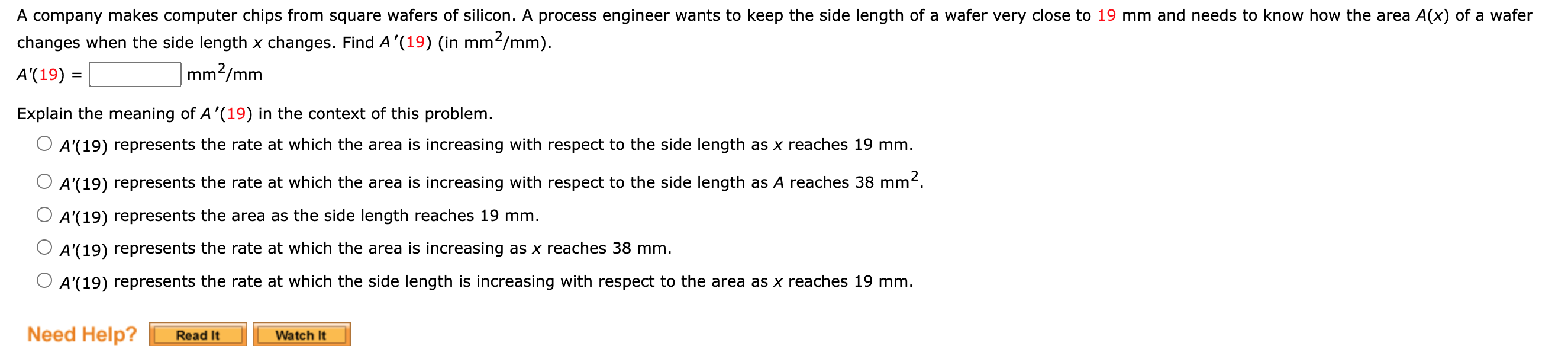
changes when the side length x changes. Find A(19) (in mm2/mm ). A(19)=mm2/mm Explain the meaning of A(19) in the context of this problem. A(19) represents the rate at which the area is increasing with respect to the side length as x reaches 19mm. A(19) represents the rate at which the area is increasing with respect to the side length as A reaches 38mm2. A(19) represents the area as the side length reaches 19mm. A(19) represents the rate at which the area is increasing as x reaches 38mm. A(19) represents the rate at which the side length is increasing with respect to the area as x reaches 19mm
Step by Step Solution
There are 3 Steps involved in it

Get step-by-step solutions from verified subject matter experts
 Study Help