Question: Chapter 10 / Developing Puterprise IT Solutions 365 REAL WORLD CASE 1 H&R Block, Morgan Stanley, and Others: In-House Development Is Alive and Well G
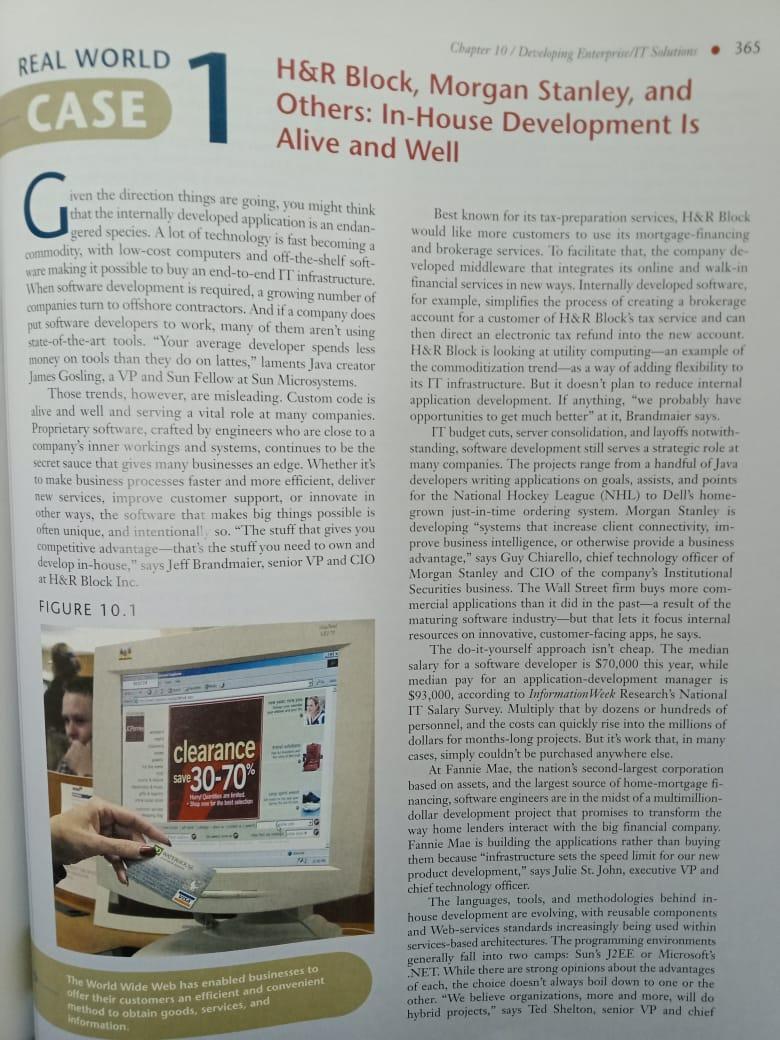


Chapter 10 / Developing Puterprise IT Solutions 365 REAL WORLD CASE 1 H&R Block, Morgan Stanley, and Others: In-House Development Is Alive and Well G iven the direction things are going, you might think that the internally developed application is an endan- gered species. A lot of technology is fast becoming a commodity, with low-cost computers and off-the-shelf soft- ware making it possible to buy an end-to-end IT infrastructure. When software development is required, a growing number of companies turn to offshore contractors. And if a company does put software developers to work, many of them aren't using state-of-the-art tools. "Your average developer spends less money on tools than they do on lattes," laments Java creator James Gosling, a VP and Sun Fellow at Sun Microsystems. Those trends, however, are misleading. Custom code is alive and well and serving a vital role at many companies. Proprietary software, crafted by engineers who are close to a company's inner workings and systems, continues to be the secret sauce that gives many businesses an edge. Whether it's to make business processes faster and more efficient, deliver new services, improve customer support, or innovate in other ways, the software that makes big things possible is often unique, and intentionally so. "The stuff that gives you competitive advantage--that's the stuff you need to own and develop in-house," says Jeff Brandmaier, senior VP and CIO at H&R Block Inc. much better" at FIGURE 10.1 Best known for its tax-preparation services. H&R Block would like more customers to use its mortgage-financing and brokerage services. To facilitate that, the company de veloped middleware that integrates its online and walk-in financial services in new ways Internally developed software, for example, simplifies the process of creating a brokerage account for a customer of H&R Block's tax service and can then direct an electronic tax refund into the new account. H&R Block is looking at utility computing-an example of the e commoditization trend as a way of adding flexibility to its IT infrastructure. But it it doesn't plan to reduce internal application development. If If anything "we probably have opportunities to get much tit, Brandmaier says IT budget cuts , server consolidation, and layoffs norwith- standing, software development still serves a strategic role at many companies The projects range from a handful of Java developers writing applications on goals, assists, and points for the National Hockey League (NHL) to Dells home- grown just-in-time ordering system. Morgan Stanley is developing "systems that increase client connectivity, im- prove business intelligence, or otherwise provide a business advantage," says Guy Chiarello, chief technology officer of Morgan Stanley and CIO of the company's Institutional Securities business. The Wall Street firm buys more com- mercial applications than it did in the pasta result of the maturing software industrybut that lets focus internal resources on innovative, customer-facing apps, he says. The do-it-yourself approach isn't cheap. The median salary for a software developer is $70,000 this year, while median pay for an application development manager is $93.000, according to Information Week Research's National IT Salary Survey. Multiply that by dozens or hundreds of personnel , and the costs can quickly rise into the millions of dollars for months-long projects. But it's work that, in many cases, simply couldn't be purchased anywhere else. At Fannie Mac, the nation's second-largest corporation based on assets, and the largest source of home-mortgage fi- nancing, software engineers are in the midst of a multimillion- dollar development project that promises to transform the way home lenders interact with the big financial company, Fannie Mae is building the applications rather than buying them because "infrastructure sets the speed limit for our new product development," says Julie St. John, executive VP and chief technology officer. The languages, tools, and methodologies behind in- house development are evolving, with reusable components and Web-services standards increasingly being used within services-based architectures. The programming environments generally fall into two camps: Sun's J2EE or Microsoft's NET. While there are strong opinions about the advantages of each, the choice doesn't always boil down to one or the other. We believe organizations, more and more, will do hybrid projects," says Ted Shelton, senior VP and chief clearance ave 30-70% The World Wide Web has enabled businesses to aller their customer's an efficient and convenient method to obtain goods, services, and information 366 Module IV / Development Processes strategy officer at Borland Software Corp., which has been selling development tools for 20 years. Either way, Shelton says, the trend among corporate development teams is to use tools to treat their work less like a craft and more like a practice." That means being more attentive to the way software-development teams collaborate with users and business managers to determine the require- ments of applications and then being more methodical in the design, development, and testing of those apps. "Software developers today have to be very familiar with the full appli- cation life cycle," Shelton says. But technological advances certainly help. The London Stock Exchange is increasingly using Microsoft's C++ lan- guage in lieu of COBOL, a decades-old language still widely used on mainframes, Ian Homan, head of technology for the exchange, says the shift is possible because the choice in application-development tools can now be made indepen- dently of hardware platform and operating system. In the past, he says, "the hardware would choose the operating sys- tem, the operating system would choose the development language, and I would have no choice whatsoever." The cost benefits are also compelling. Homan estimates programmers can generate code using C++ at half the cost of enterprise was only partly a cost-saving move. "I personally have found the open-source tools tend to be better documented and more up-to-date than their commercial counterparts, Nodine Still, the NHLs programmers are under pressure to trol costs and increase efficiency. One way they've done that is by creating a common framework of methods and funt applications and the back-end Oracle database that house tions that sits between newly developed number-crunching player and game statistics. "We're developing applications in such a way that it significantly reduces the amount of time necessary to manage them," Nodine says. In addition to building custom applications, in-house pro- grammers stay busy fine-tuning the commercial resource-planning applications used by their companies integrating it all, and, more recently, introducing Web service to those software environments. But practitioners say there's plenty of room for improvement. There's still a lot of many- ally intensive work that goes on in the development process Gosling says he encounters Emacs, a 25-year-old bare-bones coding tool, a lot more than I think is reasonable." The question of programmer productivity-and the cost of that work-is getting closer scrutiny with the increasing in- terest in offshore outsourcing. While new languages and tools keep raising the output of U.S. developers, the same products are available to engineers in India, Russia, and other overseas software centers, where upstart companies promise quality code at lower costs. Local developers do have some advan- tages in working for U.S. companies-day-to-day proximity to the business counts for a lot-but there's no escaping the fact that a growing number of CIOs look at offshore develop ment as a way of lowering costs for at least some projects. In addition, Gosling says, U.S. developers need to work even harder at understanding user needs, translating business requirements into software solutions, and fitting into the culture of the companies they work for. "You have to be really close in touch with what it is that people want from you," he says. should be plenty to do. Businesses show no signs of pulling For developers willing to change with the times, there back on the custom software projects that set them apart. Source: Adapted from John Foley, "In-House Innovation," Information Work COBOL. And, because newer languages unhitch programmers from mainframes and other proprietary platforms, money saved on hardware gets factored into the total cost of ownership. Moving from a proprietary hardware platform that requires an older programming language to Intel-based servers that allow for newer development tools can pay for itself in three years, Homan estimates. The exchange is assessing whether the eco- nomics justify moving its trading operations from the Hewlett- Packard Himalaya systems that require COBOL programming. On this side of the Atlantic, a smaller team of developers is using a different approach to build data-rich applications of another kind. The NHL staff of five programmers uses open- source tools and Java to write applications that let various user constituencies--fans, sportswriters, broadcasters, team executives--slice and dice hockey statistics. Grant Nodine, senior director of Web operations for the NHL, says the deci- sion to use open-source tools such as the NetBeans develop- ment environment and Cayenne data-modeling framework September 13, 2003. Copyright 2005 CMP Media LLC. All rights reserved 1. Can a modern organization be competitive without developing any applications in-house? Why or why not









 Study Help