Question: Chapter 10 Managing human resources in a global environment RESULTS OF THE RESEARCH Cultural dimensions of the company in Latin America From the research comes
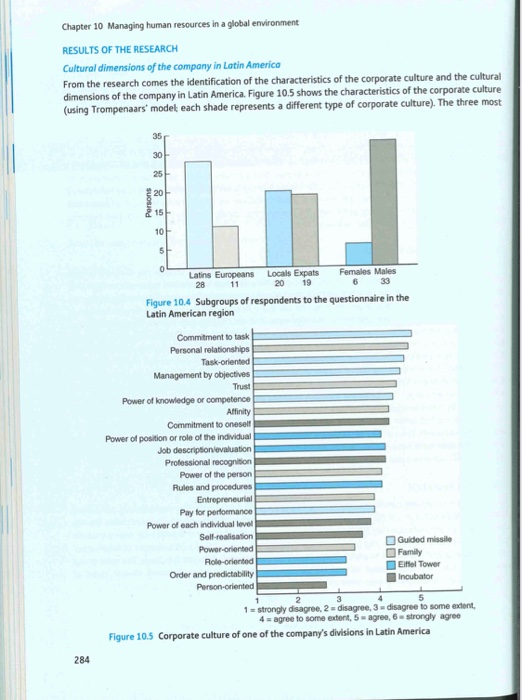
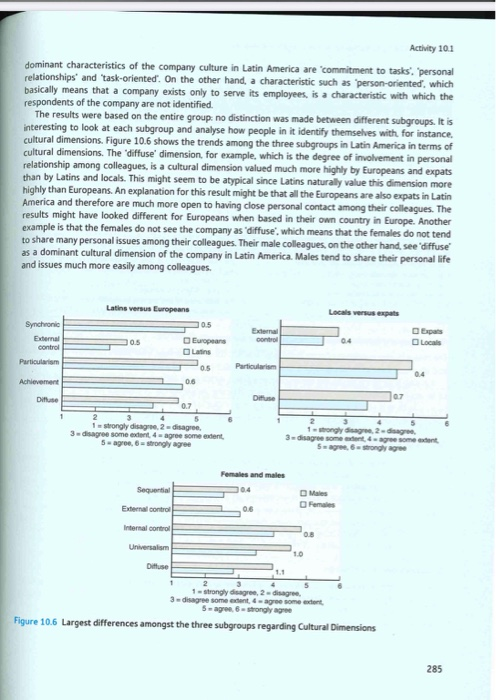
Chapter 10 Managing human resources in a global environment RESULTS OF THE RESEARCH Cultural dimensions of the company in Latin America From the research comes the identification of the characteristics of the corporate culture and the cultural dimensions of the company in Latin America. Figure 10.5 shows the characteristics of the corporate culture (using Trompenaars' modet each shade represents a different type of corporate culture). The three most 35 30 25 20 Persons 15 10 5 0 Latins Europeans Locals Expats Females Males 28 2019 33 Figure 10.4 Subgroups of respondents to the questionnaire in the Latin American region Commitment to task Personal relationships Task-oriented Management by objectives Trust Power of knowledge or competence Affinity Commitment to oneself Power of position or role of the individual Job description evaluation Professional recognition Power of the person Rules and procedures Entrepreneurial Pay for performance Power of each individual level Self-realisation Guided missile Power-oriented Family Role-oriented Eiffel Tower Order and predictability Incubator Person-oriented 5 1 = strongly disagree, 2 disagree, 3 disagree to some extent 4 = agree to some extent, 5 - agree, 6 strongly agree Figure 10.5 Corporate culture of one of the company's divisions in Latin America 284 Activity 101 dominant characteristics of the company culture in Latin America are commitment to tasks: personal relationships and task-oriented'. On the other hand, a characteristic such as person-oriented, which basically means that a company exists only to serve its employees, is a characteristic with which the respondents of the company are not identified. The results were based on the entire group: no distinction was made between different subgroups. It is interesting to look at each subgroup and analyse how people in it identify themselves with for instance, cultural dimensions. Figure 10.6 shows the trends among the three subgroups in Latin America in terms of cultural dimensions. The 'diffuse' dimension, for example, which is the degree of involvement in personal relationship among colleagues, is a cultural dimension valued much more highly by Europeans and expats than by Latins and locals. This might seem to be atypical since Latins naturally value this dimension more highly than Europeans. An explanation for this result might be that all the Europeans are also expats in Latin America and therefore are much more open to having close personal contact among their colleagues. The results might have looked different for Europeans when based in their own country in Europe. Another example is that the females do not see the company as diffuse', which means that the females do not tend to share many personal issues among their colleagues. Their male colleagues, on the other hand, see diffuse' as a dominant cultural dimension of the company in Latin America. Males tend to share their personal life and issues much more easily among colleagues, Latina versus European Locals versus pats 10.5 Synchronic External control Particularis Excel control Espais Locais 0.5 European Latins 0.5 Particularis 0.4 Achievement 0.6 Diffuse Difuse 0.7 6 1 1 strongly disagree 2 disagree 3.disagree some extent agree some extent sagree, 6 strongly agree 2 1 gydag, 2-diagra 3.disagre some detare some extent Se strongly agree Females and males Sequential External control Internal control Males Female 0.6 Universal 1.0 Diffuse 5 1 strongly disagree 2 disagree 3-disagree some extent are some extent Sagres strongly agree Figure 10.6 Largest differences amongst the three subgroups regarding Cultural Dimensions 285 1. Look at Chapter 5 for a description of Trompenaars' seven dimensions, and then examine how the author in his case study describes the results for the 'diffuse' dimension with regard to the three sub- groups (Figure 10.6). 2. Do the same analysis for the two dimensions 'external control and particularism', using the informa- tion given in Figure 10.6 and Trompenaars' definitions of these dimensions