Question: chapter 11 closing case CASE DISCUSSION QUESTIONS 1. Why do you think Apotheker was so eager to make an acquisition 2. Why do most acquisitions
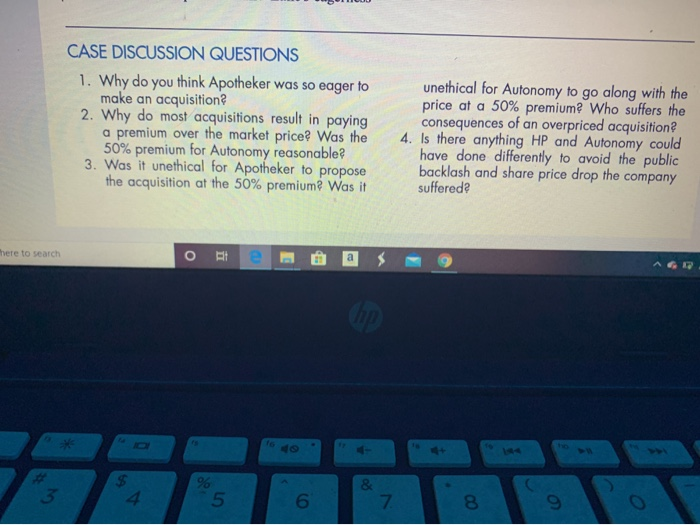
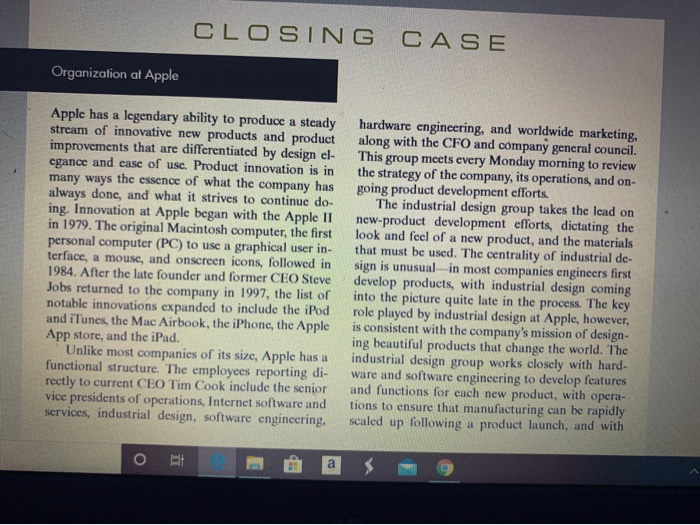
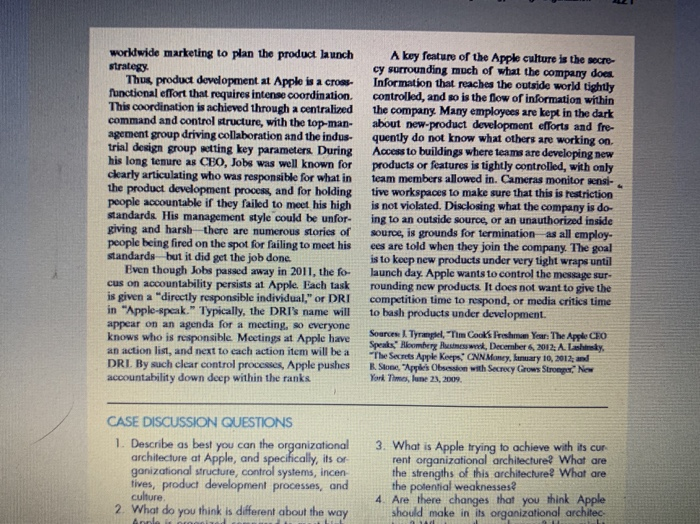
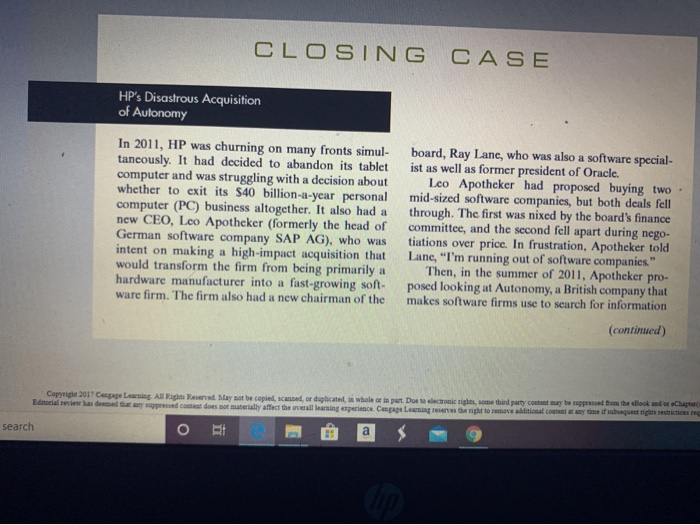
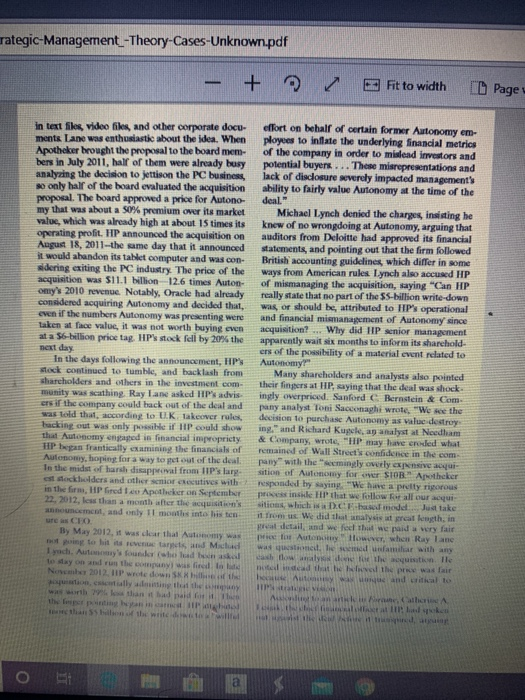
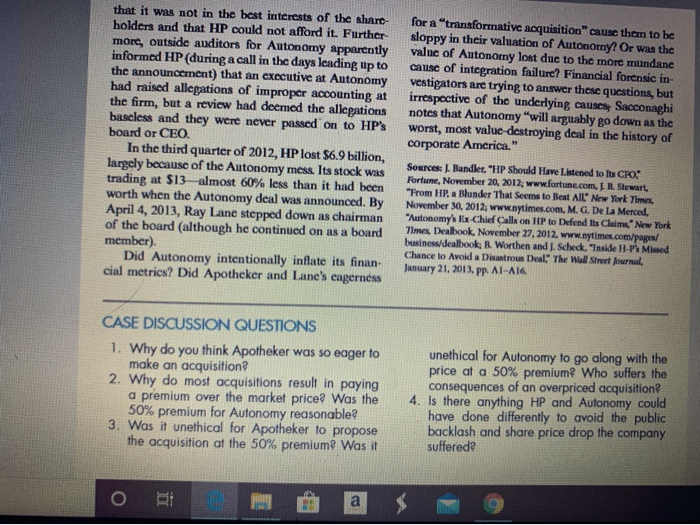
CASE DISCUSSION QUESTIONS 1. Why do you think Apotheker was so eager to make an acquisition 2. Why do most acquisitions result in paying a premium over the market price? Was the 50% premium for Autonomy reasonable? 3. Was it unethical for Apotheker to propose the acquisition at the 50% premium Was it unethical for Autonomy to go along with the price at a 50% premium? Who suffers the consequences of an overpriced acquisition 4. Is there anything HP and Autonomy could have done differently to avoid the public backlash and share price drop the company sufferede there to search OPE $ % 3 5 6 7 8 9. CLOSING CASE Organization at Apple Apple has a legendary ability to produce a steady stream of innovative new products and product improvements that are differentiated by design el- egance and ease of use. Product innovation is in many ways the essence of what the company has always done, and what it strives to continue do- ing. Innovation at Apple began with the Apple II in 1979. The original Macintosh computer, the first personal computer (PC) to use a graphical user in- terface, a mouse, and onscreen icons, followed in 1984. After the late founder and former CEO Steve Jobs returned to the company in 1997, the list of notable innovations expanded to include the iPod and iTunes, the Mac Airbook, the iPhone, the Apple App store, and the iPad. Unlike most companies of its size, Apple has a functional structure. The employees reporting di- rectly to current CEO Tim Cook include the senior vice presidents of operations, Internet software and services, industrial design, software engineering, hardware engineering, and worldwide marketing, along with the CFO and company general council. This group meets every Monday morning to review the strategy of the company, its operations, and on- going product development efforts. The industrial design group takes the lead on new-product development efforts, dictating the look and feel of a new product, and the materials that must be used. The centrality of industrial de sign is unusual in most companies engineers first develop products, with industrial design coming into the picture quite late in the process. The key role played by industrial design at Apple, however, is consistent with the company's mission of design- ing beautiful products that change the world. The industrial design group works closely with hard- ware and software engineering to develop features and functions for each new product, with opera- tions to ensure that manufacturing can be rapidly scaled up following a product launch, and with o RE worldwide marketing to plan the product launch strategy Thus, product development at Apple is a cross- functional effort that requires intense coordination This coordination is achieved through a centralized command and control structure, with the top-man- agement group driving collaboration and the indus- trial design group setting key parameters. During his long tenure as CEO, Jobs was well known for clearly articulating who was responsible for what in the product development process, and for holding people accountable if they failed to meet his high standards. His management style could be unfor- giving and harsh there are numerous stories of people being fired on the spot for failing to meet his standards but it did get the job done. Even though Jobs passed away in 2011, the fo- cus on accountability persists at Apple. Each task is given a "directly responsible individual," or DRI in "Apple-speak." Typically, the DRI's name will appear on an agenda for a meeting, so everyone knows who is responsible Meetings at Apple have an action list, and next to each action item will be a DRL By such clear control processes, Apple pushes accountability down deep within the ranks A key feature of the Apple culture is the secre- cy surrounding much of what the company doa Information that reaches the outside world tightly controlled, and so is the flow of information within the company. Many employees are kept in the dark about new-product development efforts and fre- quently do not know what others are working on Access to buildings where teams are developing new products or features is tightly controlled, with only team members allowed in. Cameras monitor sensi- tive workspaces to make sure that this is restriction is not violated. Disclosing what the company is do- ing to an outside source, or an unauthorized inside souros, is grounds for termination as all employ- ees are told when they join the company. The goal is to keep new products under very tight wraps until Jaunch day. Apple wants to control the message sur- rounding new products. It does not want to give the competition time to respond, or media critics time to bash products under development. Sources: I Tyrantel, Tim Cook's Freshman Year: The Apple CEO Speaks loomberg Husnew, December 6, 2012: A. Lanky "The Secrets Apple Keeps CNN Money, Knuary 10, 2012, and B. Stone, Apple's Obsession with Secrecy Grows Stronger, Now York Times, June 23, 2009 CASE DISCUSSION QUESTIONS 1. Describe as best you can the organizational architecture at Apple, and specifically, its or ganizational structure, control systems, incen tives, product development processes, and culture 2. What do you think is different about the way 3. What is Apple trying to achieve with its cur rent organizational architecture? What are the strengths of this architecture? What are the potential weaknesses 4. Are there changes that you think Apple should make in its organizational architec Anal CLOSING CASE HP's Disastrous Acquisition of Autonomy In 2011, HP was churning on many fronts simul- taneously. It had decided to abandon its tablet computer and was struggling with a decision about whether to exit its $40 billion-a-year personal computer (PC) business altogether. It also had a new CEO, Leo Apotheker (formerly the head of German software company SAP AG), who was intent on making a high-impact acquisition that would transform the firm from being primarily a hardware manufacturer into a fast-growing soft- ware firm. The firm also had a new chairman of the board, Ray Lane, who was also a software special- ist as well as former president of Oracle. Leo Apotheker had proposed buying two mid-sized software companies, but both deals fell through. The first was nixed by the board's finance committee, and the second fell apart during nego- tiations over price. In frustration, Apotheker told Lane, I'm running out of software companies." Then, in the summer of 2011, Apotheker pro- posed looking at Autonomy, a British company that makes software firms use to search for information (continued) Copyright 2017 Ceppe Learning All Rights Reserved. May not be copied, scanned or duplicated, is whole or input. Dostoelectronic rights, somethird party content may be suppressed from the Book and Chapter Editorial view has dead at y suppressed content does not materially affect the overall learning experience. Canape Leaves the right to remove additional content at any time i bequest rights restrictions de search o a rategic-Management -Theory-Cases-Unknown.pdf . + Fit to width O Page in text files, video files, and other corporate docu effort on behalf of certain former Autonomy em- ments Lane was enthusiastic about the idea. When ployees to inflate the underlying financial metrics Apotheker brought the proposal to the board mem of the company in order to mislead investors and bers in July 2011, hall of them were already busy potential buyers... These misrepresentations and analyzing the decision to jettison the PC business, lack of disclosure severely impacted management's se only half of the board evaluated the acquisition ability to fairly value Autonomy at the time of the proposal. The board approved a price for Autono- deal." my that was about a 50% premium over its market Michael Lynch denied the charges, insisting he value, which was already high at about 15 times its knew of no wrongdoing at Autonomy, arguing that operating profit. HP announced the acquisition on auditors from Deloitte had approved its financial August 18, 2011-the same day that it announced statements, and pointing out that the firm followed it would abandon its tablet computer and was con British accounting guidelines, which differ in some sidering exiting the PC industry. The price of the ways from American rules. Lynch also accused HP acquisition was $11.1 billion 12.6 times Auton of mismanaging the acquisition, saying "Can HP omys 2010 revenue. Notably, Oracle had already really state that no part of the 55-billion write-down considered acquiring Autonomy and decided that, was or should be attributed to HP's operational even if the numbers Autonomy was presenting were and financial mismanagement of Autonomy since taken at face value, it was not worth buying even acquisition? ... Why did HP senior management at a 56-billion price tag. HP's stock fell by 20% the apparently wait six months to inform its sharehold- next day ers of the possibility of a material event related to In the days following the announcement, HP Autonomy stock continued to tumble, and backlash from Many shareholders and analysts also pointed shareholders and others in the investment com their fingers at HP, saying that the deal was shock munity was scathing. Ray lane asked HIP's advis. ingly overpriced. Sanford Bernstein & Com ers in the company could hack out of the deal and pany analyst Toni Sacconaghi wrote, "We see the was told that according to UK takeover rules, decision to purchase Autonomy as value destroy hacking out was only possible if HP could show ing." and Richard Kugele, an analyst at Needham that Autonomy engaged in financial impropriety & Company, wrote, "HP may have crocled what HP began frantically examining the financials of remained of Wall Streets confidence in the com- Autonomy, hoping for a way to get out of the deals pany with the seemingly overly expensive acqui- In the midst of harsh disapproval from HIP's larg sition of Autonomy for over SIOB Apotheker est dockholders and other senior executives with responded by saying, "We have a pretty rigorous in the firm, HP fired 1 Apotheker on September prinsile HP that we follow it all our qui 22, 2012, less than a month after the acquisition's sitions, which hade Just take announcement, and only 11 months into his ten it from us. We did that analysis a great length, in ure CEO pre detail and we feel that we paid a very fair By May 2012, it was clear that Automy was price for Auto However, when Ray Lane not poing to hit it was Mad was one is familiar with any Iyachi Auto's four child baske cash flow and the acquisitille to say on and on the company was fired dead the love the pre was air Nober 2012. HIP wrote down Hit and critical to posto, escally in that the 1 VE ACA yang ten that both writed th, O BE a that it was not in the best interests of the share- holders and that HP could not afford it. Further more, outside auditors for Autonomy apparently informed HP (during a call in the days leading up to the announcement) that an executive at Autonomy had raised allegations of improper accounting at the firm, but a review had deemed the allegations baseless and they were never passed on to HP's board or CEO In the third quarter of 2012, HP lost $6.9 billion, largely because of the Autonomy mess. Its stock was trading at $13 almost 60% less than it had been worth when the Autonomy deal was announced. By April 4, 2013, Ray Lane stepped down as chairman of the board (although he continued on as a board member) Did Autonomy intentionally inflate its finan- cial metrics? Did Apotheker and Lane's eagerness for a transformative acquisition" cause them to be sloppy in their valuation of Autonomy? Or was the value of Autonomy lost due to the more mundane cause of integration failure? Financial forensic in- vestigators are trying to answer these questions, but irrespective of the underlying causes, Sacconaghi notes that Autonomy"will arguably go down as the worst, most value destroying deal in the history of corporate America." Sources: L Bandler. "HP Should Have Listened to its CFO, Fortume, November 20, 2012, www.fortune.com, LB. Stewart, "From HP, a Blunder That Seems to Beat All New York Times, November 30, 2012, www.nytimes.com, M. G. De La Merced. Autonomy. Rx-Chief Calls on HP to Defend Its Claims, New York Times Dealbook, November 27, 2012. www.nytimes.com/pages/ business/dealbook, R. Worthen and J. Scheck. "Inside H-P's Missed Chance to Avoid a Disastrous Deal." The Wall Street Journal January 21, 2013. pp. Al-A16. CASE DISCUSSION QUESTIONS 1. Why do you think Apotheker was so eager to make an acquisition 2. Why do most acquisitions result in paying a premium over the market price? Was the 50% premium for Autonomy reasonable 3. Was it unethical for Apotheker to propose the acquisition at the 50% premium? Was it unethical for Autonomy to go along with the price at a 50% premium? Who suffers the consequences of an overpriced acquisition 4. Is there anything HP and Autonomy could have done differently to avoid the public backlash and share price drop the company sufferede o









 Study Help