





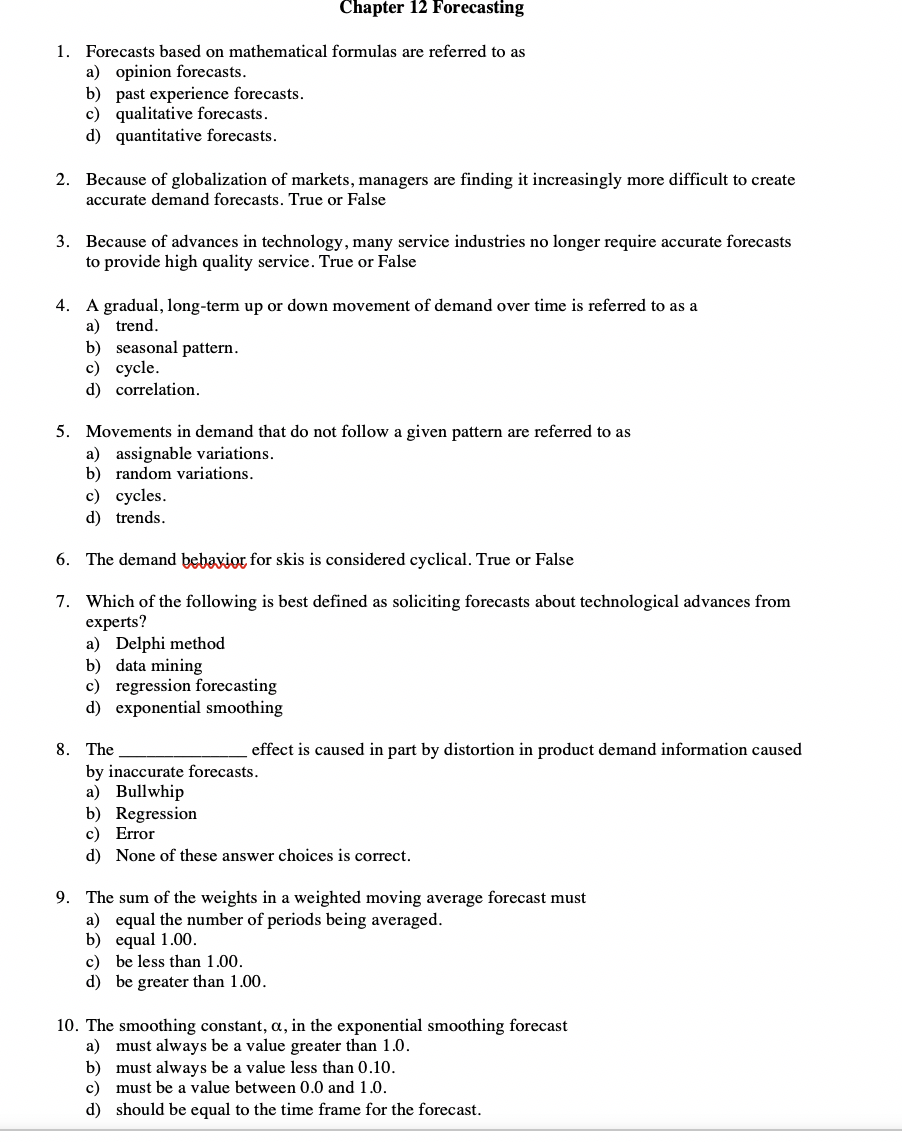
Question: Chapter 12 Forecasting 1. Forecasts based on mathematical formulas are referred to as a) opinion forecasts. b) past experience forecasts. c) qualitative forecasts. d) quantitative
Chapter 12 Forecasting 1. Forecasts based on

Chapter 12 Forecasting 1. Forecasts based on mathematical formulas are referred to as a) opinion forecasts. b) past experience forecasts. c) qualitative forecasts. d) quantitative forecasts. 2. Because of globalization of markets, managers are finding it increasingly more difficult to create accurate demand forecasts. True or False 3. Because of advances in technology, many service industries no longer require accurate forecasts to provide high quality service. True or False 4. A gradual, long-term up or down movement of demand over time is referred to as a a) trend. b) seasonal pattern. c) cycle. d) correlation. 5. Movements in demand that do not follow a given pattern are referred to as a) assignable variations. b) random variations. c) cycles. d) trends. 6. The demand behavior for skis is considered cyclical. True or False 7. Which of the following is best defined as soliciting forecasts about technological advances from experts? a) Delphi method b) data mining c) regression forecasting d) exponential smoothing 8. The effect is caused in part by distortion in product demand information caused by inaccurate forecasts. a) Bullwhip b) Regression c) Error d) None of these answer choices is correct. 9. The sum of the weights in a weighted moving average forecast must a) equal the number of periods being averaged. b) equal 1.00. c) be less than 1.00. d) be greater than 1.00. 10. The smoothing constant, a, in the exponential smoothing forecast a) must always be a value greater than 1.0. b) must always be a value less than 0.10. c) must be a value between 0.0 and 1.0. d) should be equal to the time frame for the forecast

Step by Step Solution

There are 3 Steps involved in it

1 Expert Approved Answer
Step: 1 Unlock blur-text-image

Question Has Been Solved by an Expert!

Get step-by-step solutions from verified subject matter experts

Step: 2 Unlock
Step: 3 Unlock

Students Have Also Explored These Related General Management Questions!