







Question: Chapter 13 Discussion - Third Party Beneficiary Please read CASE 13-3: Lawrence v. Fox , 20 N.Y. 268 (1859). (Page 293 in textbook) Answer the
Chapter 13 Discussion - Third Party Beneficiary
Please read CASE 13-3: Lawrence v. Fox, 20 N.Y. 268 (1859). (Page 293 in textbook)
Answer the following Critical Thinking Question: Form an opinion about the contemporary relevance of this ruling. How does this type of process aid our legal system? Please remember to define the following terms: creditor beneficiary, promisee and promisor.
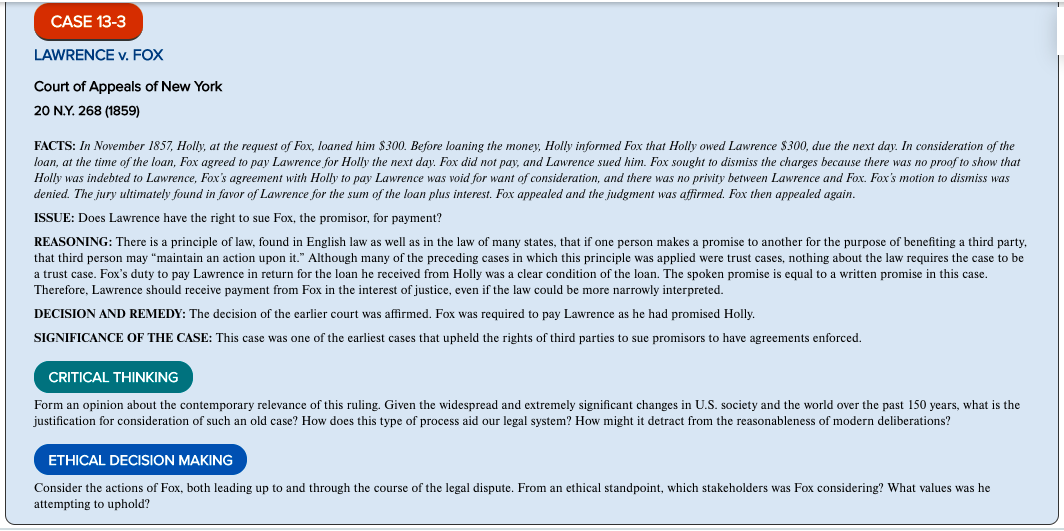
CASE 13-3 LAWRENCE v. FOX Court of Appeals of New York 20 N.Y. 268 (1859) FACTS: In November 1857, Holly, at the request of Fox, loaned him $300. Before loaning the money, Holly informed Fox that Holly owed Lawrence $300, due the next day. In consideration of the loan, at the time of the loan, Fox agreed to pay Lawrence for Holly the next day. Fox did not pay, and Lawrence sued him. Fox sought to dismiss the charges because there was no proof to show that Holly was indebted to Lawrence, Fox's agreement with Holly to pay Lawrence was void for want of consideration, and there was no privity between Lawrence and Fox. Fox's motion to dismiss was denied. The jury ultimately found in favor of Lawrence for the sum of the loan plus interest. Fox appealed and the judgment was affirmed. Fox then appealed again. ISSUE: Does Lawrence have the right to sue Fox, the promisor, for payment? REASONING: There is a principle of law, found in English law as well as in the law of many states, that if one person makes a promise to another for the purpose of benefiting a third party, that third person may "maintain an action upon it." Although many of the preceding cases in which this principle was applied were trust cases, nothing about the law requires the case to be a trust case. Fox's duty to pay Lawrence in return for the loan he received from Holly was a clear condition of the loan. The spoken promise is equal to a written promise in this case. Therefore, Lawrence should receive payment from Fox in the interest of justice, even if the law could be more narrowly interpreted. DECISION AND REMEDY: The decision of the earlier court was affirmed. Fox was required to pay Lawrence as he had promised Holly. SIGNIFICANCE OF THE CASE: This case was one of the earliest cases that upheld the rights of third parties to sue promisors to have agreements enforced. CRITICAL THINKING Form an opinion about the contemporary relevance of this ruling. Given the widespread and extremely significant changes in U.S. society and the world over the past 150 years, what is the justification for consideration of such an old case? How does this type of process aid our legal system? How might it detract from the reasonableness of modern deliberations? ETHICAL DECISION MAKING Consider the actions of Fox, both leading up to and through the course of the legal dispute. From an ethical standpoint, which stakeholders was Fox considering? What values was he attempting to upholdStep by Step Solution
There are 3 Steps involved in it
1 Expert Approved Answer
Step: 1 Unlock

Question Has Been Solved by an Expert!
Get step-by-step solutions from verified subject matter experts
Step: 2 Unlock
Step: 3 Unlock
 Study Help